

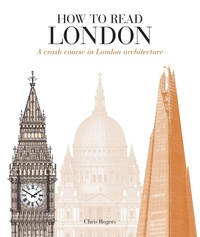
How to Read London
A crash course in London architecture
Published on 6. April 2017
Book
Paperback/Softback
256 pages
978-1-78240-452-1 (ISBN)
Description
Over 2,000 years of settlement give London its unique architectural heritage. Unlike Haussmann's Paris, neither monarch nor politician imposed their will; private ownership and enterprise shaped the city and defined its parts. Elegant West End squares and crescents hallmark the Classical townscape that emerged between 1600 and 1830, but medieval, Tudor and Victorian enclaves identified by occupation, class or guild make their own design statement, notably in the City and East End. From its renewal after the Great Fire of 1666 as a centre of commerce, culture, finance and as a railway hub, the seat of power and law, How to Read London reveals through the built environment how London's domestic, civic and commercial landscape has evolved and adapted from imperial capital to global city.
Reviews / Votes
"A superbly illustrated crash course on metropolitan architecture." * This England * "The perfect companion for anyone who walks the capital, or anyone interested in London's architectural history." * The London Society * "How to Read London comes in handy. It's divided into seven time periods, with nifty diagrams, clear explanations of what you're seeing and details of dates, architects and engineers." * Daily Telegraph *More details
Series
Language
English
Place of publication
United Kingdom
Publishing group
Quarto Publishing PLC
Product notice
Paperback (trade)
Illustrations
Full colour throughout
Dimensions
Height: 164 mm
Width: 139 mm
Thickness: 22 mm
Weight
391 gr
ISBN-13
978-1-78240-452-1 (9781782404521)
Copyright in bibliographic data and cover images is held by Nielsen Book Services Limited or by the publishers or by their respective licensors: all rights reserved.
Schweitzer Classification
Other editions
New editions
Book
approx. 01/2027
Ivy Press
€16.50
Not yet published
Person
Chris Rogers writes on architecture and visual culture, informed by twenty years of investigation, research and conversations with practitioners. He creates and leads architectural tours, often working closely with architects, and is the author of The Power of Process: The Architecture of Michael Pearson (2010) and How to Read Paris (2016).