

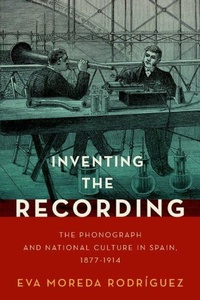
Inventing the Recording
The Phonograph and National Culture in Spain, 1877-1914
Published on 8. October 2021
Book
Hardback
240 pages
978-0-19-755206-3 (ISBN)
Description
Inventing the Recording focuses on the decades in which recorded sound went from a technological possibility to a commercial and cultural artefact. Through the analysis of a specific and unique national context, author Eva Moreda Rodriguez tells the stories of institutions and individuals in Spain and discusses the development of discourses and ideas in close connection with national concerns and debates, all while paying close attention to original recordings from this era.
The book starts with the arrival in Spain of notices about Edison's invention of the phonograph in 1877, followed by the first demonstrations of the invention (1878-1882) by scientists and showmen. These demonstrations greatly stimulated the imagination of scientists, journalists and playwrights, who spent the rest of the 1880s speculating about the phonograph and its potential to revolutionize society once it was properly developed and marketed. The book then moves on to analyse the 'traveling phonographs' and salones fonograficos of the 1890s and early 1900s, with phonographs being paraded around Spain and exhibited in group listening sessions in theatres, private homes and social spaces pertaining to different social classes. Finally, the book covers the development of an indigenous recording industry dominated by the so-called gabinetes fonograficos, small businesses that sold imported phonographs, produced their own recordings, and shaped early discourses about commercial phonography and the record as a commodity between 1896 and 1905.
The book starts with the arrival in Spain of notices about Edison's invention of the phonograph in 1877, followed by the first demonstrations of the invention (1878-1882) by scientists and showmen. These demonstrations greatly stimulated the imagination of scientists, journalists and playwrights, who spent the rest of the 1880s speculating about the phonograph and its potential to revolutionize society once it was properly developed and marketed. The book then moves on to analyse the 'traveling phonographs' and salones fonograficos of the 1890s and early 1900s, with phonographs being paraded around Spain and exhibited in group listening sessions in theatres, private homes and social spaces pertaining to different social classes. Finally, the book covers the development of an indigenous recording industry dominated by the so-called gabinetes fonograficos, small businesses that sold imported phonographs, produced their own recordings, and shaped early discourses about commercial phonography and the record as a commodity between 1896 and 1905.
More details
Series
Language
English
Place of publication
New York
United States
Target group
Professional and scholarly
Product notice
sewn/stitched
Cloth over boards
Illustrations
4 tables
Dimensions
Height: 241 mm
Width: 160 mm
Thickness: 15 mm
Weight
544 gr
ISBN-13
978-0-19-755206-3 (9780197552063)
Copyright in bibliographic data and cover images is held by Nielsen Book Services Limited or by the publishers or by their respective licensors: all rights reserved.
Schweitzer Classification
Other editions
Additional editions
E-Book
05/2021
OUP eBook
€43.49
Available for download
E-Book
05/2021
OUP eBook
€43.49
Available for download
Person
Eva Moreda Rodriguez is Senior Lecturer in Musicology at the University of Glasgow. A specialist in the political and cultural history of music in modern Spain, she is the author of Music and Exile in Francoist Spain (Ashgate, 2015), Music Criticism and Music Critics in Early Francoist Spain (Oxford University Press, 2016), and numerous articles and book chapters. In 2018-19 she held a Leadership Fellowship from the Arts and Humanities Research Council (AHRC), and her work has also received funding from the Carnegie Trust for the Universities of Scotland, the British Academy, and the Leverhulme Trust.
Content
Acknowledgements
Introduction
Chapter 1: Imagining the phonograph, 1877-1888
Chapter 2: Travelling phonographs, 1888-1900
Chapter 3: Inventing the recording: gabinetes fonograficos and early commercial phonography in Madrid, 1896-1905
Chapter 4: Science, urban space and early phonography in Barcelona, 1898-1914
Chapter 5: Gabinetes fonograficos in Valencia, 1899-1901
Chapter 6: (Dis)embodied voices: recording singers, 1896-1914
Chapter 7: Consuming and collecting records in Spain, 1896-1905
Conclusion
Table 1
Table 2
Table 3
Table 4
Bibliography
Introduction
Chapter 1: Imagining the phonograph, 1877-1888
Chapter 2: Travelling phonographs, 1888-1900
Chapter 3: Inventing the recording: gabinetes fonograficos and early commercial phonography in Madrid, 1896-1905
Chapter 4: Science, urban space and early phonography in Barcelona, 1898-1914
Chapter 5: Gabinetes fonograficos in Valencia, 1899-1901
Chapter 6: (Dis)embodied voices: recording singers, 1896-1914
Chapter 7: Consuming and collecting records in Spain, 1896-1905
Conclusion
Table 1
Table 2
Table 3
Table 4
Bibliography