

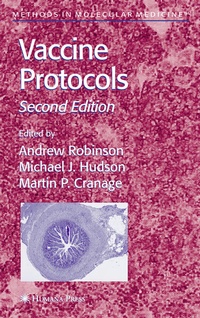
Vaccine Protocols
Second Edition
2nd Edition
Published on 27. August 2003
Book
Hardback
XII, 416 pages
978-1-58829-140-0 (ISBN)
Description
Vaccine research and development is advancing at an unprecedented pace, with an increasing emphasis on rational design based upon a fundamental und- standing of the underlying molecular mechanisms. The aim of this volume is to provide a selection of contemporary protocols that will be useful to both novice and advanced practitioner alike. The variety of procedures required to design, develop, produce, and assess a vaccine is immense and covers aspects of ch- istry, biochemistry, molecular biology, cell biology, and immunology. No single volume can hope to cover these topics exclusively. Rather, here we attempt to provide a methods sourcebook focusing on hands-on practical advice. Comp- mentary and background information may be found in other volumes in the Me- ods in Molecular Medicine series. Of particular interest are volumes on Dendritic Cell Protocols, Interleukin Protocols, Vaccine Adjuvants, and DNA Vaccines. Since the publication of the first edition of Vaccine Protocols there have been major advances, particularly in the areas of bacterial genomics, antig- specific T-cell quantification, genetic manipulation of vaccine vectors, the h- nessing of natural molecules concerned with the regulation of immune responses, and the burgeoning field of DNA vaccinology. Hence, the extensive revision of this edition with new chapters on live viral vaccine vectors, atte- ated bacterial vectors, immunomodulators, MHC-peptide tetrameric complexes, and the identification of vaccine candidates by genomic analysis. Additionally, chapters from the first edition have been updated to accommodate state-of-t- art methods in vaccinology.
Reviews / Votes
"This manual serves as a valuable guide to the process of designing, producing and assessing vaccines used against infectious agents including viruses, bacteria and parasites. This book would most benefit scientists involved in the research and development associated with vaccine technology. It also would be most useful to those new to the field of vaccine formulation and production. Health and science libraries supporting research institutions, government agencies, academic and corporate entities involved in developing or producing vaccines will find this a valuable addition to the collection." -E-STREAMSFrom reviews of the first edition...
"...cover[s] concepts and protocols applicable to a wide range of vaccines and infectious diseases and cancer...brings together many protocols of value to research and development scientists involved in the vaccine technology area."
-Immunology and Cell Biology
"...a valuable basic reference manual of vaccine related laboratory procedures...strongest in the area of vaccine development and delivery technology...especially valuable to those new to the field of vaccine development and formulation."
-Doody's Health Sciences Book Review Journal
More details
Series
Edition
Second Edition 2003
Language
English
Place of publication
Totowa
United States
Target group
Professional and scholarly
Research
Product notice
sewn/stitched
Cloth over boards
Illustrations
XII, 416 p.
Dimensions
Height: 242 mm
Width: 162 mm
Thickness: 33 mm
Weight
784 gr
ISBN-13
978-1-58829-140-0 (9781588291400)
DOI
10.1385/1592593992
Schweitzer Classification
Other editions
Additional editions
Andrew P. Robinson | Martin P. Cranage | Michael J. Hudson
Vaccine Protocols
Book
11/2010
2nd Edition
Humana Press Inc.
€160.49
Shipment within 15-20 days
Previous edition

Andrew Robinson
Vaccine Protocols
Book
05/1996
Humana Press Inc.
€84.81
Article exhausted; check for reprint
Content
Overview of Vaccines.- Temperature-Sensitive Mutant Vaccines.- Live Viral Vectors.- Live Viral Vectors.- Live Viral Vectors.- Development of Attenuated Salmonella Strains That Express Heterologous Antigens.- Expression and Delivery of Heterologous Antigens Using Lactic Acid Bacteria.- Synthetic Peptides.- Genetic Detoxification of Bacterial Toxins.- Preparation of Polysaccharide-Conjugate Vaccines.- Adjuvant Formulations for Experimental Vaccines.- Incorporation of Immunomodulators into Plasmid DNA Vaccines.- Microencapsulation of Vaccine Antigens.- Lyophilization of Vaccines.- Stimulation of Mucosal Immunity.- Induction and Detection of T-Cell Responses.- Construction of MHC Class I-Peptide Tetrameric Complexes for Analysis of T-Cell-Mediated Immune Responses.- Assessment of Functional Antibody Responses.- The Use of Complete Genome Sequences in Vaccine Design.- Severe Combined Immunodeficient (SCID) Mice in Vaccine Assessment.- Clinical Trials.- Assuring the Quality and Safety of Vaccines.- DNA Vaccination.- From Vaccine Research to Manufacture.