

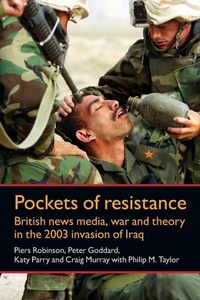
Pockets of Resistance
British News Media, War and Theory in the 2003 Invasion of Iraq
Published on 13. September 2010
Book
Paperback/Softback
224 pages
978-0-7190-8445-4 (ISBN)
Description
For scholars of media and war, the 2003 invasion of Iraq is a compelling case to study. As part of President Bush's 'war on terror', the invasion was the most controversial British foreign policy decision since Suez, and its ramifications and aftermath have rarely been far from the news. In the many political and public debates regarding this conflict, arguments over the role of the media have been omnipresent. For some, media coverage was biased against the war, for others it became a cheerleader for the invasion. Where does the truth lie? Drawing upon a uniquely-detailed and rich content and framing analysis of television and press coverage, and on interviews with some of the journalists involved, Pockets of Resistance provides an authoritative assessment of how British news media reported the 2003 Iraq invasion and also of the theoretical implications of this case for our understanding of wartime media-state relations.
Pockets of Resistance examines the successes and failures of British television news as it sought to attain independence under the difficult circumstances of war, and describes and explains the emergence of some surprisingly vociferous anti-war voices within a diverse national press. -- .
Pockets of Resistance examines the successes and failures of British television news as it sought to attain independence under the difficult circumstances of war, and describes and explains the emergence of some surprisingly vociferous anti-war voices within a diverse national press. -- .
Reviews / Votes
'Richly detailed and engagingly presented ... It is a "must read" for anyone who wants to know how the 24-7 news system covers national security crises, and why that coverage takes the shape that it does.''Pockets of Resistance ... intervenes into the heart of contemporary debates about media, democracy and legitimized killing and death. An important new landmark and essential vantage point on the contested field of media and war studies.'
'Pockets of Resistance is a first-rate study of Iraq war reporting - broad, rigorous and insightful in the way it surveys British coverage of the war. It paints a complex picture of war reporting that clarifies our understanding of the relation between media and political elites during wartime. Without a doubt, it is one of the most ambitious and important works published to date on media and war.' -- .
More details
Language
English
Place of publication
Manchester
United Kingdom
Target group
College/higher education
Professional and scholarly
Illustrations
Tables, black & white|Line drawings, black & white|Halftones, black & white
Dimensions
Height: 234 mm
Width: 156 mm
Thickness: 12 mm
Weight
351 gr
ISBN-13
978-0-7190-8445-4 (9780719084454)
Copyright in bibliographic data and cover images is held by Nielsen Book Services Limited or by the publishers or by their respective licensors: all rights reserved.
Schweitzer Classification
Other editions
Additional editions
Piers Robinson | Peter Goddard | Katy Parry
Pockets of Resistance
British News Media, War and Theory in the 2003 Invasion of Iraq
E-Book
05/2016
1st Edition
Manchester University Press
€37.99
Available for download
Piers Robinson | Peter Goddard | Katy Parry
Pockets of Resistance
British News Media, War and Theory in the 2003 Invasion of Iraq
E-Book
01/2013
11th Edition
Manchester University Press
€24.49
Available for download
Persons
Piers Robinson is Senior Lecturer in International Politics at the University of Manchester. Peter Goddard is Senior Lecturer in the Department of Communication and Media at the University of Liverpool. Katy Parry is Research Assistant in the Department of Communication and Media at the University of Liverpool. Craig Murray is head of Media Analysis at Opoint AS, Norway. Philip M. Taylor is Professor of Internal Communications at the Institute of Communication Studies, University of Leeds -- .
Content
Preface and acknowledgments
1. Introduction
2. Mobilising for battle: The news media and war from Vietnam to Iraq
3. Theorising and analysing media performance in wartime
4. Placing coverage of the invasion in context
5. 'Supporting our boys in battle': Evidence for supportive coverage and the elite-driven model
6. 'Independence, diversity and professional autonomy': Evidence for negotiated and oppositional coverage
7. Case studies from the invasion of Iraq: Jessica Lynch, Ali Abbas and the anti-war movement
8. Conclusion: Patterns of support, negotiation and opposition
Bibliography
Appendices:
A. Further information about the content and framing analysis
B. Examples of the detailed criteria provided to coders for assessing thematic frames -- .
1. Introduction
2. Mobilising for battle: The news media and war from Vietnam to Iraq
3. Theorising and analysing media performance in wartime
4. Placing coverage of the invasion in context
5. 'Supporting our boys in battle': Evidence for supportive coverage and the elite-driven model
6. 'Independence, diversity and professional autonomy': Evidence for negotiated and oppositional coverage
7. Case studies from the invasion of Iraq: Jessica Lynch, Ali Abbas and the anti-war movement
8. Conclusion: Patterns of support, negotiation and opposition
Bibliography
Appendices:
A. Further information about the content and framing analysis
B. Examples of the detailed criteria provided to coders for assessing thematic frames -- .