

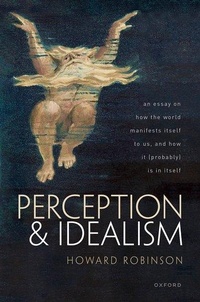
Perception and Idealism
An Essay on How the World Manifests Itself to Us, and How It (Probably) Is in Itself
Published on 17. November 2022
Book
Hardback
248 pages
978-0-19-284556-6 (ISBN)
Description
Perception and Idealism takes up two long-standing philosophical problems: how perception makes objects manifest to us, and what the world must be like for objects to be manifest in that way. Part I addresses the nature of perception. A detailed discussion of contemporary versions of naive realist and of intentionalist theories is provided, and refutations offered of both. Robinson argues that sense-datum theory is not subject to any of the vices normally attributed to it, but in fact allows one to say that we directly perceive objects as being the way that they naturally manifest themselves to creatures like us. The sense-datum theory can be reconciled with a form of direct realism, once one understands properly the cognitive and the phenomenal components in perception, a relationship which intentionalist theories confuse. As perception makes us aware of objects as they manifest themselves to us, this leaves open the question of what they are like in themselves. This is the topic of Part II. A variety of realist conceptions of the material world are considered and found to be either empty or less plausible than idealism: the 'powers' conception of matter, Lewis's quiddities, Esfeld's 'matter points', and quantum theory. The problem of giving a realist account of space is also developed. Turning to mentalist options, simple phenomenalism and panpsychism are discussed and rejected. Robinson concludes that Berkeley's theistic phenomenalism, or idealism, is the most plausible account.
Reviews / Votes
Robinson's book is clearly and beautifully written, and argumentatively persuasive ... a refreshing blast of curative air breathed into the dank enclosures of Direct Realism, Disjunctivism and Reductive Representationalism. * David Pitt, California State University, Los Angeles * Robinson argues for a kind of idealism, providing well-organized, well-documented discussions of both early modern and recent philosophers' views on the nature of perception and its relationship to the world. * Choice *More details
Language
English
Place of publication
Oxford
United Kingdom
Target group
Professional and scholarly
Dimensions
Height: 163 mm
Width: 242 mm
Thickness: 21 mm
Weight
518 gr
ISBN-13
978-0-19-284556-6 (9780192845566)
Copyright in bibliographic data and cover images is held by Nielsen Book Services Limited or by the publishers or by their respective licensors: all rights reserved.
Schweitzer Classification
Other editions
Additional editions
Howard Robinson
Perception and Idealism
An Essay on How the World Manifests Itself to Us, and How It (Probably) Is in Itself
E-Book
12/2022
1st Edition
OUP eBook
€49.99
Available for download
Howard Robinson
Perception and Idealism
An Essay on How the World Manifests Itself to Us, and How It (Probably) Is in Itself
E-Book
10/2022
1st Edition
OUP eBook
€49.99
Available for download
Person
Howard Robinson is Professor Emeritus in Philosophy at Central European University, Vienna. He is also Research Fellow at Blackfriars Hall, Oxford, and Senior Fellow, Rutgers Center for Philosophy of Religion. He was educated at Manchester Grammar School and Corpus Christi College, Oxford. He previously held positions at the University of Nottingham, Oriel College, Oxford, University of Liverpool, and Eoetvoes Lorand University, Budapest.
Content
Introduction
Part I: How the World Manifests Itself to Us
1: The Causal Argument for Sense-Data, 'Philosophers' Hallucinations', and the Disjunctive Response
2: Naive Realism and the Argument from Illusion
3: Intentionality and Perception (I): The Fundamental irrelevance of Intentionality to Phenomenal Consciousness
4: Intentionality and Perception (II): Attempts to Articulate the 'Content' and 'Object' Distinction
5: Singular Reference and its Relation to Intentionality
6: Objectivity: How is It Possible?
7: Semantic Direct Realism, Critical Realism, and the Sense-Datum Theory
8: Building the Manifest World
Part II: What the World Is, in Itself
9: The Problematic Nature of the Modern Conception of Matter
10: Two Suggestive Berkeleyan Arguments
11: Bishop Berkeley and John Foster on Problems with Physical Realism about Space
12: Mentalist Alternatives to Berkeleyan Theism, and their Failure
General Conclusion
Part I: How the World Manifests Itself to Us
1: The Causal Argument for Sense-Data, 'Philosophers' Hallucinations', and the Disjunctive Response
2: Naive Realism and the Argument from Illusion
3: Intentionality and Perception (I): The Fundamental irrelevance of Intentionality to Phenomenal Consciousness
4: Intentionality and Perception (II): Attempts to Articulate the 'Content' and 'Object' Distinction
5: Singular Reference and its Relation to Intentionality
6: Objectivity: How is It Possible?
7: Semantic Direct Realism, Critical Realism, and the Sense-Datum Theory
8: Building the Manifest World
Part II: What the World Is, in Itself
9: The Problematic Nature of the Modern Conception of Matter
10: Two Suggestive Berkeleyan Arguments
11: Bishop Berkeley and John Foster on Problems with Physical Realism about Space
12: Mentalist Alternatives to Berkeleyan Theism, and their Failure
General Conclusion