

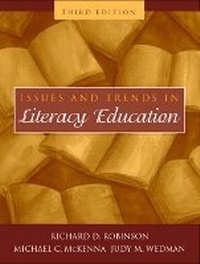
Issues and Trends in Literacy Education
3rd Edition
Published on 3. February 2004
Book
Paperback/Softback
336 pages
978-0-205-36110-6 (ISBN)
Description
Designed as a supplementary text for undergraduate- and graduate-level courses in Reading Methods, Literacy Methods, and Language Arts taught in departments of education. This issues text presents current information on critical trends and developments in literacy education to help students become well versed in reading education in order to choose and articulate their own informed approach to reading education.
More details
Edition
3rd edition
Language
English
Place of publication
United States
Publishing group
Pearson Education (US)
Target group
Professional and scholarly
Dimensions
Height: 235 mm
Width: 178 mm
Weight
531 gr
ISBN-13
978-0-205-36110-6 (9780205361106)
Copyright in bibliographic data and cover images is held by Nielsen Book Services Limited or by the publishers or by their respective licensors: all rights reserved.
Schweitzer Classification
Other editions
New editions
Richard D. Robinson | Michael C. McKenna
Issues and Trends in Literacy Education
Book
07/2007
4th Edition
Pearson
€76.91
Article exhausted; check for reprint
Previous edition
Richard D. Robinson | Judy M. Wedman
Issues and Trends in Literacy Education
Book
10/2000
2nd Edition
Pearson
€49.68
Article exhausted; check for reprint
Content
Preface.
Introduction to the Field of Literacy Education.
1. Teacher Education in Literacy.
Reading Teacher Education in the Next Millennium: What Your Grandmother's Teacher Didn't Know That Your Granddaughter's Should,James Hoffman and P. David Pearson.
2. Early Literacy Intervention.
One Down and 80,000 to Go: Word Recognition Instruction in the Primary Grades, Connie Juel and Cecila Minden-Cupp.
Teaching All Children to Read, David R. Denton.
Developing and Supporting Literacy-Rich Environments for Children, Jerlean Daniel, Theresa Clarke and Mark Ouellette.
3. Family Literacy.
Family School Partnerships: Essential Elements of Literacy Instruction in the United States, International Reading Association.
Loss of Family Languages: Should Educators Be Concerned?, Lily Wong Fillmore.
4. Multicultural Education.
Teaching and Learning About Cultural Diversity: A Dose of Empathy,Howard Miller.
Listening to Inner City Teachers of English Language Learners: Differentiating Literacy Instruction, Laurie Mac Gillivray and Robert Ruda.
English Learners Reading English: What We Know, What We Need to Know, Suzanne Peregoy and Owen Boyle.
5. Comprehension.
Improving the Reading Comprehension of America's Children, Center For the Improvement of Early Reading Achievement.
Comprehension Strategies Instruction: A Turn-of-the-Century Statue Report, Michael Pressley.
6. Adolescent Literacy.
Reinventing Adolescent Literacy For New Times: Perennial and Millennial Issues, Elizabeth Birr Moje, Josephine Young, John Readence and David Moore.
Effective Literacy Instruction for Adolescent, Donna Alvermann.
7. Writing.
Issues and Trends in Writing Instruction, Michael Moore.
Reading... with Pen in Hand!, Sharon Skeans.
8. Reading Assessment.
High-stakes Assessment in Reading, International Reading Association.
High-stakes Testing in Reading? Today in Texas, Tomorrow?, James Hoffman, Lori Assaf, and Scott Paris.
9. Technology.
Effective Use of Technology in Literacy Instruction, Michael McKenna, Linda Labbo, and David Reinking.
10. Scientific Based Research.
What I Have Learned Up Until Now About Research Methods In Reading Education, Michael Pressley.
Index.
Introduction to the Field of Literacy Education.
1. Teacher Education in Literacy.
Reading Teacher Education in the Next Millennium: What Your Grandmother's Teacher Didn't Know That Your Granddaughter's Should,James Hoffman and P. David Pearson.
2. Early Literacy Intervention.
One Down and 80,000 to Go: Word Recognition Instruction in the Primary Grades, Connie Juel and Cecila Minden-Cupp.
Teaching All Children to Read, David R. Denton.
Developing and Supporting Literacy-Rich Environments for Children, Jerlean Daniel, Theresa Clarke and Mark Ouellette.
3. Family Literacy.
Family School Partnerships: Essential Elements of Literacy Instruction in the United States, International Reading Association.
Loss of Family Languages: Should Educators Be Concerned?, Lily Wong Fillmore.
4. Multicultural Education.
Teaching and Learning About Cultural Diversity: A Dose of Empathy,Howard Miller.
Listening to Inner City Teachers of English Language Learners: Differentiating Literacy Instruction, Laurie Mac Gillivray and Robert Ruda.
English Learners Reading English: What We Know, What We Need to Know, Suzanne Peregoy and Owen Boyle.
5. Comprehension.
Improving the Reading Comprehension of America's Children, Center For the Improvement of Early Reading Achievement.
Comprehension Strategies Instruction: A Turn-of-the-Century Statue Report, Michael Pressley.
6. Adolescent Literacy.
Reinventing Adolescent Literacy For New Times: Perennial and Millennial Issues, Elizabeth Birr Moje, Josephine Young, John Readence and David Moore.
Effective Literacy Instruction for Adolescent, Donna Alvermann.
7. Writing.
Issues and Trends in Writing Instruction, Michael Moore.
Reading... with Pen in Hand!, Sharon Skeans.
8. Reading Assessment.
High-stakes Assessment in Reading, International Reading Association.
High-stakes Testing in Reading? Today in Texas, Tomorrow?, James Hoffman, Lori Assaf, and Scott Paris.
9. Technology.
Effective Use of Technology in Literacy Instruction, Michael McKenna, Linda Labbo, and David Reinking.
10. Scientific Based Research.
What I Have Learned Up Until Now About Research Methods In Reading Education, Michael Pressley.
Index.