

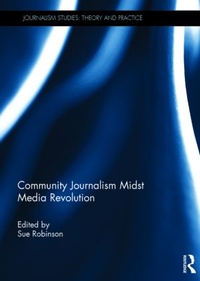
Community Journalism Midst Media Revolution
1st Edition
Published on 21. November 2014
Book
Hardback
146 pages
978-1-138-81106-5 (ISBN)
Description
This edited volume documents the changes taking place globally in local community practices. Digital technologies and globalization have forced evolutions in how we go about producing and consuming journalism, and these essays empirically and theoretically advance the scholarly conversations about those trends. What does it mean to serve the information needs of a community in a digitized social world where so many of our ties - weak and strong - are at least partially maintained in virtual worlds?
With authors and data from all over the world, this work celebrates a fundamental connectedness to citizens and their community and renews the emphasis on home as a mandate for any locally focused news organization. The contributions to this volume explore the "flows" within both digital spaces and geographic places that are an important foreground to any conversation about what is community today. Several terms are coined and explored in the volume, including "geosocial journalism" and "reciprocal journalism" that account for the essentiality of information sharing in global public realms to inspire feelings of community belonging. Other chapters include a review of Patch.com - one of the largest grassroots, digital platforms for journalism - a survey of how Norwegian community media organizations are adapting to digital worlds, how Swedish citizen sites operate, and the ethics of community journalists to advocate for their citizenry regarding digital matters.
Venturing towards both optimism and dismay, the collection argues that understandings of communal borders have expanded. So even if journalists cannot reach the current locals (such as in Africa as one chapter relates) or globally transient locals, digital technologies can help relocate fractured community into a less problematic, virtual space. This requires commitment on the part of both journalists and citizens to preserve those connections, utilize those technologies, and exercise those fundamental principles of community journalism that go back more than half a century.
This book was originally published as a special issue of Journalism Practice.
With authors and data from all over the world, this work celebrates a fundamental connectedness to citizens and their community and renews the emphasis on home as a mandate for any locally focused news organization. The contributions to this volume explore the "flows" within both digital spaces and geographic places that are an important foreground to any conversation about what is community today. Several terms are coined and explored in the volume, including "geosocial journalism" and "reciprocal journalism" that account for the essentiality of information sharing in global public realms to inspire feelings of community belonging. Other chapters include a review of Patch.com - one of the largest grassroots, digital platforms for journalism - a survey of how Norwegian community media organizations are adapting to digital worlds, how Swedish citizen sites operate, and the ethics of community journalists to advocate for their citizenry regarding digital matters.
Venturing towards both optimism and dismay, the collection argues that understandings of communal borders have expanded. So even if journalists cannot reach the current locals (such as in Africa as one chapter relates) or globally transient locals, digital technologies can help relocate fractured community into a less problematic, virtual space. This requires commitment on the part of both journalists and citizens to preserve those connections, utilize those technologies, and exercise those fundamental principles of community journalism that go back more than half a century.
This book was originally published as a special issue of Journalism Practice.
More details
Series
Language
English
Place of publication
London
United Kingdom
Publishing group
Taylor & Francis Ltd
Target group
College/higher education
Dimensions
Height: 246 mm
Width: 174 mm
Weight
408 gr
ISBN-13
978-1-138-81106-5 (9781138811065)
Copyright in bibliographic data and cover images is held by Nielsen Book Services Limited or by the publishers or by their respective licensors: all rights reserved.
Schweitzer Classification
Other editions
Additional editions
Sue Robinson
Community Journalism Midst Media Revolution
Book
06/2017
1st Edition
Routledge
€78.17
Shipment within 10-20 days
Sue Robinson
Community Journalism Midst Media Revolution
E-Book
04/2016
1st Edition
Routledge
€65.99
Available for download
Sue Robinson
Community Journalism Midst Media Revolution
E-Book
04/2016
1st Edition
Routledge
€65.99
Available for download
Person
Sue Robinson (Ph.D., Temple University, 2007) researches digital journalism, civic engagement, and information authority at the University of Wisconsin-Madison's School of Journalism & Mass Communication, USA. She left the newsroom after 13 years to teach and publish. Her work can be found in Journal of Communication, New Media & Society, Mass Communication & Society, Journalism, Journalism Studies, Journalism Practice and other venues.
Content
Preface 1. Introduction: Community journalism midst media revolution Sue Robinson 2. Geo-Social Journalism: Reorienting the study of small commercial newspapers in a digital environment Kristy Hess and Lisa Waller 3. Advocacy and Infrastructure: Community newspapers, ethics and information needs Kathleen Bartzen Culver 4. "We Write With Our Hearts": How community identity shapes Norwegian community journalists' news values John Hatcher and Emily Haavik 5. Is Anyone Out There? Assessing Swedish citizen-generated community journalism Michael Karlsson and Kristoffer Holt 6. "I Wish They Knew That We Are Doing This For Them: Participation and resistance in African community journalism Brian Ekdale 7. Patch.com: The challenge of connective community journalism in the digital sphere Burton St. John III, Kirsten Johnson, and Seungahn Nah 8. In Moderation: Examining how journalists' attitudes toward online comments affect the creation of community Hans K. Meyer and Michael Clay Carey 9. Reciprocal Journalism: A concept of mutual exchange between journalists and audiences Seth C. Lewis, Avery E. Holton, and Mark Coddington 10. Film Review: From Cinema to TV: Still the same old stories about journalism Brian McNair