

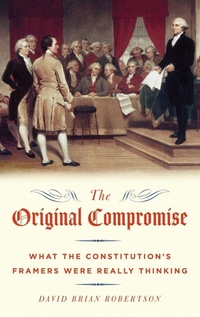
The Original Compromise
What the Constitution's Framers were Really Thinking
Published on 17. January 2013
Book
Hardback
344 pages
978-0-19-979629-8 (ISBN)
Description
What were the Founding Fathers really thinking when they gathered in the Pennsylvania State House to draft the United States Constitution? When answering this question, most have relied on The Federalist Papers, which was first published in book form after the close of the Convention, in 1788. To this day, the book's status is sacrosanct for most Americans. Yet as David Brian Robertson shows, the Papers represented one side of the debate and does not fully capture the political sensibilities that produced the U.S. Constitution. Robertson, drawing from the full range of contemporary sources and not just the Papers, provides a truly authoritative account of the founders' collective political reasoning during the Convention.
Organized thematically, each chapter covers a crucial Constitutional issue: the respective roles of the executive, the judiciary, and the legislature; the balance between the federal government and the states; slavery; and war and peace. In virtually every instance, the process was decidedly political, fractious, and piecemeal. As much as they wanted to design the government that would best serve their people, the Founders struggled to balance their broad ideals with self-interested policies and procedures. Robertson's boldly revisionist account of the political horse-trading that dominated the Convention not only greatly enriches our understanding of the nation's founding; it also elucidates why the government they created has proven so difficult to use.
Organized thematically, each chapter covers a crucial Constitutional issue: the respective roles of the executive, the judiciary, and the legislature; the balance between the federal government and the states; slavery; and war and peace. In virtually every instance, the process was decidedly political, fractious, and piecemeal. As much as they wanted to design the government that would best serve their people, the Founders struggled to balance their broad ideals with self-interested policies and procedures. Robertson's boldly revisionist account of the political horse-trading that dominated the Convention not only greatly enriches our understanding of the nation's founding; it also elucidates why the government they created has proven so difficult to use.
Reviews / Votes
The Original Compromise combines profound scholarship with remarkably accessible writing to make more clear than ever before just how and why the Constitution emerged in the form that it did. Robertson is attentive to the framers' ideas and their intertwined interests, and he traces persuasively the initiatives, negotiations, and compromises that led to their imperfect but enduring achievement. * Rogers M. Smith, Christopher H. Browne Distinguished Professor of Political Science, University of Pennsylvania *More details
Language
English
Place of publication
New York
United States
Target group
College/higher education
Professional and scholarly
General readers interested in: American history, the constitution, the Founding Fathers, American politics
Dimensions
Height: 240 mm
Width: 161 mm
Thickness: 23 mm
Weight
681 gr
ISBN-13
978-0-19-979629-8 (9780199796298)
Copyright in bibliographic data and cover images is held by Nielsen Book Services Limited or by the publishers or by their respective licensors: all rights reserved.
Schweitzer Classification
Other editions
Additional editions
Book
11/2017
Oxford University Press Inc
€53.50
Shipment within 15-20 days
E-Book
12/2012
1st Edition
OUP eBook
€23.99
Available for download
E-Book
12/2012
1st Edition
Oxford University Press, USA
€47.99
Available for download
Person
University of Missouri Curators Teaching Professor and Professor of Political Science, University of Missouri-St. Louis
Content
Principal Speakers at the Convention
Abbreviations
1. Introduction
Part 1: The Illness and the Cure
2. The Setting
3. The Remedy
4. Controlling Republican Politics: The Main Challenge
5. Broad Nationalism: The Politics of Virginia's Plan
6. Narrow Nationalism: The Virginia Plan's Opponents
Part 2: The Politics of Building Government Institutions
7. Selecting U.S. Representatives
8. Selecting U.S. Senators
9. Congressional Independence
10. Selecting the President
11. Presidential Independence and Isolation
12. The Courts and a Bill of Rights
Part 3: The Politics of Government Power
13. Federalism
14. Slavery
15. Economic Authority
16. National Security and Foreign Policy Authority
17. The End Game
18. Conclusion: A Republic If You Can Keep It
Appendix 1: Chronological Sequence of Constitutional Convention Decisions
Appendix 2: The United States Constitution and accompanying documents from the Constitutional Convention
Abbreviations
1. Introduction
Part 1: The Illness and the Cure
2. The Setting
3. The Remedy
4. Controlling Republican Politics: The Main Challenge
5. Broad Nationalism: The Politics of Virginia's Plan
6. Narrow Nationalism: The Virginia Plan's Opponents
Part 2: The Politics of Building Government Institutions
7. Selecting U.S. Representatives
8. Selecting U.S. Senators
9. Congressional Independence
10. Selecting the President
11. Presidential Independence and Isolation
12. The Courts and a Bill of Rights
Part 3: The Politics of Government Power
13. Federalism
14. Slavery
15. Economic Authority
16. National Security and Foreign Policy Authority
17. The End Game
18. Conclusion: A Republic If You Can Keep It
Appendix 1: Chronological Sequence of Constitutional Convention Decisions
Appendix 2: The United States Constitution and accompanying documents from the Constitutional Convention