

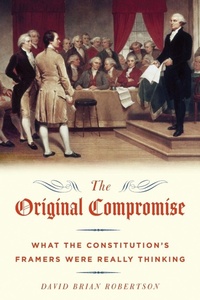
The Original Compromise
What the Constitution's Framers Were Really Thinking
Published on 2. November 2017
Book
Paperback/Softback
344 pages
978-0-19-068615-4 (ISBN)
Description
The eighty-five famous essays by Hamilton, Madison, and Jay--known collectively as the Federalist Papers--comprise the lens through which we typically view the ideas behind the U.S. Constitution. But we are wrong to do so, writes David Brian Robertson, if we really want to know what the Founders were thinking.
In this provocative new account of the framing of the Constitution, Robertson observes that the Federalist Papers represented only one side in a fierce argument that was settled by compromise--in fact, multiple compromises. Drawing on numerous primary sources, Robertson unravels the highly political dynamics that shaped the document. Hamilton and Madison, who hailed from two of the larger states, pursued an ambitious vision of a robust government with broad power. Leaders from smaller states envisioned only a few added powers, sufficient to correct the disastrous weakness of the Articles of Confederation, but not so strong as to threaten the governing systems within their own states. The two sides battled for three arduous months; the Constitution emerged piece by piece, the product of an evolving web of agreements. Robertson examines each contentious debate, including arguments over the balance between the federal government and the states, slavery, war and peace, and much more. In nearly every case, a fractious, piecemeal, and very political process prevailed. In this way, the convention produced a government of separate institutions, each with the will and ability to defend its independence. Majorities would rule, but the Constitution made it very difficult to assemble majorities large enough to let the government act.
Brilliantly argued and deeply researched, this book will change the way we think of "original intent." With a bracing willingness to challenge old pieties, Robertson rescues the political realities that created the government we know today.
In this provocative new account of the framing of the Constitution, Robertson observes that the Federalist Papers represented only one side in a fierce argument that was settled by compromise--in fact, multiple compromises. Drawing on numerous primary sources, Robertson unravels the highly political dynamics that shaped the document. Hamilton and Madison, who hailed from two of the larger states, pursued an ambitious vision of a robust government with broad power. Leaders from smaller states envisioned only a few added powers, sufficient to correct the disastrous weakness of the Articles of Confederation, but not so strong as to threaten the governing systems within their own states. The two sides battled for three arduous months; the Constitution emerged piece by piece, the product of an evolving web of agreements. Robertson examines each contentious debate, including arguments over the balance between the federal government and the states, slavery, war and peace, and much more. In nearly every case, a fractious, piecemeal, and very political process prevailed. In this way, the convention produced a government of separate institutions, each with the will and ability to defend its independence. Majorities would rule, but the Constitution made it very difficult to assemble majorities large enough to let the government act.
Brilliantly argued and deeply researched, this book will change the way we think of "original intent." With a bracing willingness to challenge old pieties, Robertson rescues the political realities that created the government we know today.
Reviews / Votes
The Original Compromise combines profound scholarship with remarkably accessible writing to make more clear than ever before just how and why the Constitution emerged in the form that it did. Robertson is attentive to the framers' ideas and their intertwined interests, and he traces persuasively the initiatives, negotiations, and compromises that led to their imperfect but enduring achievement. * Rogers M. Smith, Christopher H. Browne Distinguished Professor of Political Science, University of Pennsylvania* By systematically considering the political process that produced the Constitution, this immensely useful and beautifully realized study reveals the many compromises that made the government of the United States possible. So doing, it deepens understanding of key themes in American political development, and thoughtfully explains why ambiguities about constitutional meaning continue to animate contemporary disputes. * Ira Katznelson, Ruggles Professor of Political Science and History, Columbia University
* The Philadelphia Convention may have been 'an assembly of demigods,' as Thomas Jefferson later suggested. But the Constitution was still written one word at a time. By letting the delegates speak for themselves, Robertson shows us that genius works in pieces, that creation is a stormy voyage of discovery, and that human frailty is a necessary virtue. * Richard F. Bensel, Professor of Government, Cornell University
* ...Robertson draws chiefly from the records of the convention debates to portray the reasoning of the delegates and the progression of agreements and compromises... Recommended. * CHOICE
*
More details
Language
English
Place of publication
New York
United States
Target group
College/higher education
Professional and scholarly
Dimensions
Height: 234 mm
Width: 156 mm
Thickness: 20 mm
Weight
586 gr
ISBN-13
978-0-19-068615-4 (9780190686154)
Copyright in bibliographic data and cover images is held by Nielsen Book Services Limited or by the publishers or by their respective licensors: all rights reserved.
Schweitzer Classification
Other editions
Additional editions
Book
01/2013
Oxford University Press Inc
€81.90
Shipment within 15-20 days
Person
David Brian Robertson is Curator's Distinguished Teaching Professor of Political Science at the University of Missouri, St. Louis. He is the author of The Constitution and America's Destiny and Federalism and the Making of America.
Content
Principal Speakers at the Convention
Abbreviations
1. Introduction
Part 1: The Illness and the Cure
2. The Setting
3. The Remedy
4. Controlling Republican Politics: The Main Challenge
5. Broad Nationalism: The Politics of Virginia's Plan
6. Narrow Nationalism: The Virginia Plan's Opponents
Part 2: The Politics of Building Government Institutions
7. Selecting U.S. Representatives
8. Selecting U.S. Senators
9. Congressional Independence
10. Selecting the President
11. Presidential Independence and Isolation
12. The Courts and a Bill of Rights
Part 3: The Politics of Government Power
13. Federalism
14. Slavery
15. Economic Authority
16. National Security and Foreign Policy Authority
17. The End Game
18. Conclusion: A Republic If You Can Keep It
Appendix 1: Chronological Sequence of Constitutional Convention Decisions
Appendix 2: The United States Constitution and accompanying documents from the Constitutional Convention
Abbreviations
1. Introduction
Part 1: The Illness and the Cure
2. The Setting
3. The Remedy
4. Controlling Republican Politics: The Main Challenge
5. Broad Nationalism: The Politics of Virginia's Plan
6. Narrow Nationalism: The Virginia Plan's Opponents
Part 2: The Politics of Building Government Institutions
7. Selecting U.S. Representatives
8. Selecting U.S. Senators
9. Congressional Independence
10. Selecting the President
11. Presidential Independence and Isolation
12. The Courts and a Bill of Rights
Part 3: The Politics of Government Power
13. Federalism
14. Slavery
15. Economic Authority
16. National Security and Foreign Policy Authority
17. The End Game
18. Conclusion: A Republic If You Can Keep It
Appendix 1: Chronological Sequence of Constitutional Convention Decisions
Appendix 2: The United States Constitution and accompanying documents from the Constitutional Convention