

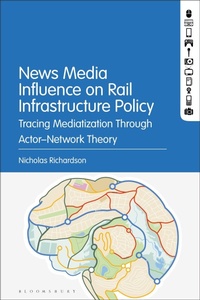
News Media Influence on Rail Infrastructure Policy
Tracing Mediatization Through Actor-Network Theory
Published on 29. May 2025
Book
Paperback/Softback
304 pages
978-1-5013-8745-6 (ISBN)
Description
In this book, Richardson's research spans a decade and two cities - Sydney, Australia and Montreal, Canada - focusing on three metro-style rail infrastructure case study projects: one ongoing, one failed and one upgraded after reaching fifty years of age - to build an irrefutable case that the news media is highly influential to policy, and that these influences are complex, messy and changing.
News Media Influence on Rail Infrastructure Policy offers scholars and industry practitioners in the arenas of policy analysis, politics and media communications a method for astutely guiding large-scale projects through the complex and changing landscape of 24/7 news media. It is underpinned by empirical research that identifies and endeavors to close a considerable gap in current understanding and practice. This gap represents a failure to recognise and respect mediatization - the many powerful influences impacting a policy arena that has drawn the ire of the news media. The result of this failure is ineffective communication that does little to advance the policy piece and, in the worst instances, leads to policy immobilisation or poor policy decision-making.
Drawing significantly on Actor--Network Theory, Richardson identifies the influential actors and alliances at play when policy is subjected to media discourse, and he proposes a framework for tracing and managing them. In doing so, he demonstrates that such a framework is not only vital for the successful negotiation of policy and projects in the media, but also to an (r)evolutionary recasting of public, expert and media actors in the development and decision-making process.
News Media Influence on Rail Infrastructure Policy offers scholars and industry practitioners in the arenas of policy analysis, politics and media communications a method for astutely guiding large-scale projects through the complex and changing landscape of 24/7 news media. It is underpinned by empirical research that identifies and endeavors to close a considerable gap in current understanding and practice. This gap represents a failure to recognise and respect mediatization - the many powerful influences impacting a policy arena that has drawn the ire of the news media. The result of this failure is ineffective communication that does little to advance the policy piece and, in the worst instances, leads to policy immobilisation or poor policy decision-making.
Drawing significantly on Actor--Network Theory, Richardson identifies the influential actors and alliances at play when policy is subjected to media discourse, and he proposes a framework for tracing and managing them. In doing so, he demonstrates that such a framework is not only vital for the successful negotiation of policy and projects in the media, but also to an (r)evolutionary recasting of public, expert and media actors in the development and decision-making process.
Reviews / Votes
This book employs the Actor-Network Theory (ANT) developed by Bruno Latour, Michel Callon and others in the analysis of two contemporary cases of local infrastructure planning - the Metro projects in Sydney, Australia and Montreal, Canada. The author unearths and dissects coalitions of human and non-human authors, which are often invisible but nevertheless critical for the success or failure of such projects. An insightful read for every academic, practitioner and student fascinated by but also concerned about the 24/7 news cycle and its ambiguous impact on local politics nowadays. * Roumen Dimitrov, Visiting Professor, University Pompeu Fabra, Spain, and Honorary Academic, UNSW, Australia * In this book, Nicholas Richardson takes us through the complexities of major infrastructure projects in Australia and Canada. These projects exist through the networks of actors who tell their stories in an ever-changing landscape. In this context, where controlling the narrative is a challenge, communicators must seek political approval for projects to go ahead. To achieve this, they need a fine-grained understanding of actor networks. The book is truly enlightening. * Eric Montpetit, Professor of Political Science, Universite de Montreal, Canada * Assembling a motley cast of policy experts, career bureaucrats, communications consultants, election-cycle politicians and opinionated amateurs around the scene of rapid rail networks in Sydney and Montreal, Nicholas Richardson follows the actors in this magnificent account of mediatization, railways and the policy apparatus. Deftly weaving together the complex threads of policy failures and fictions with infrastructural futures, Richardson ensures the reader remains on the rails in this compelling journey into the urban underground. * Ned Rossiter, Professor of Communication and Director of Research at the Institute for Culture and Society, Western Sydney University, Australia *More details
Language
English
Place of publication
New York
United States
Publishing group
Bloomsbury Publishing Plc
Target group
Professional and scholarly
Dimensions
Height: 229 mm
Width: 152 mm
Thickness: 16 mm
Weight
441 gr
ISBN-13
978-1-5013-8745-6 (9781501387456)
Copyright in bibliographic data and cover images is held by Nielsen Book Services Limited or by the publishers or by their respective licensors: all rights reserved.
Schweitzer Classification
Other editions
Additional editions
Nicholas Richardson
News Media Influence on Rail Infrastructure Policy
Tracing Mediatization Through Actor-Network Theory
E-Book
10/2023
1st Edition
Bloomsbury Academic USA
€32.99
Available for download
Nicholas Richardson
News Media Influence on Rail Infrastructure Policy
Tracing Mediatization Through Actor-Network Theory
E-Book
10/2023
1st Edition
Bloomsbury Academic USA
€32.99
Available for download
Person
Nicholas Richardson is a lecturer in Strategic and Creative Commercial Communications at the University of New South Wales, Australia. In previous lives he has written speeches for politicians and developed communications strategies for government agencies, NGOs and international companies.
Content
Abbreviations and acronyms
Introduction
Part I: Following the Actors: A Journey to ANT
Chapter 1. Discursive Beginnings
Chapter 2. The Case for ANT
Chapter 3. Tracing the Media Hinterland
Part II: Metro Development in Sydney
Chapter 4. Upheaval: The Media Beast and Political Decision-Making
Chapter 5. Policy Demise: Where Have All the Leaders Gone?
Chapter 6. A Derailing of Sydney Transit
Chapter 7. My Kingdom for a Car: The Motoring Mythology
Chapter 8. Sydney Metro Comes Full Circle
Part III: The Montreal Metro Turns Fifty
Chapter 9. Wandering the Montreal Metro: Where Do You Come From?
Chapter 10. Wandering the Montreal Metro Part 2: What Do You Do?
Part IV: Tracing an Actor-network
Chapter 11. Chains of Translation
Conclusion: Intersecting Pathways
Glossary: Summary of Key Terminology
References
Index
Introduction
Part I: Following the Actors: A Journey to ANT
Chapter 1. Discursive Beginnings
Chapter 2. The Case for ANT
Chapter 3. Tracing the Media Hinterland
Part II: Metro Development in Sydney
Chapter 4. Upheaval: The Media Beast and Political Decision-Making
Chapter 5. Policy Demise: Where Have All the Leaders Gone?
Chapter 6. A Derailing of Sydney Transit
Chapter 7. My Kingdom for a Car: The Motoring Mythology
Chapter 8. Sydney Metro Comes Full Circle
Part III: The Montreal Metro Turns Fifty
Chapter 9. Wandering the Montreal Metro: Where Do You Come From?
Chapter 10. Wandering the Montreal Metro Part 2: What Do You Do?
Part IV: Tracing an Actor-network
Chapter 11. Chains of Translation
Conclusion: Intersecting Pathways
Glossary: Summary of Key Terminology
References
Index