

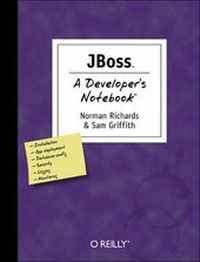
Jboss: A Developer's Notebook
1st Edition
Published on 2. August 2005
Book
Paperback/Softback
176 pages
978-0-596-10007-0 (ISBN)
Description
There's nothing ordinary about JBoss. What began, as an open source EJB container project six years ago has become a fully certified J2EE 1.4 application server with the largest market share, competitive with proprietary Java application servers in features and quality. And with its dynamic architecture, JBoss isn't just a J2EE server. You can alter the services to make J2EE work the way you want, or even throw J2EE away completely. After more than a million downloads, many JBoss users are no longer trying it out on internal test boxes, but rolling it out on production machines. "JBoss: A Developer's Notebook" takes you on a complete tour of JBoss in a very unique way: rather than long discussions, you will find code--lots of code. In fact, the book is a collection of hands-on labs that take you through the critical JBoss features step-by-step. You don't just read about JBoss, you learn it through direct practical application. That includes exploring the server's many configurations: from bare features for simple applications, to the lightweight J2EE configuration, to everything JBoss has in store-including Hibernate and Tomcat.
"JBoss: A Developer's Notebook" also introduces the management console, the web services messaging features, enhanced monitoring capabilities, and shows you how to improve performance. At the end of each lab, you'll find a section called "What about..." that anticipates and answers likely follow-up questions, along with a section that points you to articles and other resources if you need more information. JBoss is truly an extraordinary application server. And we have an extraordinary way for you to learn it.
"JBoss: A Developer's Notebook" also introduces the management console, the web services messaging features, enhanced monitoring capabilities, and shows you how to improve performance. At the end of each lab, you'll find a section called "What about..." that anticipates and answers likely follow-up questions, along with a section that points you to articles and other resources if you need more information. JBoss is truly an extraordinary application server. And we have an extraordinary way for you to learn it.
Reviews / Votes
"JBoss is the certified J2EE application server from JEMS (JBoss Enterprise Middleware System) and with JBoss: A Developer's Notebook you'll be able set up and manage your project in minutes. It takes a no-nonsense approach and is the practical guide to JBoss for developers. It's certainly the kind of book that you'll constantly have open on your desk, and to save time they've added in some coffee cup stains on the pages for you! Scribbled notes in the margin also add to the notebook theme, but they are actually useful asides to the main text, which makes it one of the most readable books on the subject. However, some sections might prove a bit lightweight for the coding hardcore." .NET, November 2005 "A daring format which works well, a style that lends to quick reading and progress, and an all-round enjoyable read. I look forward to other O'Reilly books in this series." - Mark Jones, news@UK, March 2006More details
Edition
1., Aufl.
Language
English
Place of publication
Sebastopol
United States
Target group
Professional and scholarly
Product notice
Paperback (trade)
Unsewn / adhesive bound
Dimensions
Height: 233 mm
Width: 180 mm
Thickness: 14 mm
Weight
299 gr
ISBN-13
978-0-596-10007-0 (9780596100070)
Schweitzer Classification
Other editions
Additional editions
Norman Richards
JBoss: A Developer's Notebook
E-Book
06/2005
1st Edition
O'Reilly
€29.49
Available for download
E-Book
06/2005
1st Edition
O'Reilly
€24.49
Available for download
Persons
Norman Richards has developed software for a decade and has been working with code generation techniques for much of that time. He is an avid XDoclet user and evangelist. Norman lives in Austin, Texas.Sam Griffith is an OO Architect/Developer/Mentor who has programmed OO systems since 1987. He has used Obj-C, C++, Smalltalk, Object Pascal, Object-Forth (Neon), CLOS and other OO systems.
Content
The Developer's Notebook Series;
Notebooks Are...;
Notebooks Aren't...;
Organization;
Preface;
Conventions Used in This Book;
Using Code Examples;
Comments and Questions;
Safari® Enabled;
Acknowledgments;
Chapter 1: Installing and Running JBoss;
1.1 Installing the Server;
1.2 Starting Up JBoss;
1.3 Examining the Server (JMX ConsoleJMX ConsoleJMX Console;
1.4 Shutting Down the Server;
1.5 Specifying a Server Configuration;
1.6 Creating a New Configuration;
Chapter 2: Deploying an Application on JBoss;
2.1 Getting Ant;
2.2 Creating and Packaging the Application;
2.3 Running the Application;
2.4 Modifying the Deployed Application;
2.5 Exploding Deployments;
2.6 Viewing the Application on the Management Console;
2.7 Uninstalling the Application;
Chapter 3: Creating a Complete Application;
3.1 Building the EJB Tier;
3.2 Using XDoclet to Build the Web Tier;
3.3 Defining Users;
3.4 Deploying the Application;
3.5 Examining the Database;
Chapter 4: Connecting to a Real Database;
4.1 Setting Up MySQL;
4.2 Adding the JDBC Driver;
4.3 Creating a Datasource;
4.4 Linking the Datasource to Our Application;
4.5 Monitoring the Connection Pool;
Chapter 5: Applying Security;
5.1 Defining a Security Domain;
5.2 Using a Relational Database for Users;
5.3 Using Hashed Passwords;
5.4 Using an LDAP Server for Users;
5.5 Stacking Login Modules;
5.6 Enabling SSL;
Chapter 6: Logging;
6.1 Configuring log4j;
6.2 Adding a Logging Category;
6.3 Configuring the Log Format;
6.4 Creating a New Logfile;
6.5 Rolling Logfiles;
6.6 Adjusting Logging from the JMX Console;
6.7 HTTP Access Logs;
6.8 Logging Generated SQL for CMP;
Chapter 7: Configuring Persistence;
7.1 Managing Schema;
7.2 Mapping Objects;
7.3 Mapping Relations;
7.4 Adding Audit Data;
7.5 Generating Primary Keys;
Chapter 8: Managing and Monitoring JBoss;
8.1 Starting the Web Console;
8.2 Monitoring Your Application;
8.3 Working with MBeans;
8.4 Monitoring MBeans;
8.5 Creating a Snapshot;
8.6 Creating a Monitor;
8.7 Creating an Email Alert;
8.8 Managing JBoss from the Command Line;
Chapter 9: Rolling Out JBoss;
9.1 Securing the Management Consoles;
9.2 Securing the JMX Invoker;
9.3 Removing the HTTP Invokers;
9.4 Configuring the JMS Invokers;
9.5 Removing Hypersonic;
9.6 Configuring Tomcat Connectors;
9.7 Setting a Root Web Application;
9.8 Removing the Class Download Service;
;