

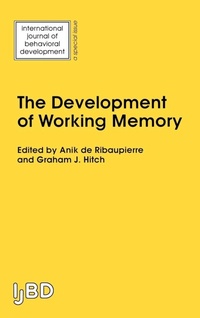
The Development of Working Memory
A Special Issue of the International Journal of Behavioural Development
Will be published approx. on 12. April 1994
Book
Hardback
212 pages
978-0-86377-927-5 (ISBN)
Description
Working memory refers to the temporary storage and manipulation of information that is being processed in a wide range of cognitive tasks.
This Special Issue of the International Journal of Behavioral Development brings together research on the development of working memory that arises within two quite different approaches. The first is the neo-Piagetian perspective, which proposes that working memory limitations play an important role in the development of cognitive abilities. Accordingly, a major goal of neo-Piagetian research has been to develop techniques for measuring the capacity of working memory and to chart its development. Papers by Alp, de Ribaupierre and Bailleux, Morra, and Pascual-Leone, illustrate different facets of this approach.
The second approach stems from the study of working memory and information-processing in mainstream cognitive psychology, which has suggested the need to distinguish relatively peripheral phonological and visuo-spatial subsystems from central resources. Since these subsystems are currently better understood than the central component of adult working memory, they have tended to be the focus of related developmental studies. This tendency is illustrated in papers on visuo-spatial working memory by Longoni and by Walker and Hitch, and on phonological working memory by Henry.
A further significant strand of research in both approaches, is to investigate links between the development of working memory and various aspects of cognitive development; this type of work is illustrated in the papers by Blake on language acquisition and by Siegel on reading. Although the two approaches have tended to remain rather separate, their complementarity is fairly obvious: one has tended to emphasise central aspects of working memory, the other more peripheral aspects.
This special issue is intended to promote the exchange of ideas, methods and data between researchers using the two approaches, and to identify areas of conflicts and agreements.
This Special Issue of the International Journal of Behavioral Development brings together research on the development of working memory that arises within two quite different approaches. The first is the neo-Piagetian perspective, which proposes that working memory limitations play an important role in the development of cognitive abilities. Accordingly, a major goal of neo-Piagetian research has been to develop techniques for measuring the capacity of working memory and to chart its development. Papers by Alp, de Ribaupierre and Bailleux, Morra, and Pascual-Leone, illustrate different facets of this approach.
The second approach stems from the study of working memory and information-processing in mainstream cognitive psychology, which has suggested the need to distinguish relatively peripheral phonological and visuo-spatial subsystems from central resources. Since these subsystems are currently better understood than the central component of adult working memory, they have tended to be the focus of related developmental studies. This tendency is illustrated in papers on visuo-spatial working memory by Longoni and by Walker and Hitch, and on phonological working memory by Henry.
A further significant strand of research in both approaches, is to investigate links between the development of working memory and various aspects of cognitive development; this type of work is illustrated in the papers by Blake on language acquisition and by Siegel on reading. Although the two approaches have tended to remain rather separate, their complementarity is fairly obvious: one has tended to emphasise central aspects of working memory, the other more peripheral aspects.
This special issue is intended to promote the exchange of ideas, methods and data between researchers using the two approaches, and to identify areas of conflicts and agreements.
More details
Language
English
Place of publication
Hove
United Kingdom
Publishing group
Taylor & Francis Ltd
Target group
College/higher education
Professional and scholarly
Dimensions
Height: 235 mm
Width: 157 mm
Thickness: 17 mm
Weight
502 gr
ISBN-13
978-0-86377-927-5 (9780863779275)
Copyright in bibliographic data and cover images is held by Nielsen Book Services Limited or by the publishers or by their respective licensors: all rights reserved.
Schweitzer Classification
Other editions
Additional editions
Anik de Ribaupierre | Graham Hitch
The Development of Working Memory
A Special Issue of the International Journal of Behavioural Development
Book
02/2019
1st Edition
Psychology Press Ltd
€44.10
Shipment within 10-20 days
Persons
Anik De Ribaupierre, Graham Hitch
Content
Preface, Developmental Change in a Spatial Task of Attentional Capacity: An Essay Toward an Integration of Two Working Memory Models, The Relationship between Speech Rate and Memory Span in Children, Developmental Aspects of Phonemic and Visual Similarity Effects: Further Evidence in Italian Children, The Development of Short-term Visual Memory in Young Children, The Relationship between Memory Span and Measures of Imitative and Spontaneous Language Complexity in Preschool Children, Working Memory and Reading: A Life-span Perspective, Measuring the Size of Working Memory in Very Young Children: The Imitation Sorting Task, Issues in Working Memory Measurement: Testing for M Capacity, Developmental Measurement of Mental Attention, Subject Index