

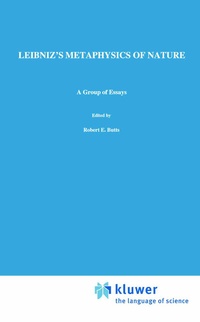
Leibniz's Metaphysics of Nature
A Group of Essays
Published on 30. June 1981
Book
Hardback
XIV, 128 pages
978-90-277-1252-3 (ISBN)
Description
The essays included in this volume are a mixture of old and new. Three of them make their first appearance in print on this occa sion (Nos III, IV, and V). The remaining four are based upon materials previously published in learned journals or anthologies. (However, these previously published papers have been revised and, generally, expanded for inclusion here.) Detailed acknowl edgement of prior publications is made in the notes to the relevant articles. I am grateful to the editors of these several publications for their kind permission to use this material. I am grateful to an anonymous reader for the Western Ontario Series for some useful corrigenda. And I should like to thank John Horty and Lily Knezevich for their help in seeing this material through the press. NICHOLAS RESCHER Pittsburgh, Pennsylvania May, 1980 xi INTRODUCTION The unifying theme of these essays is their concern with Leibniz's metaphysics of nature. In particular, they revolve about his cos mology of creation and his conception of the real world as one among infinitely many equipossible alternatives.
More details
Series
Edition
1981 ed.
Language
English
Place of publication
Dordrecht
Netherlands
Publishing group
Springer
Target group
Professional and scholarly
Research
Product notice
sewn/stitched
Cloth over boards
Illustrations
XIV, 128 p.
Dimensions
Height: 241 mm
Width: 160 mm
Thickness: 13 mm
Weight
389 gr
ISBN-13
978-90-277-1252-3 (9789027712523)
DOI
10.1007/978-94-009-8445-5
Schweitzer Classification
Other editions
Additional editions
Book
06/1981
Kluwer Academic Publishers
€160.49
Shipment within 15-20 days
Content
I. Leibniz on Creation and the Evaluation of Possible Worlds.- 1. Stagesetting.- 2. Mathematico-Physical Inspiration.- 3. Epistemological Implications.- 4. Leibniz as a Pioneer of the Coherence Theory of Truth.- II. The Epistemology of Inductive Reasoning in Leibniz.- 1. Introduction.- 2. The Extraction of General Truths from Experience.- 3. Concluding Observations.- III. Leibniz and the Concept of a System.- 1. The Concept of a System.- 2. Leibniz as System Builder.- 3. Why System?.- 4. Cognitive vs. Ontological Systematicity.- 5. System and Infinite Complexity.- IV. Leibniz on the Infinite Analysis of Contingent Truths.- 1. Introduction.- 2. Analysis.- 3. Calculus as the Inspiration of Infinite Analysis.- 4. A Metaphysical Calculus of Perfection-Optimization.- 5. Conclusion.- V. Leibniz on Intermonadic Relations.- 1. Introduction.- 2. The Crucial Role of Relations in Incompossibility.- 3. The Reducibility of Relations.- 4. Relational Reducibility and Incompossibility.- 5. Reducibility Not a Logical But a Metaphysical Thesis.- 6. The Reality of Intermonadic Relations.- 7. Abstract Relations.- VI. Leibniz and the Plurality of Space-Time Frameworks.- 1. The Question of Distinct Frameworks.- 2. Spatiality: The Conception of Space as Everywhere the Same.- 3. One World, One Space.- 4. Distinct Worlds Must Have Distinct Spaces.- 5. How are Distinct Spaces Distinct?.- 6. Why Distinct Spaces?.- 7. A Superspace After All?.- 8. Cross-World Spatial Comparisons.- 9. Must the Spatial Structure of Other Worlds Be Like that of Ours?.- 10. The Important Fact That, for Leibniz, Time is Coordinate With Space.- 11. Can a Possible World Lack Spatiotemporal Structure?.- VII. The Contributions of the Paris Period (1672-76) to Leibniz's Metaphysics.- 1. Overview of Cardinal Theses ofLeibniz's Metaphysics.- 2. A Missing Piece.- 3. Conclusion.- Appendix: Rescher on Leibniz, with Bibliography.- Index of Names.