

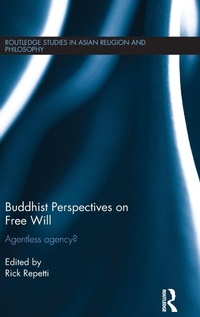
Buddhist Perspectives on Free Will
Agentless Agency?
1st Edition
Published on 2. August 2016
Book
Hardback
214 pages
978-1-138-95034-4 (ISBN)
Description
Throughout the history of Buddhism, little has been said prior to the Twentieth Century that explicitly raises the question whether we have free will, though the Buddha rejected fatalism and some Buddhists have addressed whether karma is fatalistic. Recently, however, Buddhist and Western philosophers have begun to explicitly discuss Buddhism and free will.
This book incorporates Buddhist philosophy more explicitly into the Western analytic philosophical discussion of free will, both in order to render more perspicuous Buddhist ideas that might shed light on the Western philosophical debate, and in order to render more perspicuous the many possible positions on the free will debate that are available to Buddhist philosophy. The book covers:
Buddhist and Western perspectives on the problem of free will
The puzzle of whether free will is possible if, as Buddhists believe, there is no agent/self
Theravada views
Mahayana views
Evidential considerations from science, meditation, and skepticism
The first book to bring together classical and contemporary perspectives on free will in Buddhist thought, it is of interest to academics working on Buddhist and Western ethics, comparative philosophy, metaphysics, philosophy of mind, philosophy of action, agency, and personal identity.
This book incorporates Buddhist philosophy more explicitly into the Western analytic philosophical discussion of free will, both in order to render more perspicuous Buddhist ideas that might shed light on the Western philosophical debate, and in order to render more perspicuous the many possible positions on the free will debate that are available to Buddhist philosophy. The book covers:
Buddhist and Western perspectives on the problem of free will
The puzzle of whether free will is possible if, as Buddhists believe, there is no agent/self
Theravada views
Mahayana views
Evidential considerations from science, meditation, and skepticism
The first book to bring together classical and contemporary perspectives on free will in Buddhist thought, it is of interest to academics working on Buddhist and Western ethics, comparative philosophy, metaphysics, philosophy of mind, philosophy of action, agency, and personal identity.
Reviews / Votes
'This is an outstanding collection on an undertheorized, but fascinating, set of topics: Buddhist accounts of agency, free will, and moral responsibility (among others). The editor's introduction is insightful and helpful, and the authors constitute an all-star lineup in this area. I highly recommend this book.'John Martin Fischer, University of California, Riverside, USA
'Repetti brings together a wide range of scholars to consider the notion of free will in Buddhist thought. Is free will a meaningful conjunction of terms in a Buddhist context? What constitutes freedom for a Buddhist? And what (if anything) corresponds to will? This volume tackles these tough questions and moves cross-cultural philosophy another step forward.'
Douglas Duckworth, Temple University, USA
'Buddhist philosophy and the historical problem of free will have each been of major philosophical interest for centuries, but until recently they have been studied separately and by scholars of different traditions. That is changing, thanks in large part to the work of the contributors in this volume. Rick Repetti has collected contributions from the world's leading scholars on Buddhism and free will. His insightful and engaging introduction sets the stage beautifully for philosophers and non-philosophers alike. Anyone interested in Buddhism and free will, either individually or in relation to each other, should buy this book.'
Gregg D. Caruso, SUNY Corning, USA
More details
Series
Language
English
Place of publication
London
United Kingdom
Publishing group
Taylor & Francis Ltd
Target group
College/higher education
Dimensions
Height: 240 mm
Width: 161 mm
Thickness: 18 mm
Weight
531 gr
ISBN-13
978-1-138-95034-4 (9781138950344)
Copyright in bibliographic data and cover images is held by Nielsen Book Services Limited or by the publishers or by their respective licensors: all rights reserved.
Schweitzer Classification
Other editions
Additional editions
Book
12/2019
1st Edition
Routledge
€65.30
Shipment within 15-20 days
E-Book
07/2016
Routledge
€58.99
Available for download
E-Book
07/2016
Routledge
€59.49
Available for download
Person
Rick Repetti is Professor of Philosophy at Kingsborough Community College, CUNY, USA. He is the author of The Counterfactual Theory of Free Will (2010), as well as several articles on Buddhism, meditation, free will, and philosophy of religion.
Content
Introduction
1. Why the Buddha Did Not Discuss 'the Problem of Free Will and Determinism'
2. Why There Should Be a Buddhist Theory of Free Will
3. Uses of the Illusion of Agency: Why Some Buddhists Should Believe in Free Will
4. Just Another Word for Nothing Left to Lose: Freedom, Agency and Ethics for Madhyamikas
5. Negative Dialectics in Comparative Philosophy: The Case of Buddhist Free Will Quietism
6. Free Will and the Sense of Self
7. What Am I Doing?
8. Freedom from Responsibility: Agent-Neutral Consequentialism and the Bodhisattva Ideal
9. Free Will, Liberation and Buddhist Philosophy
10. Buddhism and Free Will: Beyond the 'Free Will Problem'
11. Degrees of Freedom: The Buddha's Implied Views on the (Im)possibility of Free Will
12. Buddhist Paleocompatibilism
13. Shifting Coalitions, Free Will, and the Responsibility of Persons
14. Psychological versus Metaphysical Agents: A Theravada Buddhist View of ?Free Will and Moral Responsibility
15. Emotions and Choice: Lessons from Tsongkhapa
16. Grasping Snakes: Reflections on Free Will, Samadhi, and Dharmas
17. Agentless Agency: The Soft Compatibilist Argument from Buddhist Meditation, Mind-Mastery, Evitabilism, and Mental Freedom
1. Why the Buddha Did Not Discuss 'the Problem of Free Will and Determinism'
2. Why There Should Be a Buddhist Theory of Free Will
3. Uses of the Illusion of Agency: Why Some Buddhists Should Believe in Free Will
4. Just Another Word for Nothing Left to Lose: Freedom, Agency and Ethics for Madhyamikas
5. Negative Dialectics in Comparative Philosophy: The Case of Buddhist Free Will Quietism
6. Free Will and the Sense of Self
7. What Am I Doing?
8. Freedom from Responsibility: Agent-Neutral Consequentialism and the Bodhisattva Ideal
9. Free Will, Liberation and Buddhist Philosophy
10. Buddhism and Free Will: Beyond the 'Free Will Problem'
11. Degrees of Freedom: The Buddha's Implied Views on the (Im)possibility of Free Will
12. Buddhist Paleocompatibilism
13. Shifting Coalitions, Free Will, and the Responsibility of Persons
14. Psychological versus Metaphysical Agents: A Theravada Buddhist View of ?Free Will and Moral Responsibility
15. Emotions and Choice: Lessons from Tsongkhapa
16. Grasping Snakes: Reflections on Free Will, Samadhi, and Dharmas
17. Agentless Agency: The Soft Compatibilist Argument from Buddhist Meditation, Mind-Mastery, Evitabilism, and Mental Freedom