

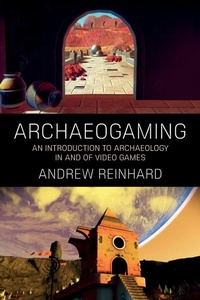
Archaeogaming
An Introduction to Archaeology in and of Video Games
1st Edition
Published on 18. June 2018
Book
Paperback/Softback
236 pages
978-1-78533-873-1 (ISBN)
Description
A general introduction to archeogaming describing the intersection of archaeology and video games and applying archaeological method and theory into understanding game-spaces.
"[T]he author's clarity of style makes it accessible to all readers, with or without an archaeological background. Moreover, his personal anecdotes and gameplay experiences with different game titles, from which his ideas often develop, make it very enjoyable reading."-Antiquity
Video games exemplify contemporary material objects, resources, and spaces that people use to define their culture. Video games also serve as archaeological sites in the traditional sense as a place, in which evidence of past activity is preserved and has been, or may be, investigated using the discipline of archaeology, and which represents a part of the archaeological record.
From the introduction:
Archaeogaming, broadly defined, is the archaeology both in and of digital games... As will be described in the following chapters, digital games are archaeological sites, landscapes, and artifacts, and the game-spaces held within those media can also be understood archaeologically as digital built environments containing their own material culture... Archaeogaming does not limit its study to those video games that are set in the past or that are treated as "historical games," nor does it focus solely on the exploration and analysis of ruins or of other built environments that appear in the world of the game. Any video game-from Pac-Man to Super Meat Boy-can be studied archaeologically.
"[T]he author's clarity of style makes it accessible to all readers, with or without an archaeological background. Moreover, his personal anecdotes and gameplay experiences with different game titles, from which his ideas often develop, make it very enjoyable reading."-Antiquity
Video games exemplify contemporary material objects, resources, and spaces that people use to define their culture. Video games also serve as archaeological sites in the traditional sense as a place, in which evidence of past activity is preserved and has been, or may be, investigated using the discipline of archaeology, and which represents a part of the archaeological record.
From the introduction:
Archaeogaming, broadly defined, is the archaeology both in and of digital games... As will be described in the following chapters, digital games are archaeological sites, landscapes, and artifacts, and the game-spaces held within those media can also be understood archaeologically as digital built environments containing their own material culture... Archaeogaming does not limit its study to those video games that are set in the past or that are treated as "historical games," nor does it focus solely on the exploration and analysis of ruins or of other built environments that appear in the world of the game. Any video game-from Pac-Man to Super Meat Boy-can be studied archaeologically.
Reviews / Votes
"Although the topics and references included in the text are more closely aligned to the ?eld of archaeology than to game studies, the author's clarity of style makes it accessible to all readers, with or without an archaeological background. Moreover, his personal anecdotes and gameplay experiences with different game titles, from which his ideas often develop, make it very enjoyable reading." * Antiquity"For those interested in the archaeology of modernity including 'internet archaeology,' [this book] represents a significant introduction to investigations of a rapidly expanding area of human activity." * Journal of Eastern Mediterranean Archaeology and Heritage Studies
"In Archaeogaming, Reinhard presents a passionate look at a cool subject, displaying his love for both archaeology and gaming. More importantly, he consistently manages to take his work further than simply being a neat idea to show the practicality of archaeogaming as a sub-field and method... Overall, Archaeogaming is exactly what Reinhard claims it to be, an introduction. His focus on major themes creates an accessible entry point for anyone who may be interested in the topic, regardless of their prior knowledge about archaeology or gaming studies. As such, this book makes an excellent addition to both undergraduate and graduate courses, by both laying a solid foundation and opening multiple doors for future scholarship." * Anthropology Book Forum
"Many interesting arguments and ideas are put forth in Reinhard's book. The main axiom, however, is not so much the need for an archaeology of videogames, understood within contemporary archaeology, but that videogames, by themselves, deserve their own archaeology." * arqueologiapublica.es
"The book encompasses many perspectives, with subjects ranging from the ordinary (such as listing games in which you can play as an archaeologist) to deeply philosophical considerations...Reinhard fulfilled his aim of introducing the five main themes of archaeogaming in one book. Archaeogaming forms a solid starting point for researchers who are ready to dive into the world (real or virtual) of archaeogaming and all its subfields." * Internet Archaeology
"Reinhard's willingness to move between the densely philosophical, the methodological, and the colloquial would make this book a nice option for an introductory archaeology class where students learn about theory, methods, procedures, and techniques, but less frequently have opportunities to put these ideas into practice...Reinhard's book provides both the student and the scholar a way to think about what this kind of work will look like." * The Archaeology of the Mediterranean World
"This is a stellar piece of work that moves beyond disciplines and worlds." * Anna Foka, Umea University
More details
Language
English
Place of publication
Oxford
United Kingdom
Target group
College/higher education
Professional and scholarly
Product notice
Paperback (trade)
Illustrations
Bibliography; Index; 22 Illustrations
Dimensions
Height: 229 mm
Width: 152 mm
Thickness: 14 mm
Weight
351 gr
ISBN-13
978-1-78533-873-1 (9781785338731)
DOI
10.3167/9781785338724
Copyright in bibliographic data and cover images is held by Nielsen Book Services Limited or by the publishers or by their respective licensors: all rights reserved.
Schweitzer Classification
Other editions
Additional editions
E-Book
06/2018
1st Edition
Berghahn Books
€19.49
Available for download
E-Book
06/2018
1st Edition
Berghahn Books
€19.49
Available for download
Person
Andrew Reinhard is a Cultural Resource Management (CRM) Project Director for Metcalf Archaeological Consultants and is also a Research Affiliate at the Institute for the Study of the Ancient World (ISAW) at New York University. He is editor of the series Digital Archaeology: Documenting the Anthropocene published by Berghahn.
Content
List of Illustrations
Acknowledgements
Introduction
Chapter 1. Real-World Archaeogaming
Chapter 2. Playing as Archaeologists
Chapter 3. Video Games as Archaeological Sites
Chapter 4. Material Culture of the Immaterial
Conclusion
Appendix: No Man's Sky Archaeological Survey (NMSAS) Code of Ethics
Works Cited
Games Cited
Index
Acknowledgements
Introduction
Chapter 1. Real-World Archaeogaming
Chapter 2. Playing as Archaeologists
Chapter 3. Video Games as Archaeological Sites
Chapter 4. Material Culture of the Immaterial
Conclusion
Appendix: No Man's Sky Archaeological Survey (NMSAS) Code of Ethics
Works Cited
Games Cited
Index