

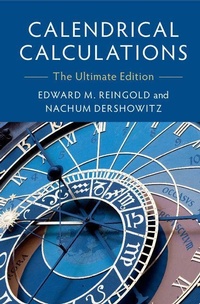
Calendrical Calculations
The Ultimate Edition
4th Edition
Published on 5. April 2018
Book
Hardback
660 pages
978-1-107-05762-3 (ISBN)
Description
An invaluable resource for working programmers, as well as a fount of useful algorithmic tools for computer scientists, astronomers, and other calendar enthusiasts, The Ultimate Edition updates and expands the previous edition to achieve more accurate results and present new calendar variants. The book now includes coverage of Unix dates, Italian time, the Akan, Icelandic, Saudi Arabian Umm al-Qura, and Babylonian calendars. There are also expanded treatments of the observational Islamic and Hebrew calendars and brief discussions of the Samaritan and Nepalese calendars. Several of the astronomical functions have been rewritten to produce more accurate results and to include calculations of moonrise and moonset. The authors frame the calendars of the world in a completely algorithmic form, allowing easy conversion among these calendars and the determination of secular and religious holidays. LISP code for all the algorithms is available in machine-readable form.
Reviews / Votes
'It retains all the features that made the first edition ... such a wonderful resource, while adding much new material ... If you are at all interested in time and calendars, this book must find a place on your desk.' Victor J. Katz, Mathematical ReviewsMore details
Edition
4th Revised edition
Language
English
Place of publication
Cambridge
United Kingdom
Target group
Professional and scholarly
Edition type
Revised edition
Dimensions
Height: 240 mm
Width: 161 mm
Thickness: 43 mm
Weight
1272 gr
ISBN-13
978-1-107-05762-3 (9781107057623)
Copyright in bibliographic data and cover images is held by Nielsen Book Services Limited or by the publishers or by their respective licensors: all rights reserved.
Schweitzer Classification
Other editions
Additional editions
E-Book
04/2018
4th Edition
Cambridge University Press
€38.49
Available for download
E-Book
04/2018
Cambridge University Press
€38.49
Available for download
Previous edition
Nachum Dershowitz | Edward M. Reingold
Calendrical Calculations
Book
12/2007
3rd Edition
Cambridge University Press
€89.13
Article exhausted; check for reprint
Persons
Edward M. Reingold is Professor of Computer Science at the Illinois Institute of Technology, where he also served as chair from 2000 to 2006. Prior to that, he was a faculty member in the Department of Computer Science at the University of Illinois, Urbana-Champaign for thirty years. His research interests are in theoretical computer science, especially the design and analysis of algorithms and data structures. A Fellow of the Association for Computing Machinery since 1996, Reingold has authored or coauthored more than seventy research papers and ten books; his papers on backtrack search, generation of combinations, weight-balanced binary trees, and drawing of trees and graphs are considered classics. Reingold has won awards for his undergraduate and graduate teaching, and is intensely interested in calendars and their computer implementation. He is the author of Calendrical Tabulations (with Nachum Dershowitz, Cambridge, 2002) and is the author and former maintainer of the calendar/diary part of GNU Emacs. Nachum Dershowitz is Professor of Computational Logic at Tel Aviv University. Beyond his expertise in calendars, he is a leading figure in software verification in general and termination of programs in particular, and is an international authority on equational inference and term rewriting. Other areas in which he has made major contributions include program semantics, analysis of historical manuscripts, and combinatorial enumeration. Dershowitz has authored or coauthored more than 100 research papers and several books and has held visiting positions at prominent institutions around the globe. He has won numerous awards for his research and teaching, including the Herbrand Award for Distinguished Contributions to Automated Reasoning (2011), and Test-of-Time awards for the Institute of Electrical and Electronics Engineers Symposium on Logic in Computer Science (2006), for the International Conference on Rewriting Techniques and Applications (2014), and for the International Conference on Automated Deduction (2015). He was elected to Academia Europaea in 2013.
Content
1. Calendar basics; Part I. Arithmetical Calendars: 2. The Gregorian calendar; 3. The Julian calendar; 4. The Coptic and Ethiopic calendars; 5. The ISO calendar; 6. The Icelandic calendar; 7. The Islamic calendar; 8. The Hebrew calendar; 9. The Ecclesiastical calendars; 10. The old Hindu calendars; 11. The Mayan calendars; 12. The Balinese Pawukon calendar; 13. Generic Cyclical calendars; Part II. Astronomical Calendars: 14. Time and astronomy; 15. The Persian calendar; 16. The Baha'i calendar; 17. The French Revolutionary calendar; 18. Astronomical Lunar calendars; 19. The Chinese calendar; 20. The modern Hindu calendars; 21. The Tibetan calendar; Part III. Appendices: A. Function, parameter, and constant types; B. Cross references; C. Sample data; D. Lisp implementation.