

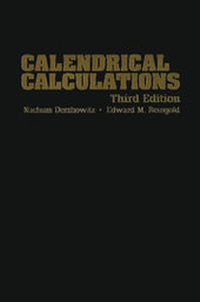
Calendrical Calculations
3rd Edition
Published on 10. December 2007
Book
Hardback
512 pages
978-0-521-88540-9 (ISBN)
Description
A valuable resource for working programmers, as well as a fount of useful algorithmic tools for computer scientists, this new edition of the popular calendars book expands the treatment of the previous edition to new calendar variants: generic cyclical calendars and astronomical lunar calendars as well as the Korean, Vietnamese, Aztec, and Tibetan calendars. The authors frame the calendars of the world in a completely algorithmic form, allowing easy conversion among these calendars and the determination of secular and religious holidays. LISP code for all the algorithms are available on the Web.
Reviews / Votes
'Because years, months, and days don't mesh simply, calendar making has been a challenge throughout history. Reingold and Dershowitz's compendium, here in its third edition, has already established itself as the definitive reference on calendrical structures. Their manual displays conversions between all the major calendar systems as well as between many fascinating schemes from bygone civilizations.' Owen Gingerich, Harvard-Smithsonian Center for Astrophysics 'One of the most fascinating books I've read all year. Takes chronology into the computer age with impressive erudition and elan. Just finding out what the calendar rules are is usually close to impossible: Calendrical Calculations tells you how to use them too. A must for everyone who worries about days, months, years - and why they never quite fit.' Ian Stewart ' ... a good, comprehensive documentation of software for calculating dates on very many calendars.' P. Kenneth Seidelmann, Director of Astrometry, U.S. Naval Observatory '... something of immense value ... a true labor of love, this cultural service to humanity should be in every library of the world.' Choice 'If you are interested in Calendars this book is a must have - an excellent mind-broadening book.' Journal of the ACCU ' ... this book must surely become the standard work on calendar conversions. No historian, chronologist or recreational mathematician should be without it.' E. G. Richards, NatureMore details
Edition
3rd Revised edition
Language
English
Place of publication
Cambridge
United Kingdom
Target group
Professional and scholarly
Edition type
Revised edition
Illustrations
20 Tables, unspecified
Dimensions
Height: 242 mm
Width: 160 mm
Thickness: 27 mm
Weight
798 gr
ISBN-13
978-0-521-88540-9 (9780521885409)
Copyright in bibliographic data and cover images is held by Nielsen Book Services Limited or by the publishers or by their respective licensors: all rights reserved.
Schweitzer Classification
Other editions
New editions
Book
04/2018
4th Edition
Cambridge University Press
€142.10
Shipment within 15-20 days
Additional editions
Nachum Dershowitz
Calendrical Calculations
E-Book
12/2007
Cambridge University Press
€36.99
Available for download
Nachum Dershowitz | Edward M. Reingold
Calendrical Calculations
E-Book
12/2007
3rd Edition
Cambridge University Press
€44.49
Available for download
Persons
In addition to his expertise on calendars, Nachum Dershowitz is a leading figure in software verification in general, and termination of programs in particular; he is an international authority on equational inference and term-rewriting. Other research interests of his include program semantics and combinatorial enumeration. Dershowitz has authored or co-authored over one hundred research papers and several books and has held visiting positions at prominent institutions around the globe. He has won numerous awards for his research and teaching. He was born in 1951 and his graduate degrees in Applied Mathematics are from the Weizmann Institute in Israel. He is currently a Professor of Computer Science at Tel-Aviv University. Edward M. Reingold was born in Chicago, Illinois in 1945. He has an undergraduate degree in Mathematics from Illinois Institute of Technology and a Ph.D. in Computer Science from Cornell University. Reingold has been at the University of Illinois at Urbana-Champaign since 1970; he now a Professor of Computer Science there. His research interests are in theoretical computer science, especially the design and analysis of algorithms and data structures. A Fellow of the Association for Computing Machinery since 1995, Reingold has authored or co-authored over fifty research papers and nine books; his papers on backtrack search, generation of combinations, weight-balanced binary trees, and drawing of trees and graphs are considered classics. He has won awards for his undergraduate and graduate teaching. Reingold is intensely interested in calendars and their computer implementation: in addition to Calendrical Tabulations and Calendrical Calculations, he is the author and maintainer of the calendar/diary part of GNU Emacs.
Content
1. Introduction; Part I. Arithmetical Calendars: 2. The Gregorian calendar; 3. The Julian calendar; 4. The Coptic and Ethiopic calendars; 5. The ISO calendar; 6. The Islamic calendar; 7. The Hebrew calendar; 8. The Ecclesiastical calendars; 9. The Old Hindu calendars; 10. The Mayan calendar; 11. The Balinese Pawukon calendar; 12. Generic cyclical calendars; Part II. Astronomical Calendars: 13. Time and astronomy; 14. The Persian calendar; 15. The Baha'i calendar; 16. The French Revolutionary calendar; 17. The Chinese calendar; 18. The modern Hindu calendars ; 19. The Tibetan calendar; 20. Astronomical lunar calendars coda; Part III. Appendices: A. Function, parameter, and constant types; B. Lisp implementation; C. Sample data.