

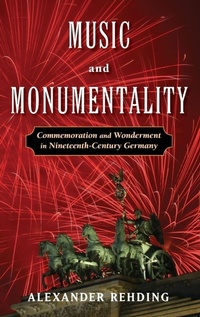
Music and Monumentality
Commemoration and Wonderment in Nineteenth Century Germany
Published on 20. August 2009
Book
Hardback
320 pages
978-0-19-538538-0 (ISBN)
Description
A few weeks after the reunification of Germany, Leonard Bernstein raised his baton above the ruins of the Berlin Wall and conducted a special arrangement of Beethoven's Ninth Symphony. The central statement of the work, that "all men will be brothers," captured the sentiment of those who saw a brighter future for the newly reunited nation. This now-iconic performance is a palpable example of "musical monumentality" - a significant concept which underlies our cultural and ideological understanding of Western art music since the nineteenth-century. Although the concept was first raised in the earliest years of musicological study in the 1930s, a satisfying exploration of the "monumental" in music has not yet been made. Alexander Rehding, one of the brightest young stars in the field, takes on the task in Resounding Monumentality, an elegant, thorough treatment that will serve as a foundation for all future discussion in this area.
Rehding sets his focus on the main players of the period within the Austro-German repertoire -Beethoven, Liszt, Wagner, Brahms, Bruckner and Mahler- as he unpacks a two-fold definition of "musical monumentality." In the conventional sense, monumentality is a stylistic property often described as 'grand,' 'uplifting,' and 'sublime' and rife with overpowering brass chorales, sparkling string tremolos, triumphant fanfares, and glorious thematic returns. Yet Rehding sees the monumental in music performing a cultural task as well: it is employed in the service of establishing national identity. Through a clear theoretical lens, Rehding examines how grand sound effects are strategically employed with the view to overwhelming audiences, how supposedly immutable musical halls of fame change over time, how challenging musical works are domesticated, how the highest cultural achievements are presented in immediately consumable form-in a word, how German music emerges as a unified cultural and musical brand.
Rehding sets his focus on the main players of the period within the Austro-German repertoire -Beethoven, Liszt, Wagner, Brahms, Bruckner and Mahler- as he unpacks a two-fold definition of "musical monumentality." In the conventional sense, monumentality is a stylistic property often described as 'grand,' 'uplifting,' and 'sublime' and rife with overpowering brass chorales, sparkling string tremolos, triumphant fanfares, and glorious thematic returns. Yet Rehding sees the monumental in music performing a cultural task as well: it is employed in the service of establishing national identity. Through a clear theoretical lens, Rehding examines how grand sound effects are strategically employed with the view to overwhelming audiences, how supposedly immutable musical halls of fame change over time, how challenging musical works are domesticated, how the highest cultural achievements are presented in immediately consumable form-in a word, how German music emerges as a unified cultural and musical brand.
Reviews / Votes
it does more than simply provide historical background to questions of present-day importance; one of the most impressive features of this book is its multilayered treatment of its topic, constantly using the attitudes and practices of one period to interrogate those of the others ... [this monograph] makes an original and highly stimulating contribution to both musicology and cultural history. * James Garratt, Music and Letters *More details
Language
English
Place of publication
New York
United States
Target group
College/higher education
Professional and scholarly
Illustrations
20 black and white half tone, 28 line illustrations
Dimensions
Height: 240 mm
Width: 161 mm
Thickness: 23 mm
Weight
705 gr
ISBN-13
978-0-19-538538-0 (9780195385380)
Copyright in bibliographic data and cover images is held by Nielsen Book Services Limited or by the publishers or by their respective licensors: all rights reserved.
Schweitzer Classification
Other editions
Additional editions
E-Book
03/2017
OUP eBook
€18.99
Available for download
E-Book
03/2017
1st Edition
OUP eBook
€20.99
Available for download
Book
01/2017
Oxford University Press Inc
€47.30
Shipment within 15-20 days
Person
Alexander Rehding is Professor of Music at Harvard University and co-editor of Acta musicological. His research specializes in nineteenth and twentieth century music and in the history of music theory. He is the author of Hugo Riemann and the Birth of Modern Musical Thought (Cambridge University Press, 2003).
Content
ACKNOWLEDGEMENTS; PREFACE; INTRODUCTION - FACETS OF MUSICAL MONUMENTALITY; EPILOGUE - BEETHOVEN'S NINTH AT THE WALL; BIBLIOGRAPHY; INDEX