

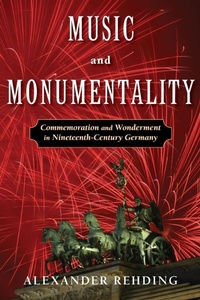
Music and Monumentality
Commemoration and Wonderment in Nineteenth-Century Germany
Published on 26. January 2017
Book
Paperback/Softback
320 pages
978-0-19-065613-3 (ISBN)
Description
A few weeks after the reunification of Germany, Leonard Bernstein raised his baton above the ruins of the Berlin Wall and conducted a special arrangement of Beethoven's Ninth Symphony. The central statement of the work, that "all men will be brothers," captured the sentiment of those who saw a brighter future for the newly reunited nation. This now-iconic performance is a palpable example of "musical monumentality" - a significant concept that underlies our cultural and ideological understanding of Western music since the nineteenth century. Although the concept was first raised in the earliest years of musicological study in the 1930s, a satisfying exploration of the "monumental" in music has not yet been made. Alexander Rehding, one of the brightest young stars in the field takes on the task in Music and Monumentality, an elegant, thorough treatment that will serve as a foundation for all future discussion in the area.
Rehding sets his focus on the main players of the period within the Austro-German repertoire - Beethoven, Liszt, Wagner, Brahms, Bruckner, and Mahler - as he unpacks a twofold definition of musical monumentality. In the conventional sense, monumentality is a stylistic property often described as 'grand,' 'uplifting,' and 'sublime,' rife with overpowering brass chorales, sparking string tremolos, triumphant fanfares, and glorious thematic returns. Yet Rehding sees the monumental in music performing a cultural task as well: it is employed in the service of establishing national identity. Through a clear theoretical lens, Rehding examines how grand sound effects are strategically employed with the view to overwhelming audiences, how supposedly immutable musical halls of fame change over time, how challenging musical works are domesticated, how the highest cultural achievements are presented in immediately consumable form - in short, how German music emerges as a unified cultural and musical brand.
Music and Monumentality is an important addition to the libraries of students and scholars of Western musicology and music theory, as well as all readers and listeners interested in music theory, nationalism, and the nineteenth century.
Rehding sets his focus on the main players of the period within the Austro-German repertoire - Beethoven, Liszt, Wagner, Brahms, Bruckner, and Mahler - as he unpacks a twofold definition of musical monumentality. In the conventional sense, monumentality is a stylistic property often described as 'grand,' 'uplifting,' and 'sublime,' rife with overpowering brass chorales, sparking string tremolos, triumphant fanfares, and glorious thematic returns. Yet Rehding sees the monumental in music performing a cultural task as well: it is employed in the service of establishing national identity. Through a clear theoretical lens, Rehding examines how grand sound effects are strategically employed with the view to overwhelming audiences, how supposedly immutable musical halls of fame change over time, how challenging musical works are domesticated, how the highest cultural achievements are presented in immediately consumable form - in short, how German music emerges as a unified cultural and musical brand.
Music and Monumentality is an important addition to the libraries of students and scholars of Western musicology and music theory, as well as all readers and listeners interested in music theory, nationalism, and the nineteenth century.
Reviews / Votes
An original and highly stimulating contribution to both musicology and cultural history. * Music and Letters * Rehding ranges widely within each chapter, pulling threads from many areas of thought. Recommended. * Choice * Prepare to have your assumptions rearranged by Alexander Rehding's brilliantly nimble variations on the monumental in music. Above all, he refuses to treat his subjects as immobilized monoliths ripe for defacement, but rather seeks to liberate the full range of their cultural resonance. * Scott Burnham, Princeton University * 'Monumentality' turns out to be something like the elephant in the room of nineteenth-century musical culture, a topic so obvious but at the same time so huge and potentially disconcerting that musicologists have all but ignored it. Alex Rehding traces the lineaments of this intriguing, elusive cultural beast in a series of brilliant essays illustrating the ways in which histories of composition, canon, memory, nation, and indeed musicology itself participate in a collective project of monumentalization, one whose consequences for the twentieth century we are only beginning to appreciate. Ranging from the Romantic infancy of music journalism to the first triumphs of modern musical edition-making, from Wagner's Gluck revival to Bruckner's entry into 'Walhalla' to Beethoven at the Berlin Wall, this study illuminates the aesthetics and politics of the musical monument in fascinating ways that open up a whole new field of inquiry. * Thomas Grey, Stanford University * This elegantly written book is not so much a monument to musical monumentality as an archeology of a neglected and half-forgotten concept. With his virtuosic command of historical and theoretical tools, Rehding excavates several sites - some familiar, others obscure - unearthing the complex cultural mechanisms of this deceptively simple aesthetic in order to demonstrate its foundational significance in the formation of German identity. The sounding monument may be an outmoded aesthetic in the twenty-first century; by exploring its history, however, Rehding not only lays bare its past but demonstrates how it still determines our cultural practices today. This is an important book, rich in detail yet broad in scope, and should be widely read. * Daniel K. L. Chua, Head of the School of Humanities, The University of Hong Kong *More details
Language
English
Place of publication
New York
United States
Target group
College/higher education
Dimensions
Height: 234 mm
Width: 156 mm
Thickness: 19 mm
Weight
547 gr
ISBN-13
978-0-19-065613-3 (9780190656133)
Copyright in bibliographic data and cover images is held by Nielsen Book Services Limited or by the publishers or by their respective licensors: all rights reserved.
Schweitzer Classification
Other editions
Additional editions
E-Book
03/2017
OUP eBook
€18.99
Available for download
Book
08/2009
Oxford University Press Inc
€115.00
Shipment within 15-20 days
Person
Alexander Rehding is the Fanny Peabody Professor of Music at Harvard University, an affiliate of the Department of Germanic Languages and Literatures, and an associate at the Center for European Studies. His research specializes in nineteenth-century music and in history of music theory. He is author of Hugo Riemann and the Birth of Modern Musical Thought.
Content
Acknowledgements
Preface
Introduction - Facets of musical monumentality
Chapter 1 - Musical Apotheoses
Chapter 2 - Sounding Souvenirs
Chapter 3 - Classical Values
Chapter 4 - Collective Historia
Chapter 5 - Faustian Descents
Epilogue - Beethoven's Ninth at the Wall
Bibliography
Index
Preface
Introduction - Facets of musical monumentality
Chapter 1 - Musical Apotheoses
Chapter 2 - Sounding Souvenirs
Chapter 3 - Classical Values
Chapter 4 - Collective Historia
Chapter 5 - Faustian Descents
Epilogue - Beethoven's Ninth at the Wall
Bibliography
Index