

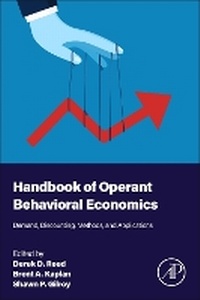
Handbook of Operant Behavioral Economics
Demand, Discounting, Methods, and Applications
Published on 29. July 2025
Book
Paperback/Softback
364 pages
978-0-323-95745-8 (ISBN)
Description
Handbook of Operant Behavioral Economics: Demand, Discounting, Methods, and Applications delves into the rapidly evolving field of behavioral economics, focusing specifically on the operant approach that marries operant learning principles with microeconomic theory. This comprehensive guide begins with a brief history of behavioral economics, setting the stage for a more thorough review of operant demand and reward discounting. It presents both human and nonhuman research methods, offering critical insights into how these methodologies can be employed to study consumption behaviors and decision-making processes. This book also features quantitative models that elucidate operant demand and discounting, along with practical applications that extend the relevance of these concepts to real-world scenarios. Additionally, it highlights the policy implications of applied behavioral economics, bridging the gap between theory and practice. With a strong emphasis on consumer behavior analysis as a foundational element, this handbook equips readers with the knowledge to translate academic research into actionable policy. Designed for graduate students, clinicians, and academics alike, this resource is ideal for those looking to deepen their understanding of behavioral economics and its applications.
More details
Language
English
Place of publication
Oxford
United Kingdom
Publishing group
Elsevier Science & Technology
Target group
Professional and scholarly
Dimensions
Height: 229 mm
Width: 152 mm
Weight
450 gr
ISBN-13
978-0-323-95745-8 (9780323957458)
Copyright in bibliographic data and cover images is held by Nielsen Book Services Limited or by the publishers or by their respective licensors: all rights reserved.
Schweitzer Classification
Other editions
Additional editions
Bcba-D Reed | Brent A. Kaplan | Ncsp Gilroy
Handbook of Operant Behavioral Economics
Demand, Discounting, Methods, and Applications
E-Book
07/2025
Elsevier
€140.99
Available for download
Persons
Dr. Reed is Director of Applied Behavioral Sciences at Institutes for Behavior Resources, Inc. His research programs apply behavioral economic principles to understand and treat issues of societal importance. He is an author of a textbook and has co-edited three other books. He has served as Associate Editor for Journal of the Experimental Analysis of Behavior, Journal of Applied Behavior Analysis, The Psychological Record, and Behavior Analysis in Practice. Dr. Reed was previously the Executive Director for the Society for the Quantitative Analyses of Behavior and Coordinator for the ABAI Science Board. His research program has been recognized with the APA Division 25 B. F. Skinner New Applied Researcher Award, Society for the Experimental Analysis of Behavior Don Hake Translational Research Award, and the Federation of Associations of Behavioral and Brain Sciences' Early Career Impact Award. He has over 200 publications.
Dr. Kaplan is a Data Scientist in the Innovation Department at Advocates for Human Potential. He obtained his PhD from the University of Kansas in 2016, completed a postdoctoral fellowship at Virginia Tech in 2019, and most recently worked as an Assistant Professor at the University of Kentucky. He has contributed over 65 peer-reviewed journal articles in behavioral economics, behavioral science, substance use, policy implications, and statistics and methodological tools for experimental psychology. Dr. Kaplan develops and publishes software tools and quantitative methods to aid behavioral economic research, including the R packages beezdemand and beezdiscounting and the R Shiny web app shinybeez. His significant research and scholarly contributions have been recognized with numerous honors and awards, including the APA Division 25 B. F. Skinner New Researcher Award and the APA Division 28 Outstanding Dissertation Award.
Dr. Gilroy is an Assistant Professor of School Psychology at Louisiana State University. His research centers on translating principles of behavior analysis and behavioral economics into approaches for improving academic and behavioral interventions. He writes extensively on models of operant demand and explores their application towards socially significant choice, e.g., treatment-seeking, pseudoscience.
Dr. Kaplan is a Data Scientist in the Innovation Department at Advocates for Human Potential. He obtained his PhD from the University of Kansas in 2016, completed a postdoctoral fellowship at Virginia Tech in 2019, and most recently worked as an Assistant Professor at the University of Kentucky. He has contributed over 65 peer-reviewed journal articles in behavioral economics, behavioral science, substance use, policy implications, and statistics and methodological tools for experimental psychology. Dr. Kaplan develops and publishes software tools and quantitative methods to aid behavioral economic research, including the R packages beezdemand and beezdiscounting and the R Shiny web app shinybeez. His significant research and scholarly contributions have been recognized with numerous honors and awards, including the APA Division 25 B. F. Skinner New Researcher Award and the APA Division 28 Outstanding Dissertation Award.
Dr. Gilroy is an Assistant Professor of School Psychology at Louisiana State University. His research centers on translating principles of behavior analysis and behavioral economics into approaches for improving academic and behavioral interventions. He writes extensively on models of operant demand and explores their application towards socially significant choice, e.g., treatment-seeking, pseudoscience.
Content
1. A Brief History of Behavioral Economics
2. Introduction to Operant Demand
3. Nonhuman Research Methods/Procedures for Studying Operant Demand
4. Human Research Methods for Studying Operant Demand
5. Quantitative Models of Operant Demand
6. Educational and Applied Behavior Analytic Implications of Demand
7. Clinical and Behavioral Health Implications of Demand
8. Introduction to Discounting
9. Nonhuman Research Methods/Procedures for Studying Discounting
10. Human Research Methods for Studying Discounting
11. Quantitative Models of Discounting
12. Educational and Applied Behavior Analytic Implications of Discounting
13. Clinical and Behavioral Health Implications of Demand
14. Policy Implications for Applied Behavioral Economics
15. Consumer Behavioral Economics & Consumer Behavior Analysis
16. Resources for Beginning Lines of Operant Behavioral Economic Research
2. Introduction to Operant Demand
3. Nonhuman Research Methods/Procedures for Studying Operant Demand
4. Human Research Methods for Studying Operant Demand
5. Quantitative Models of Operant Demand
6. Educational and Applied Behavior Analytic Implications of Demand
7. Clinical and Behavioral Health Implications of Demand
8. Introduction to Discounting
9. Nonhuman Research Methods/Procedures for Studying Discounting
10. Human Research Methods for Studying Discounting
11. Quantitative Models of Discounting
12. Educational and Applied Behavior Analytic Implications of Discounting
13. Clinical and Behavioral Health Implications of Demand
14. Policy Implications for Applied Behavioral Economics
15. Consumer Behavioral Economics & Consumer Behavior Analysis
16. Resources for Beginning Lines of Operant Behavioral Economic Research