

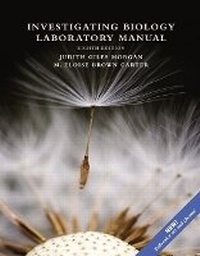
Investigating Biology Laboratory Manual
8th Edition
Published on 29. December 2014
Book
Spiral bound
848 pages
978-0-321-83899-5 (ISBN)
Description
NEW! Now in full color!
With its distinctive investigative approach to learning, this best-selling laboratory manual is now more engaging than ever, with full-color art and photos throughout. As always, the lab manual encourages students to participate in the process of science and develop creative and critical-reasoning skills.
The Eighth Edition includes major revisions that reflect new molecular evidence and the current understanding of phylogenetic relationships for plants, invertebrates, protists, and fungi. The sequence of the lab topics has been reorganized to reflect the closer relationship of the fungi and animal kingdoms. A new lab topic, "Fungi," has been added, providing expanded coverage of the major fungi groups. The "Protists" lab topic has been revised and expanded with additional examples of all the major clades. Both lab topics include suggestions and exercises for open-inquiry investigations.
In the new edition, population genetics is covered in one lab topic with new problems and examples that connect ecology, evolution, and genetics.
With its distinctive investigative approach to learning, this best-selling laboratory manual is now more engaging than ever, with full-color art and photos throughout. As always, the lab manual encourages students to participate in the process of science and develop creative and critical-reasoning skills.
The Eighth Edition includes major revisions that reflect new molecular evidence and the current understanding of phylogenetic relationships for plants, invertebrates, protists, and fungi. The sequence of the lab topics has been reorganized to reflect the closer relationship of the fungi and animal kingdoms. A new lab topic, "Fungi," has been added, providing expanded coverage of the major fungi groups. The "Protists" lab topic has been revised and expanded with additional examples of all the major clades. Both lab topics include suggestions and exercises for open-inquiry investigations.
In the new edition, population genetics is covered in one lab topic with new problems and examples that connect ecology, evolution, and genetics.
More details
Other editions
New editions
Judith Morgan | M. Eloise Carter
Investigating Biology Laboratory Manual
Book
04/2017
9th Edition
Pearson
€163.40
Article exhausted; check different version
Previous edition
Jane B. Reece | Lisa A. Urry | Michael L. Cain
Investigating Biology Lab Manual
Book
01/2011
7th Edition
Pearson
€106.45
Article exhausted; check for reprint
Content
LABS
1. Scientific Investigation
2. Microscopes and Cells
3. Diffusion and Osmosis
4. Enzymes
5. Cellular Respiration and Fermentation
6. Photosynthesis
7. Mitosis and Meiosis
8. Mendelian Genetics I: Fast Plants
9. Mendelian Genetics II: Drosophila
10. Molecular Biology
11. Population Genetics I: The Hardy-Weinberg Theorem
12. Bacteriology
13. Protists
14. Plant Diversity I: Bryophytes (Nonvascular Plants) and Seedless Vascular Plants
15. Plant Diversity II: Seed Plants
16. Bioinformatics: Molecular Phylogeny of Plants
17. The Kingdom Fungi
18. Animal Diversity I: Porifera, Cnidaria, Platyhelminthes, Mollusca, and Annelida
19. Animal Diversity II: Nematoda, Arthropoda, Echinodermata, and Chordata
20. Plant Anatomy
21. Plant Growth
22. Vertebrate Anatomy I: The Skin and Digestive System
23. Vertebrate Anatomy II: The Circulatory and Respiratory Systems
24. Vertebrate Anatomy III: The Excretory, Reproductive, and Nervous Systems
25. Animal Development
26. Animal Behavior
27. Ecology I: Terrestrial Ecology
28. Ecology II: Computer Simulations of a Pond Ecosystem
APPENDIXES
A Scientific Writing and Communication
B The Metric System
C Instrumentation and Techniques
D Chi-Square Test
C Terminology and Techniques for Dissection
1. Scientific Investigation
2. Microscopes and Cells
3. Diffusion and Osmosis
4. Enzymes
5. Cellular Respiration and Fermentation
6. Photosynthesis
7. Mitosis and Meiosis
8. Mendelian Genetics I: Fast Plants
9. Mendelian Genetics II: Drosophila
10. Molecular Biology
11. Population Genetics I: The Hardy-Weinberg Theorem
12. Bacteriology
13. Protists
14. Plant Diversity I: Bryophytes (Nonvascular Plants) and Seedless Vascular Plants
15. Plant Diversity II: Seed Plants
16. Bioinformatics: Molecular Phylogeny of Plants
17. The Kingdom Fungi
18. Animal Diversity I: Porifera, Cnidaria, Platyhelminthes, Mollusca, and Annelida
19. Animal Diversity II: Nematoda, Arthropoda, Echinodermata, and Chordata
20. Plant Anatomy
21. Plant Growth
22. Vertebrate Anatomy I: The Skin and Digestive System
23. Vertebrate Anatomy II: The Circulatory and Respiratory Systems
24. Vertebrate Anatomy III: The Excretory, Reproductive, and Nervous Systems
25. Animal Development
26. Animal Behavior
27. Ecology I: Terrestrial Ecology
28. Ecology II: Computer Simulations of a Pond Ecosystem
APPENDIXES
A Scientific Writing and Communication
B The Metric System
C Instrumentation and Techniques
D Chi-Square Test
C Terminology and Techniques for Dissection