

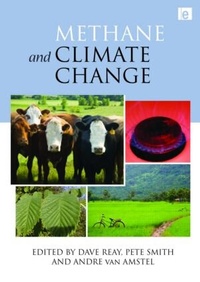
Methane and Climate Change
1st Edition
Will be published approx. on 26. May 2010
Book
Hardback
272 pages
978-1-84407-823-3 (ISBN)
Description
Methane is a powerful greenhouse gas and is estimated to be responsible for approximately one-fifth of man-made global warming. Per kilogram, it is twenty-five times more powerful than carbon dioxide over a 100-year time horizon - and global warming is likely to enhance methane release from a number of sources. Current natural and man-made sources include many where methane-producing micro-organisms can thrive in anaerobic conditions, particularly ruminant livestock, rice cultivation, landfill, wastewater, wetlands and marine sediments.
This timely and authoritative book provides the only comprehensive and balanced overview of our current knowledge of sources of methane and how these might be controlled to limit future climate change. It describes how methane is derived from the anaerobic metabolism of micro-organisms, whether in wetlands or rice fields, manure, landfill or wastewater, or the digestive systems of cattle and other ruminant animals. It highlights how sources of methane might themselves be affected by climate change. It is shown how numerous point sources of methane have the potential to be more easily addressed than sources of carbon dioxide and therefore contribute significantly to climate change mitigation in the 21st century.
This timely and authoritative book provides the only comprehensive and balanced overview of our current knowledge of sources of methane and how these might be controlled to limit future climate change. It describes how methane is derived from the anaerobic metabolism of micro-organisms, whether in wetlands or rice fields, manure, landfill or wastewater, or the digestive systems of cattle and other ruminant animals. It highlights how sources of methane might themselves be affected by climate change. It is shown how numerous point sources of methane have the potential to be more easily addressed than sources of carbon dioxide and therefore contribute significantly to climate change mitigation in the 21st century.
Reviews / Votes
'This book takes a unique and powerful approach to the global methane problem. The organization by the key sources (termites, rice, ruminants etc.) illustrates the global nature of the challenge and directly points the way to novel solutions.'Peter M. Groffman, Cary Institute of Ecosystem Studies, USA
More details
Language
English
Place of publication
London
United Kingdom
Publishing group
Taylor & Francis Ltd
Target group
College/higher education
Dimensions
Height: 234 mm
Width: 156 mm
Weight
498 gr
ISBN-13
978-1-84407-823-3 (9781844078233)
Copyright in bibliographic data and cover images is held by Nielsen Book Services Limited or by the publishers or by their respective licensors: all rights reserved.
Schweitzer Classification
Other editions
Additional editions
Dave Reay | Pete Smith | Andre Van Amstel
Methane and Climate Change
Book
05/2015
1st Edition
Routledge
€85.60
Shipment within 10-20 days
Dave Reay | Pete Smith | Andre Van Amstel
Methane and Climate Change
E-Book
08/2010
1st Edition
Routledge
€69.99
Available for download
Dave Reay | Pete Smith | Andre Van Amstel
Methane and Climate Change
E-Book
08/2010
1st Edition
Routledge
€69.99
Available for download
Persons
Dave Reay is a senior lecturer in Carbon Management in the School of Geosciences at the University of Edinburgh. He is the author of several climate change books and runs the Greenhouse Gas Online web site, which has won several awards.
Pete Smith is the Royal Society-Wolfson Professor of Soils & Global Change, in the School of Biological Sciences at the University of Aberdeen, UK.
Andre van Amstel is Assistant Professor in the Dept. Environmental Sciences at Wageningen University, The Netherlands.
Pete Smith is the Royal Society-Wolfson Professor of Soils & Global Change, in the School of Biological Sciences at the University of Aberdeen, UK.
Andre van Amstel is Assistant Professor in the Dept. Environmental Sciences at Wageningen University, The Netherlands.
Content
1. Methane Sources and the Global Methane Budget
2. The Microbiology of Methanogenesis
3. Wetlands
4. Geological Methane
5. Termites
6. Vegetation
7. Biomass Burning
8. Rice Cultivation
9. Ruminants
10. Wastewater and Manure
11. Landfill
12. Fossil Energy and Ventilation Air Methane
13. Options for Methane Control
14. Summary
Index
2. The Microbiology of Methanogenesis
3. Wetlands
4. Geological Methane
5. Termites
6. Vegetation
7. Biomass Burning
8. Rice Cultivation
9. Ruminants
10. Wastewater and Manure
11. Landfill
12. Fossil Energy and Ventilation Air Methane
13. Options for Methane Control
14. Summary
Index