

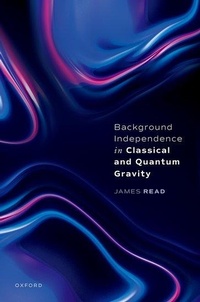
Background Independence in Classical and Quantum Gravity
Published on 9. November 2023
Book
Hardback
160 pages
978-0-19-288911-9 (ISBN)
Description
It is often claimed that Einstein's magnum opus---his 1915 theory of General Relativity---is distinguished from other theories of space and time in virtue of its background independence. It's also often claimed that background independence is an essential feature of any quantum theory of gravity. But are these claims true? This book aspires to offer definitive answers to both of these questions, by (a) charting the space of possible definitions of background independence, and (b) applying said definitions to various classical and quantum theories of gravity. The outcome, in brief, is as follows: General Relativity is not unique by virtue of its background independence (and, indeed, fails to be background independent on some popular definitions); moreover, the situation in the case of quantum theories of gravity is delicate, because (i) there are viable such theories which (by some accounts, at least) fail to be background independent, but also (ii) theories (e.g. perturbative string theory) which have often been dismissed for (allegedly) being background dependent in fact, on many accounts, are better classified as background independent. In giving these answers in rigorous detail, this book seeks to elevate the standards and generality of future discussions of background independence in the foundations of spacetime theories.
Reviews / Votes
Read has given us a wonderful analysis of the formal aspects of various conceptions of background-independence, with minimal discussion of their interpretation. * Sebastian De Haro, The British Journal for the Philosophy of Science * A fascinating, ambitious, and thought-provoking account of ancient exploration. By placing exploration in its wider societal context, Schulz offers a reason why people seemed to regularly--even keenly--sail into the unknown, and how these explorations created more opportunities to explore farther afield, developed ancient notions of science and medicine, and even contributed to the discovery of the Americas in the fifteenth century. * Ancient History * The book would be of interest to philosophers of physics with interests in the foundations of spacetime theories and quantum gravity. It would also be useful as acomplementary book to a graduate class on the philosophy of space and time and as a resource for reviewing classical and quantum theories of spacetime. * Clara Bradley, Cambridge University Press * ...Read does admirable work in synthesizing a considerable body of specialist literature in physics and its foundations into a coherent and comprehensible survey. ...Background Independence in Classical and Quantum Gravity will prove of undoubted lasting value. * Karim P. Y. Thebault, Metascience *More details
Language
English
Place of publication
Oxford
United Kingdom
Target group
College/higher education
Product notice
sewn/stitched
Cloth over boards
Dimensions
Height: 235 mm
Width: 161 mm
Thickness: 18 mm
Weight
400 gr
ISBN-13
978-0-19-288911-9 (9780192889119)
Copyright in bibliographic data and cover images is held by Nielsen Book Services Limited or by the publishers or by their respective licensors: all rights reserved.
Schweitzer Classification
Other editions
Additional editions
E-Book
12/2023
1st Edition
OUP eBook
€68.49
Available for download
E-Book
10/2023
1st Edition
OUP eBook
€68.49
Available for download
Person
James Read is an Associate Professor of Philosophy at the University of Oxford. He studied Physics and Philosophy at Oxford, and Mathematics at Cambridge, before completing a doctorate in Philosophy from Oxford in 2018. He works in the philosophy of physics, in particular on issues in the foundations of spacetime theories and symmetries. His work has won various international awards, including the Hanneke Janssen Prize and Clifton Memorial Prize.
Content
1: Introduction 2: Models and Gauge 3: Classical Background Independence 4: Classical Theories of Spacetime 5: Quantum Theories of Spacetime 6: Conclusions