


Stop Walking On Eggshells
Taking Your Life Back When Someone You Care About Has Borderline Personality Disorder
Published on 28. January 2010
Book
Paperback/Softback
288 pages
978-1-57224-690-4 (ISBN)
Description
Do you feel manipulated, controlled, or lied to? Are you the focus of intense, violent, and irrational rages? Do you feel you are 'walking on eggshells' to avoid the next confrontation? If the answer is 'yes,' someone you care about may have borderline personality disorder (BPD).
Stop Walking on Eggshells has already helped nearly half a million people with friends and family members suffering from BPD understand this destructive disorder, set boundaries, and help their loved ones stop relying on dangerous BPD behaviors.
This fully revised edition has been updated with the very latest BPD research and includes coping and communication skills you can use to stabilize your relationship with the BPD sufferer in your life. This compassionate guide will enable you to:
Make sense out of the chaos.
Stand up for yourself and assert your needs.
Defuse arguments and conflicts.
Protect yourself and others from violent behavior.
Stop Walking on Eggshells has already helped nearly half a million people with friends and family members suffering from BPD understand this destructive disorder, set boundaries, and help their loved ones stop relying on dangerous BPD behaviors.
This fully revised edition has been updated with the very latest BPD research and includes coping and communication skills you can use to stabilize your relationship with the BPD sufferer in your life. This compassionate guide will enable you to:
Make sense out of the chaos.
Stand up for yourself and assert your needs.
Defuse arguments and conflicts.
Protect yourself and others from violent behavior.
Reviews / Votes
Stop Walking on Eggshells makes good on its promise to restore the lives of people in close relationships with someone diagnosed with borderline personality disorder (BPD). It is a rich guide to understanding and coping with the reactions aroused in others by troubling BPD behaviors that negatively impact relationships. Readers will find this book very useful and beneficial. -- Nina W. Brown, Ed.D., professor and Eminent Scholar at Old Dominion University in Norfolk, VA, author of Children of the Self-Absorbed This book is the absolute go-to guide for my clients who are dealing with a loved one with borderline personality disorder. Readable and thorough, it strikes a perfect balance of practical advice and emotional sensitivity. This book has helped so many people break through their sense of confusion and isolation by helping them to name, understand, and respond to the difficulties of this complex and misunderstood disorder. -- Daniel E. Mattila, M.Div., LCSWMore details
Language
English
Place of publication
Oakland, CA
United States
Dimensions
Height: 227 mm
Width: 153 mm
Thickness: 15 mm
Weight
387 gr
ISBN-13
978-1-57224-690-4 (9781572246904)
Copyright in bibliographic data and cover images is held by Nielsen Book Services Limited or by the publishers or by their respective licensors: all rights reserved.
Schweitzer Classification
Other editions
New editions
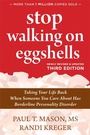
Paul T. Mason | Randi Kreger
Stop Walking on Eggshells
Taking Your Life Back When Someone You Care About Has Borderline Personality Disorder
Book
01/2021
New Harbinger Publications
€21.50
Shipment within 3-4 weeks
Previous edition

Paul T. Mason | Randy Kreger
Stop Walking on Eggshells
Coping When Someone You Care About Has Borderline Personality Disorder
Book
07/1998
New Harbinger Publications
€34.84
Article exhausted; check for reprint
Persons
Paul T. Mason, MS, is vice president of clinical services at Wheaton Franciscan Healthcare in Racine, WI. Under his leadership, the mental health and addiction care service line has expanded the number of inpatient services and outpatient programs it provides for patients, family members, and loved ones affected by borderline personality disorder (BPD). His research on BPD has been published in the Journal of Clinical Psychology and his written work has appeared in the news and print media.