

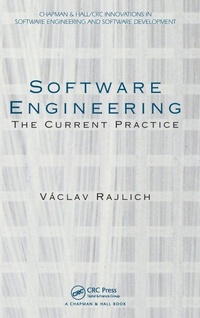
Software Engineering
The Current Practice
1st Edition
Published on 17. November 2011
Book
Hardback
320 pages
978-1-4398-4122-8 (ISBN)
Description
Software Engineering: The Current Practice teaches students basic software engineering skills and helps practitioners refresh their knowledge and explore recent developments in the field, including software changes and iterative processes of software development.
After a historical overview and an introduction to software technology and models, the book discusses the software change and its phases, including concept location, impact analysis, refactoring, actualization, and verification. It then covers the most common iterative processes: agile, directed, and centralized processes. The text also journeys through the software life span from the initial development of software from scratch to the final stages that lead toward software closedown.
For ProfessionalsThe book gives programmers and software managers a unified view of the contemporary practice of software engineering. It shows how various developments fit together and fit into the contemporary software engineering mosaic. The knowledge gained from the book allows practitioners to evaluate and improve the software engineering processes in their projects.
For InstructorsInstructors have several options for using this classroom-tested material. Designed to be run in conjunction with the lectures, ideas for student projects include open source programs that use Java or C++ and range in size from 50 to 500 thousand lines of code. These projects emphasize the role of developers in a classroom-tailored version of the directed iterative process (DIP).
For StudentsStudents gain a real understanding of software engineering processes through the lectures and projects. They acquire hands-on experience with software of the size and quality comparable to that of industrial software. As is the case in the industry, students work in teams but have individual assignments and accountability.
After a historical overview and an introduction to software technology and models, the book discusses the software change and its phases, including concept location, impact analysis, refactoring, actualization, and verification. It then covers the most common iterative processes: agile, directed, and centralized processes. The text also journeys through the software life span from the initial development of software from scratch to the final stages that lead toward software closedown.
For ProfessionalsThe book gives programmers and software managers a unified view of the contemporary practice of software engineering. It shows how various developments fit together and fit into the contemporary software engineering mosaic. The knowledge gained from the book allows practitioners to evaluate and improve the software engineering processes in their projects.
For InstructorsInstructors have several options for using this classroom-tested material. Designed to be run in conjunction with the lectures, ideas for student projects include open source programs that use Java or C++ and range in size from 50 to 500 thousand lines of code. These projects emphasize the role of developers in a classroom-tailored version of the directed iterative process (DIP).
For StudentsStudents gain a real understanding of software engineering processes through the lectures and projects. They acquire hands-on experience with software of the size and quality comparable to that of industrial software. As is the case in the industry, students work in teams but have individual assignments and accountability.
Reviews / Votes
"... a great read ... this [is] an entirely different approach to teaching software engineering and it could really help students (and practitioners) understand recent advances in software engineering and become better software engineers. ... this book explains software engineering not from a constructionist point of view, but from a change/maintenance perspective, meaning most of the time you need to read/analyze programs rather than write them (though there is plenty of material in the book to support green field development)."-Will Tracz, ACM SIGSOFT Software Engineering Notes, November 2013
More details
Series
Language
English
Place of publication
Oxford
United States
Publishing group
Taylor & Francis Inc
Target group
College/higher education
Senior undergraduate and graduate students in software engineering; software engineers.
Illustrations
111 s/w Abbildungen, 21 s/w Tabellen
21 Tables, black and white; 111 Illustrations, black and white
Dimensions
Height: 235 mm
Width: 157 mm
Thickness: 22 mm
Weight
610 gr
ISBN-13
978-1-4398-4122-8 (9781439841228)
Copyright in bibliographic data and cover images is held by Nielsen Book Services Limited or by the publishers or by their respective licensors: all rights reserved.
Schweitzer Classification
Other editions
Additional editions
E-Book
04/2016
1st Edition
Chapman & Hall/CRC
€125.99
Available for download
E-Book
04/2016
1st Edition
Chapman & Hall/CRC
€125.99
Available for download
Person
Vaclav Rajlich is a professor and former chair of computer science at Wayne State University. Dr. Rajlich is an editorial board member of the Journal of Software Maintenance and Evolution and the founder and permanent steering committee member of the IEEE International Conference on Program Comprehension (ICPC). His research focuses on software evolution and comprehension.
Content
INTRODUCTION: History of Software Engineering. Software Life Span Models. Software Technologies. Software Models. SOFTWARE CHANGE: Introduction to Software Change. Concepts and Concept Location. Impact Analysis. Actualization. Refactoring. Verification. Conclusion of Software Change. SOFTWARE PROCESSES: Introduction to Software Processes. Team Iterative Processes. Initial Development. Final Stages. CONCLUSION: Related Topics. Example of Software Change. Example of SIP. Index.