

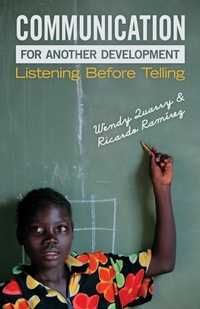
Communication for Another Development
Listening before Telling
Published on 13. August 2009
Book
Paperback/Softback
168 pages
978-1-84813-009-8 (ISBN)
Description
This lively book argues that in the development process, communication is everything. The authors, world experts in this field as teachers, practitioners and theorists, argue that Communication for Development is a creative and innovative way of thinking that can permeate the overall approach to any development initiative. They illustrate their argument with vivid case studies and tools for the reader, drawing on the stories of individual project leaders who have championed development for communication, and using a range of situations to show the different possibilities in various contexts.
Free from jargon, and keeping a close look at how development is actually being implemented at ground level, this book is an important contribution to development studies not just for students but also for development practitioners and policy makers.
Free from jargon, and keeping a close look at how development is actually being implemented at ground level, this book is an important contribution to development studies not just for students but also for development practitioners and policy makers.
Reviews / Votes
'Personal funny and entertaining, this book provides a better insight into the value, potential - and ultimately hugely frustrating practice - of using communication to listen rather than tell than any I've come across for a very long time. Anyone interested in development will learn much from this book. Those working or interested in using communication in development could usefully place it on their required reading list.'James Deane, BBC World Service Trust
'Quarry and Ramirez have written a highly readable, information-packed, lucid book on the challenges and successes of communication for international social change. Drawing from their extensive expertise, they patiently dissect the lessons from numerous programs showing how grassroots communication contributes to sustainable change.'
Silvio Waisbord
'This should become required reading for communication for development practitioners. This highly personal reflection by two experienced advocates of participatory communication lays bare the reasons why we are so often frustrated with the outcomes of our work, while showing clearly the opportunities for creative support of empowering development from good deployment of communication processes. The stories from their own and others' professional experience demonstrate the power of narrative in bringing us face to face with our preconceptions and misunderstanding.'
Chris Garforth, Reading University
More details
Language
English
Place of publication
United Kingdom
Publishing group
Bloomsbury Publishing PLC
Target group
College/higher education
Professional and scholarly
Dimensions
Height: 216 mm
Width: 140 mm
Thickness: 9 mm
Weight
218 gr
ISBN-13
978-1-84813-009-8 (9781848130098)
Copyright in bibliographic data and cover images is held by Nielsen Book Services Limited or by the publishers or by their respective licensors: all rights reserved.
Schweitzer Classification
Other editions
Additional editions
E-Book
07/2013
1st Edition
Zed Books Ltd
€35.49
Available for download
E-Book
10/2009
1st Edition
Zed Books Ltd
€35.49
Available for download
Persons
Wendy Quarry and Ricardo Ramirez are both independent consultant practitioners in Communication for Development, they have worked together on field projects, evaluations and publications over the last years, and they have been involved in relevant academia and development circles.
Ricardo Ramirez was born and raised in Mexico and is now based in Guelph, Ontario, Canada. His consulting and research work includes communication planning, participatory evaluation and capacity development. Ricardo began his career in agricultural sciences that he followed with demonstration farm projects in South America. His graphic design and illustration skills led to a focus on participatory learning and media. He then switched to the field of adult education and community development. His doctoral work focused on how rural and remote communities harness information and communication technology. He has worked with the Communication for Development group at FAO, Rome, with non-governmental organizations, and with consulting firms. For two years he was professor in the School of Environmental Design and Rural Development at the University of Guelph where remains as adjunct. The writing of this book has helped him reflect on the rare conditions under which international development achieves its goals, in contrast with the many achievements that people demonstrate in the absence of aid.
Wendy Quarry began her work as a communication specialist with an apprenticeship to the radio school movement in Latin America. Before that she had been a broadcaster in radio and television in Montreal. In 1981 she accepted a grant from the International Development Research Centre (IDRC) to learn to adapt her Canadian communication experience to a development context. She joined the Canadian International Development Agency (CIDA) in 1982 as a communication specialist on the Bangladesh program. Later she and her family moved with CIDA to Ghana, West Africa and from there took a secondment to the World Bank in New Delhi. This was followed by a return to CIDA in Pakistan where she stayed for four years. After leaving CIDA in 1994 she became an independent consultant in communication, evaluation and capacity building working for governments, NGOs, the private sector and a variety of donors. In 2004 she and her husband moved to Kabul for two years where she worked with Afghan NGOs funded by Novib. Now back in Canada she lives in Ottawa and continues to consult in communication. She has a great deal of experience working in the grey zone.
Ricardo Ramirez was born and raised in Mexico and is now based in Guelph, Ontario, Canada. His consulting and research work includes communication planning, participatory evaluation and capacity development. Ricardo began his career in agricultural sciences that he followed with demonstration farm projects in South America. His graphic design and illustration skills led to a focus on participatory learning and media. He then switched to the field of adult education and community development. His doctoral work focused on how rural and remote communities harness information and communication technology. He has worked with the Communication for Development group at FAO, Rome, with non-governmental organizations, and with consulting firms. For two years he was professor in the School of Environmental Design and Rural Development at the University of Guelph where remains as adjunct. The writing of this book has helped him reflect on the rare conditions under which international development achieves its goals, in contrast with the many achievements that people demonstrate in the absence of aid.
Wendy Quarry began her work as a communication specialist with an apprenticeship to the radio school movement in Latin America. Before that she had been a broadcaster in radio and television in Montreal. In 1981 she accepted a grant from the International Development Research Centre (IDRC) to learn to adapt her Canadian communication experience to a development context. She joined the Canadian International Development Agency (CIDA) in 1982 as a communication specialist on the Bangladesh program. Later she and her family moved with CIDA to Ghana, West Africa and from there took a secondment to the World Bank in New Delhi. This was followed by a return to CIDA in Pakistan where she stayed for four years. After leaving CIDA in 1994 she became an independent consultant in communication, evaluation and capacity building working for governments, NGOs, the private sector and a variety of donors. In 2004 she and her husband moved to Kabul for two years where she worked with Afghan NGOs funded by Novib. Now back in Canada she lives in Ottawa and continues to consult in communication. She has a great deal of experience working in the grey zone.
Content
Acknowledgments
Introduction
About this book
1. Communication for development: Setting the scene
Part I: What We Know
2. The meaning of Another Development
3. Planners and searchers: Two ways of doing development
4. Why communicators can't communicate
Part II: What We Learned
5. Working in the grey zone
6. Early champions: Uncovering principles
7. New activists: Principles that travel
8. The forgotten context
Part III: What We Can Do Differently
9. Training and negotiating in the grey zone: A collection of touchstones
10. Searching and listening: Good development breeds good communication
Postscript: Cultivating common sense on the farm
References
Introduction
About this book
1. Communication for development: Setting the scene
Part I: What We Know
2. The meaning of Another Development
3. Planners and searchers: Two ways of doing development
4. Why communicators can't communicate
Part II: What We Learned
5. Working in the grey zone
6. Early champions: Uncovering principles
7. New activists: Principles that travel
8. The forgotten context
Part III: What We Can Do Differently
9. Training and negotiating in the grey zone: A collection of touchstones
10. Searching and listening: Good development breeds good communication
Postscript: Cultivating common sense on the farm
References