

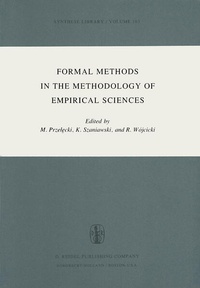
Formal Methods in the Methodology of Empirical Sciences
Proceedings of the Conference for Formal Methods in the Methodology of Empirical Sciences, Warsaw, June 17-21, 1974
Published on 22. November 2011
Book
Paperback/Softback
VIII, 452 pages
978-94-010-1137-2 (ISBN)
Description
Proceedings of the Conference for Formal Methods in the Methodology of Emperical Sciences, Warsaw, June 17-21, 1974, Poland.
More details
Series
Edition
Softcover reprint of the original 1st ed. 1976
Language
English
Place of publication
Dordrecht
Netherlands
Target group
Professional and scholarly
Research
Illustrations
VIII, 452 p.
Dimensions
Height: 235 mm
Width: 155 mm
Thickness: 25 mm
Weight
692 gr
ISBN-13
978-94-010-1137-2 (9789401011372)
DOI
10.1007/978-94-010-1135-8
Schweitzer Classification
Other editions
Additional editions
Marian Przelecki | A. Szaniawski | Ryszard Wójcicki
Formal Methods in the Methodology of Empirical Sciences
Proceedings of the Conference for Formal Methods in the Methodology of Empirical Sciences, Warsaw, June 17-21, 1974
E-Book
12/2012
Springer
€149.79
Available for download
Marian Przelecki | A. Szaniawski | Ryszard Wójcicki
Formal Methods in the Methodology of Empirical Sciences
Proceedings of the Conference for Formal Methods in the Methodology of Empirical Sciences, Warsaw, June 17-21, 1974
Book
02/1977
Kluwer Academic Publishers
€164.50
Shipment within 15-20 days
Persons
Content
A.- Some problems of formal methodology.- Approximate truth and truthlikeness.- A multiple sentential logic for empirical theories.- An axiomatic foundation for the logic of inductive generalization.- A two-dimensional continuum of a priori probability distributions on constituents.- Inductive logic and theoretical concepts.- A pragmatic approach to the formalization of empirical theories.- Uncertainty, probability and empirical knowledge.- The concept of empirical data.- Interpretation of theoretical terms: In defence of an empiricist dogma.- Definability problems in the methodology of science.- Laws, identities and reduction.- On logical analysis of methods.- Axiomatization in expected utility theory.- A logical model for game-like situations and the transformation of game-like situations.- Indeterminate probabilities.- Theoretical laws.- Causality, ontology and subsumptive explanation.- On the introduction of intensions into set theory.- Types of information and their role in the methodology of science.- Classification and ranking models in the discrete data analysis.- What have physicists learned from experience about inductive inference?.- B (Papers presented by title).- Verisimilitude: Popper, Miller and Hattiangadi.- On a general scheme of causal analysis.- Logic of quantum mechanics.- On possibilities and limits of the application of inductive methods.- Correspondence principle and the idealization.- Pragmatic meaning and truth.- Semantic complementarity in quantitative empirical sciences.- Marx's concept of law of science.- The impossibility theorem for universal theory of prediction.- Scientific knowledge-formation.- The methodology of behavioral theory construction: Nomological-deductive and axiomatic aspects of formalized theory.- Intertheory relations onthe formal and semantical level.