

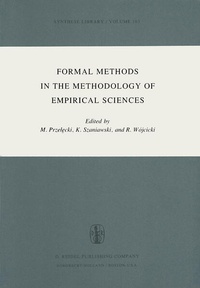
Formal Methods in the Methodology of Empirical Sciences
Proceedings of the Conference for Formal Methods in the Methodology of Empirical Sciences, Warsaw, June 17-21, 1974
Published on 28. February 1977
Book
Hardback
VIII, 452 pages
978-90-277-0698-0 (ISBN)
Description
Proceedings of the Conference for Formal Methods in the Methodology of Emperical Sciences, Warsaw, June 17-21, 1974, Poland.
More details
Series
Edition
1976 ed.
Language
English
Place of publication
Dordrecht
Netherlands
Publishing group
Springer
Target group
Professional and scholarly
Research
Product notice
sewn/stitched
Cloth over boards
Illustrations
VIII, 452 p.
Dimensions
Height: 241 mm
Width: 160 mm
Thickness: 30 mm
Weight
855 gr
ISBN-13
978-90-277-0698-0 (9789027706980)
DOI
10.1007/978-94-010-1135-8
Schweitzer Classification
Other editions
Additional editions
Marian Przelecki | A. Szaniawski | Ryszard Wójcicki
Formal Methods in the Methodology of Empirical Sciences
Proceedings of the Conference for Formal Methods in the Methodology of Empirical Sciences, Warsaw, June 17-21, 1974
E-Book
12/2012
Springer
€149.79
Available for download
Marian Przelecki | A. Szaniawski | Ryszard Wójcicki
Formal Methods in the Methodology of Empirical Sciences
Proceedings of the Conference for Formal Methods in the Methodology of Empirical Sciences, Warsaw, June 17-21, 1974
Book
11/2011
Springer
€160.49
Shipment within 15-20 days
Persons
Content
A.- Some problems of formal methodology.- Approximate truth and truthlikeness.- A multiple sentential logic for empirical theories.- An axiomatic foundation for the logic of inductive generalization.- A two-dimensional continuum of a priori probability distributions on constituents.- Inductive logic and theoretical concepts.- A pragmatic approach to the formalization of empirical theories.- Uncertainty, probability and empirical knowledge.- The concept of empirical data.- Interpretation of theoretical terms: In defence of an empiricist dogma.- Definability problems in the methodology of science.- Laws, identities and reduction.- On logical analysis of methods.- Axiomatization in expected utility theory.- A logical model for game-like situations and the transformation of game-like situations.- Indeterminate probabilities.- Theoretical laws.- Causality, ontology and subsumptive explanation.- On the introduction of intensions into set theory.- Types of information and their role in the methodology of science.- Classification and ranking models in the discrete data analysis.- What have physicists learned from experience about inductive inference?.- B (Papers presented by title).- Verisimilitude: Popper, Miller and Hattiangadi.- On a general scheme of causal analysis.- Logic of quantum mechanics.- On possibilities and limits of the application of inductive methods.- Correspondence principle and the idealization.- Pragmatic meaning and truth.- Semantic complementarity in quantitative empirical sciences.- Marx's concept of law of science.- The impossibility theorem for universal theory of prediction.- Scientific knowledge-formation.- The methodology of behavioral theory construction: Nomological-deductive and axiomatic aspects of formalized theory.- Intertheory relations onthe formal and semantical level.