

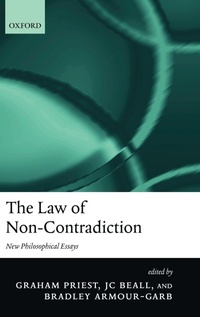
The Law of Non-Contradiction
New Philosophical Essays
Published on 21. October 2004
Book
Hardback
456 pages
978-0-19-926517-6 (ISBN)
Description
The Law of Non-Contradiction - that no contradiction can be true - has been a seemingly unassailable dogma since the work of Aristotle, in Book G of the Metaphysics. It is an assumption challenged from a variety of angles in this collection of original papers. Twenty-three of the world's leading experts investigate the 'law', considering arguments for and against it and discussing methodological issues that arise whenever we question the legitimacy of logical principles. The result is a balanced inquiry into a venerable principle of logic, one that raises questions at the very centre of logic itself.
The aim of this volume is to present a comprehensive debate about the Law of Non-Contradiction, from discussions as to how the law is to be understood, to reasons for accepting or re-thinking the law, and to issues that raise challenges to the law, such as the Liar Paradox, and a 'dialetheic' resolution of that paradox. The editors contribute an introduction which surveys the issues and serves to frame the debate, and a useful bibliography offering a guide to further reading.
This volume will be of interest to anyone working on philosophical logic, and to anyone who has ever wondered about the status of logical laws and about how one might proceed to mount arguments for or against them.
The aim of this volume is to present a comprehensive debate about the Law of Non-Contradiction, from discussions as to how the law is to be understood, to reasons for accepting or re-thinking the law, and to issues that raise challenges to the law, such as the Liar Paradox, and a 'dialetheic' resolution of that paradox. The editors contribute an introduction which surveys the issues and serves to frame the debate, and a useful bibliography offering a guide to further reading.
This volume will be of interest to anyone working on philosophical logic, and to anyone who has ever wondered about the status of logical laws and about how one might proceed to mount arguments for or against them.
Reviews / Votes
Since dialetheism has, in recent years, scrounged its way from being a view easily defeated by the dreaded incredulous stare to being a major (but still sometimes ignored) contender in the contest for an adequate logical account of the semantic and set-theoretic paradoxes (or an adequate logical theory in general), the volume is to be commended merely for its existence. The fact that it contains, not just a number of good philosophers taking this view seriously, but also a lot of seriously good philosophy increases its worth. . . . The volume begins with an.... * Roy Cook, Notre Dame Philosophical Reviews * continued........... excellent introduction by JC Beall. . . . As a survey of a difficult subject, Beall's introduction is a tour-de-force and should be required reading for anyone interested in true contradictions or the philosophy of logic more generally. . . . once one views dialetheism as a natural companion to other, supposedly more 'traditional' views such as classicism, intuitionism, and gappy logics, one wonders why it has taken so long for such an excellent volume to appear. * Roy Cook, Notre Dame Philosophical Reviews *More details
Language
English
Place of publication
Oxford
United Kingdom
Target group
Professional and scholarly
Dimensions
Height: 240 mm
Width: 161 mm
Thickness: 29 mm
Weight
845 gr
ISBN-13
978-0-19-926517-6 (9780199265176)
Copyright in bibliographic data and cover images is held by Nielsen Book Services Limited or by the publishers or by their respective licensors: all rights reserved.
Schweitzer Classification
Other editions
Additional editions
Book
11/2006
Oxford University Press
€89.60
Shipment within 15-20 days
E-Book
11/2006
1st Edition
OUP eBook
€59.49
Available for download
Persons
Content
PART I: SETTING UP THE DEBATE ; PART II: WHAT IS THE LNC? ; PART III: METHODOLOGICAL ISSUES IN THE DEBATE ; PART IV: AGAINST THE LNC ; PART V: FOR THE LNC