

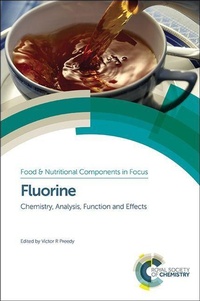
Fluorine
Chemistry, Analysis, Function and Effects
Published on 29. April 2015
Book
Hardback
360 pages
978-1-84973-888-0 (ISBN)
Description
Fluorine is best known for its role in the prevention of cavities and in improving oral and bone health however equally there are millions of people around the world suffering from dental fluorosis due to chronic exposure to high levels of fluoride in drinking water. This volume, written by leading researchers in this area, examines the positives and negatives of fluorine and its effects on humans for example fluoride-induced oxidative stress in the liver, effects of fluoride on insulin and preventing fluoride toxicity. Extremely useful for underpinning cross-disciplinary fluorine research, this book provides a fascinating insight for those with an interest in the health and nutritional sciences.
More details
Series
Language
English
Place of publication
Cambridge
United Kingdom
Target group
Professional and scholarly
Product notice
Unsewn / adhesive bound
Dimensions
Height: 234 mm
Width: 160 mm
Thickness: 28 mm
Weight
771 gr
ISBN-13
978-1-84973-888-0 (9781849738880)
DOI
10.1039/b10046
Copyright in bibliographic data and cover images is held by Nielsen Book Services Limited or by the publishers or by their respective licensors: all rights reserved.
Schweitzer Classification
Other editions
Additional editions
E-Book
04/2015
1st Edition
Royal Society of Chemistry
€274.99
Available for download
E-Book
04/2015
1st Edition
Royal Society of Chemistry
€274.99
Available for download
Person
Victor R. Preedy is a senior member of King's College London (Professor of Nutritional Biochemistry) and King's College Hospital (Professor of Clinical Biochemistry; Hon). He is attached to both the Diabetes and Nutritional Sciences Division and the Department of Nutrition and Dietetics. He is also Director of the Genomics Centre and a member of the School of Medicine. Professor Preedy graduated in 1974 with an Honours Degree in Biology and Physiology with Pharmacology. He gained his University of London PhD in 1981 and in 1992, he received his Membership of the Royal College of Pathologists. Professor Preedy was elected as a Fellow of the Institute of Biology in 1995 and to the Royal College of Pathologists in 2000. Since then he has been elected as a Fellow to the Royal Society for the Promotion of Health (2004) and The Royal Institute of Public Health and Hygiene (2004). In 2009, Professor Preedy became a Fellow of the Royal Society for Public Health and in 2012 a Fellow of the Royal Society of Chemistry. During his career, Professor Preedy has worked at the National Heart Hospital (part of Imperial College London) and the MRC Centre at Northwick Park Hospital. He has collaborated with research groups in Finland, Japan, Australia, USA and Germany. He is a leading expert on nutritional and food sciences and has a long standing interest in how food, food quality, nutrition and diet affect wellbeing and health. He has lectured nationally and internationally. To his credit, Professor Preedy has over 600 publications, which includes peer-reviewed manuscripts based on original research, abstracts and symposium presentations, reviews, books and volumes.
Content
Fluoride in the Context of the Environment;
Fluoride Intake in the Context of Dental Fluorosis;
The Chemistry of Fluorine;
Fluoride Metabolism;
Fluorine Determination in Milk, Tea and Water by High-Resolution, High-Temperature Molecular Absorption Spectrometry;
Blood, Plasma and Bone Fluoride Measurement;
Fluoride Accumulation in Crops and Vegetables: Indian Perspectives;
Fluoride Levels in Herbal and Tea Infusions;
Bioavailability of Fluoride: Factors and Mechanisms Involved;
Fluoride in Saliva and its Impact on Health;
Teeth-saliva Migration of Fluoride Ions and Health Implications;
Effect of Fluoride on Bone Metabolism, Structure and Remodelling;
Fluoride and Dietary Calcium on Bone;
Sodium Fluoride and PET Bone Scans;
Fluoride-induced Oxidative Damage in Hippocampal Cells;
Fluoride-induced Oxidative Stress in the Liver;
Effect of Fluoride on the Sensitivity and Secretion of Insulin;
Preventing Fluoride Toxicity with Selenium;
Fluoride and Effects on Caspases;
Subject Index
Fluoride Intake in the Context of Dental Fluorosis;
The Chemistry of Fluorine;
Fluoride Metabolism;
Fluorine Determination in Milk, Tea and Water by High-Resolution, High-Temperature Molecular Absorption Spectrometry;
Blood, Plasma and Bone Fluoride Measurement;
Fluoride Accumulation in Crops and Vegetables: Indian Perspectives;
Fluoride Levels in Herbal and Tea Infusions;
Bioavailability of Fluoride: Factors and Mechanisms Involved;
Fluoride in Saliva and its Impact on Health;
Teeth-saliva Migration of Fluoride Ions and Health Implications;
Effect of Fluoride on Bone Metabolism, Structure and Remodelling;
Fluoride and Dietary Calcium on Bone;
Sodium Fluoride and PET Bone Scans;
Fluoride-induced Oxidative Damage in Hippocampal Cells;
Fluoride-induced Oxidative Stress in the Liver;
Effect of Fluoride on the Sensitivity and Secretion of Insulin;
Preventing Fluoride Toxicity with Selenium;
Fluoride and Effects on Caspases;
Subject Index