

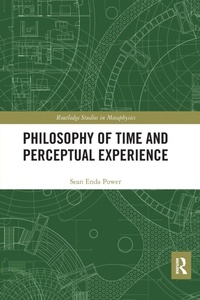
Philosophy of Time and Perceptual Experience
1st Edition
Published on 30. September 2020
Book
Paperback/Softback
260 pages
978-0-367-66708-5 (ISBN)
Description
This book explores the important yet neglected relationship between the philosophy of time and the temporal structure of perceptual experience. It examines how time structures perceptual experience and, through that structuring, the ways in which time makes perceptual experience trustworthy or erroneous.
Sean Power argues that our understanding of time can determine our understanding of perceptual experience in relation to perceptual structure and perceptual error. He examines the general conditions under which an experience may be sorted into different kinds of error such as illusions, hallucinations, and anosognosia. Power also argues that some theories of time are better than others at giving an account of the structure and errors of perceptual experience. He makes the case that tenseless theory and eternalism more closely correspond to experience than tense theory and presentism. Finally, the book includes a discussion of the perceptual experience of space and how tenseless theory and eternalism can better support the problematic theory of naive realism.
Philosophy of Time and Perceptual Experience originally illustrates how the metaphysics of time can be usefully applied to thinking about experience in general. It will appeal to those interested in the philosophy of time and debates about the trustworthiness of experience.
Sean Power argues that our understanding of time can determine our understanding of perceptual experience in relation to perceptual structure and perceptual error. He examines the general conditions under which an experience may be sorted into different kinds of error such as illusions, hallucinations, and anosognosia. Power also argues that some theories of time are better than others at giving an account of the structure and errors of perceptual experience. He makes the case that tenseless theory and eternalism more closely correspond to experience than tense theory and presentism. Finally, the book includes a discussion of the perceptual experience of space and how tenseless theory and eternalism can better support the problematic theory of naive realism.
Philosophy of Time and Perceptual Experience originally illustrates how the metaphysics of time can be usefully applied to thinking about experience in general. It will appeal to those interested in the philosophy of time and debates about the trustworthiness of experience.
More details
Series
Language
English
Place of publication
London
United Kingdom
Publishing group
Taylor & Francis Ltd
Target group
College/higher education
Postgraduate and Undergraduate
Dimensions
Height: 229 mm
Width: 152 mm
Thickness: 14 mm
Weight
382 gr
ISBN-13
978-0-367-66708-5 (9780367667085)
Copyright in bibliographic data and cover images is held by Nielsen Book Services Limited or by the publishers or by their respective licensors: all rights reserved.
Schweitzer Classification
Other editions
Additional editions
Book
02/2018
1st Edition
Routledge
€206.50
Shipment within 15-20 days
Sean Enda Power
Philosophy of Time and Perceptual Experience
E-Book
02/2018
Routledge
€60.49
Available for download
Sean Enda Power
Philosophy of Time and Perceptual Experience
E-Book
02/2018
1st Edition
Routledge
€60.49
Available for download
Person
Sean Enda Power is Adjunct Lecturer in the Department of Philosophy at Trinity College Dublin. He is the author of Philosophy of Time: A Contemporary Introduction (forthcoming, Routledge).
Content
1. Introduction
2. The Philosophy of Time
3. The Structure of Perceptual Experience
4. Erroneous Experience
5. Choosing Erroneous Experience
6. Spatial Relations to the Past
7. The Perceptual Experience of Depth
8. Distortions of Depth
9. Temporal Experience
10. Eliminating Hallucination
11. Conclusion
2. The Philosophy of Time
3. The Structure of Perceptual Experience
4. Erroneous Experience
5. Choosing Erroneous Experience
6. Spatial Relations to the Past
7. The Perceptual Experience of Depth
8. Distortions of Depth
9. Temporal Experience
10. Eliminating Hallucination
11. Conclusion