

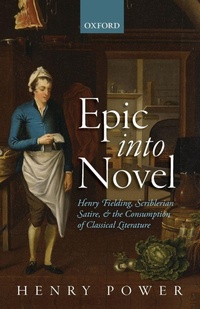
Epic into Novel
Henry Fielding, Scriblerian Satire, and the Consumption of Classical Literature
Published on 15. November 2019
Book
Paperback/Softback
256 pages
978-0-19-883396-3 (ISBN)
Description
Epic into Novel examines an unexplored tension in Fielding's work: the tension between his commitment to the classical tradition and his immersion in a print culture in which books were regarded as consumable commodities. It gives a fresh account of Fielding's engagement with classical literature, showing how he fashioned his novels out of ancient epic. It also shows how Fielding drew on the language of cookery and consumption in order to characterize his relationship with the market.
This interest in the place of the ancients in a world of consumerism was inherited from the previous generation of satirists. The 'Scriblerians'--among them Jonathan Swift, John Gay, and Alexander Pope--repeatedly suggest in their work that classical values are at odds with modern tastes and appetites. Fielding, who had idolized these writers as a young man, developed many of their satiric routines in his own writing. But Fielding broke from Swift, Gay, and Pope in creating a version of epic designed to appeal to modern consumers.
Henry Power draws on a range of sources--including eighteenth-century cookery books as well as works of classical literature--to offer fresh readings of works by Swift, Gay, and Pope, and of Fielding's major novels. Epic into Novel explores Fielding's engagement with various Scriblerian themes, primarily the consumption of literature, but also the professionalization of scholarship, and the status of the author. It shows ultimately that Fielding broke with the Scriblerians in acknowledging and celebrating the influence of the marketplace on his work.
This interest in the place of the ancients in a world of consumerism was inherited from the previous generation of satirists. The 'Scriblerians'--among them Jonathan Swift, John Gay, and Alexander Pope--repeatedly suggest in their work that classical values are at odds with modern tastes and appetites. Fielding, who had idolized these writers as a young man, developed many of their satiric routines in his own writing. But Fielding broke from Swift, Gay, and Pope in creating a version of epic designed to appeal to modern consumers.
Henry Power draws on a range of sources--including eighteenth-century cookery books as well as works of classical literature--to offer fresh readings of works by Swift, Gay, and Pope, and of Fielding's major novels. Epic into Novel explores Fielding's engagement with various Scriblerian themes, primarily the consumption of literature, but also the professionalization of scholarship, and the status of the author. It shows ultimately that Fielding broke with the Scriblerians in acknowledging and celebrating the influence of the marketplace on his work.
Reviews / Votes
In sum, Power's Epic into Novel offers a scholarly, impressively learned and broadly contextualised re-reading of Fielding's contribution to the bridging of the gap between the classical and the modern. * Jakub Lipski, The Shandean * ...while this fascinating book offers much original material to interest experts, its lucid and elegant style also makes it an excellent introduction to classical reception in this period. * Bryn Mawr, Classical Review *More details
Language
English
Place of publication
Oxford
United Kingdom
Target group
College/higher education
Illustrations
3 black-and-white halftones
Dimensions
Height: 216 mm
Width: 140 mm
Thickness: 14 mm
Weight
317 gr
ISBN-13
978-0-19-883396-3 (9780198833963)
Copyright in bibliographic data and cover images is held by Nielsen Book Services Limited or by the publishers or by their respective licensors: all rights reserved.
Schweitzer Classification
Other editions
Additional editions
Henry Power
Epic into Novel
Henry Fielding, Scriblerian Satire, and the Consumption of Classical Literature
Book
02/2015
Oxford University Press
€142.37
Shipment within 15-20 days
Person
Henry Power is Professor of English at the University of Exeter.
Content
Introduction: 'Modern Dinners'
1: 'Mackarel a Week after the Season': Swift and the Durability of Epic
2: John Gay's Art of Walking the Streets
3: Alexander Pope: 'Fragments, not a Meal'
4: Joseph Andrews: 'The Sanction of Great Antiquity'
5: Tom Jones I: 'The Cookery of the Author'
6: Tom Jones II: Fielding's Sagacious Reader
6: Amelia: 'Talk not to me of Dinners'
1: 'Mackarel a Week after the Season': Swift and the Durability of Epic
2: John Gay's Art of Walking the Streets
3: Alexander Pope: 'Fragments, not a Meal'
4: Joseph Andrews: 'The Sanction of Great Antiquity'
5: Tom Jones I: 'The Cookery of the Author'
6: Tom Jones II: Fielding's Sagacious Reader
6: Amelia: 'Talk not to me of Dinners'