

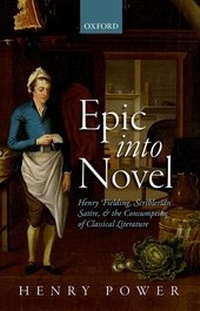
Epic into Novel
Henry Fielding, Scriblerian Satire, and the Consumption of Classical Literature
Published on 19. February 2015
Book
Hardback
248 pages
978-0-19-872387-5 (ISBN)
Description
Epic into Novel looks at Henry Fielding's adaptation of classical epic in the context of what he called the 'Trade of . . . authoring'. Fielding was always keen to stress that his novels were modelled on classical literature. Equally, he was fascinated by--and wrote at length about--the fact that they were objects to be consumed. He recognised that he wrote in an age when an author had to consider himself 'as one who keeps a public Ordinary, at which all persons are welcome for their Money.' In describing his work, he alludes both to Homeric epic and to contemporary cookery books.
This tension in Fielding's work has gone unexplored, a tension between his commitment to a classical tradition and his immersion in a print culture in which books were consumable commodities. This interest in the place of the ancients in a world of consumerism was inherited from the previous generation of satirists. The 'Scriblerians'--among them Jonathan Swift, John Gay, and Alexander Pope--repeatedly suggest in their work that classical values are at odds with modern tastes and appetites. Fielding, who had idolised these writers as a young man, developed many of their satiric routines in his own writing. But Fielding broke from Swift, Gay, and Pope in creating a version of epic designed to appeal to modern consumers.
Henry Power provides new readings of works by Swift, Gay, and Pope, and of Fielding's major novels. He examines Fielding's engagement with various Scriblerian themes--primarily the consumption of literature, but also the professionalisation of scholarship, and the status of the author--and shows ultimately that Fielding broke with the Scriblerians in acknowledging and celebrating the influence of the marketplace on his work.
This tension in Fielding's work has gone unexplored, a tension between his commitment to a classical tradition and his immersion in a print culture in which books were consumable commodities. This interest in the place of the ancients in a world of consumerism was inherited from the previous generation of satirists. The 'Scriblerians'--among them Jonathan Swift, John Gay, and Alexander Pope--repeatedly suggest in their work that classical values are at odds with modern tastes and appetites. Fielding, who had idolised these writers as a young man, developed many of their satiric routines in his own writing. But Fielding broke from Swift, Gay, and Pope in creating a version of epic designed to appeal to modern consumers.
Henry Power provides new readings of works by Swift, Gay, and Pope, and of Fielding's major novels. He examines Fielding's engagement with various Scriblerian themes--primarily the consumption of literature, but also the professionalisation of scholarship, and the status of the author--and shows ultimately that Fielding broke with the Scriblerians in acknowledging and celebrating the influence of the marketplace on his work.
More details
Language
English
Place of publication
Oxford
United Kingdom
Target group
College/higher education
Illustrations
3 black-and-white halftones
Dimensions
Height: 223 mm
Width: 146 mm
Thickness: 21 mm
Weight
462 gr
ISBN-13
978-0-19-872387-5 (9780198723875)
Copyright in bibliographic data and cover images is held by Nielsen Book Services Limited or by the publishers or by their respective licensors: all rights reserved.
Schweitzer Classification
Other editions
Additional editions
Henry Power
Epic into Novel
Henry Fielding, Scriblerian Satire, and the Consumption of Classical Literature
Book
11/2019
Oxford University Press
€46.40
Shipment within 15-20 days
Henry Power
Epic into Novel
Henry Fielding, Scriblerian Satire, and the Consumption of Classical Literature
E-Book
02/2015
1st Edition
OUP eBook
€16.49
Available for download
Person
Henry Power is Professor of English at the University of Exeter
Content
Introduction: 'Modern Dinners' ; 1. 'Mackarel a Week after the Season': Swift and the Durability of Epic ; 2. John Gay's Art of Walking the Streets ; 3. Alexander Pope: 'Fragments, not a Meal' ; 4. Joseph Andrews: 'The Sanction of Great Antiquity' ; 5. Tom Jones I: 'The Cookery of the Author' ; 6. Tom Jones II: Fielding's Sagacious Reader. ; 6. Amelia: 'Talk not to me of Dinners'