

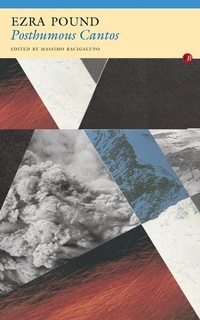
Posthumous Cantos
Published on 29. October 2015
Book
Paperback/Softback
192 pages
978-1-78410-120-6 (ISBN)
Description
Ezra Pound's Posthumous Cantos collects unpublished pages of his great poem, drawn from manuscripts held in the archive at Yale's Beinecke Library and elsewhere. They are assembled by Pound's Italian translator, the critic and scholar Massimo Bacigalupo, into a companion book to the Cantos, running from 1917 to 1972 and including the Cantos he wrote in Italian in 1944-5. An Italian edition was published in 2002 and revised in 2012. This is the first English edition of a crucial part of the Pound canon. Posthumous Cantos is arranged to reflect the eight phases of the Cantos' composition. Pound's writing suffered the consequences of the turbulent history of his century. World War I left the cultural world he came to Europe for in ruins; and the aftermath of the World War II in which he took a contrary side, made his work, like his life, discontinuous, a sequence of brilliant moments and profound ruptures.
Reviews / Votes
'The previously unpublished pages of an epic masterpiece offer fresh insights into its creation'The Guardian
More details
Language
English
Place of publication
Manchester
United Kingdom
Publishing group
Carcanet Press Ltd
Dimensions
Height: 216 mm
Width: 131 mm
Thickness: 25 mm
Weight
314 gr
ISBN-13
978-1-78410-120-6 (9781784101206)
Copyright in bibliographic data and cover images is held by Nielsen Book Services Limited or by the publishers or by their respective licensors: all rights reserved.
Schweitzer Classification
Other editions
Additional editions
Ezra Pound | Massimo Bacigalupo
Posthumous Cantos
E-Book
01/2015
Fyfield Books
€14.39
Available for download
Persons
One of the key figures of the modernist movement, Ezra Pound played a formative role in the poetic career of T.S. Eliot as well as distinguishing himself through his own work. Born in 1885, Pound emmigrated to Europe after a childhood and adolescence in America. In London, he became very well connected in literary circles. His literary career is, however, marred by his turn to facsism. Over World War II he began broacasting on Italian radio for Mussolini's Government - by 1940 these were occuring once every three days. Unlike Eliot, however, he ultimately renounced his allignment to the ideology. Massimo Bacigalupo is an experimental filmmaker, scholar, translator and literary critic. Since 1990, he has been Professor of American Literature at the University of Genoa.