

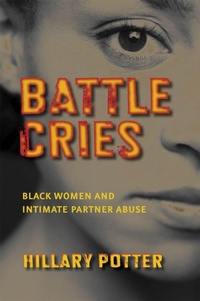
Battle Cries
Black Women and Intimate Partner Abuse
Published on 1. November 2008
Book
Hardback
295 pages
978-0-8147-6729-0 (ISBN)
Description
Contrary to the stereotype of the "strong Black woman," African American women are more plagued by domestic violence than any other racial group in the United States. In fact, African American women experience intimate partner violence at a rate 35% higher than white women and about two and a half times more than women of other races and ethnicities. This common portrayal can hinder black women seeking help and support simply because those on the outside don't think help is needed. Yet, as Hillary Potter argues in Battle Cries: Black Women and Intimate Partner Abuse, this stereotype often helps these African American women to resist and to verbally and physically retaliate against their abusers. Thanks to this generalization, Potter observes, black women are less inclined to label themselves as "victims" and more inclined to fight back.
Battle Cries is an eye-opening examination of African American women's experiences with intimate partner abuse, the methods used to contend with abusive mates, and the immediate and enduring consequences resulting from the maltreatment. Based on intensive interviews with 40 African American women abused by their male partners, Potter's analysis takes into account variations in their experiences based on socioeconomic class, education level, and age, and discusses the common abuses and perceptions they share. Combining her remarkable findings with black feminist thought and critical race theory, Potter offers a unique and significant window through which we can better understand this understudied though rampant social problem.
Battle Cries is an eye-opening examination of African American women's experiences with intimate partner abuse, the methods used to contend with abusive mates, and the immediate and enduring consequences resulting from the maltreatment. Based on intensive interviews with 40 African American women abused by their male partners, Potter's analysis takes into account variations in their experiences based on socioeconomic class, education level, and age, and discusses the common abuses and perceptions they share. Combining her remarkable findings with black feminist thought and critical race theory, Potter offers a unique and significant window through which we can better understand this understudied though rampant social problem.
Reviews / Votes
Battle Cries is the most comprehensive study of intimate partner abuse in heterosexual Black relationships. Battle Cries makes a significant contribution to the scholarship on domestic violence and our understanding, in particular, of African American women and their experience of and responses to abusive relationships. Her comparative approach to the topic and her class analysis also makes this the most compelling book to be published recently on the challenges facing Black women in the U.S. - Beverly Guy-Sheftall,co-author of Gender Talk: The Struggle for Women's Equality in African American CommunitiesMore details
Language
English
Place of publication
New York
United States
Target group
Professional and scholarly
College/higher education
Product notice
Cloth over boards
Dimensions
Height: 229 mm
Width: 152 mm
Thickness: 21 mm
Weight
561 gr
ISBN-13
978-0-8147-6729-0 (9780814767290)
Copyright in bibliographic data and cover images is held by Nielsen Book Services Limited or by the publishers or by their respective licensors: all rights reserved.
Schweitzer Classification
Other editions
Additional editions
E-Book
11/2009
1st Edition
New York University Press
€142.99
Available for download
Person
Hillary Potter is Assistant Professor of Sociology at the University of Colorado, Boulder.
Content
Acknowledgments 1 Introduction: The Call 2 Black Feminist Criminology and the Power of Narrative: "I Just Wanted to Tell My Story" 3 Dynamic Resistance: "I'm a Strong Black Woman" 4 Surviving Childhood: "I Learned to Stand up for Myself " 5 Living Through It: "He Made Me Believe He Was Something He Wasn't" 6 Fighting Back: "You Want to Fight? We Gonna Fight!" 7 Getting Out: "We Have to Pray to God and Hope Everything Works Out" 8 Conclusion: The Response Appendix A: Research Methods and Demographics Appendix B: Pseudonyms and Demographic Information Notes Bibliography Index About the Author