

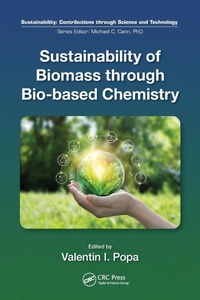
Sustainability of Biomass through Bio-based Chemistry
1st Edition
Published on 30. September 2022
Book
Paperback/Softback
320 pages
978-0-367-71012-5 (ISBN)
Description
The process of photosynthesis is a potential source of energy and bioproducts. Renewable sources of polymeric materials offer an answer to maintaining sustainable development of economically and ecologically attractive technology. The innovations in the development of materials from biopolymers, preservation of fossil-based raw materials, complete biological degradability, reduction in the volume of garbage and compostability in the natural cycle, climate protection through reduction of carbon dioxide released, and the application possibilities of agricultural resources for the production of bio/green materials are some of the reasons why such materials are attracting public interest.
FEATURES
Discusses waste from urban areas, forestry and agricultural processes, specifically grown crops such as trees, starch crops, sugar crops hydrocarbon plants and oils, and finally aquatic plants such as water seaweeds and algae, which can be used as raw materials for sustainable development.
Presents recent advances in the development of some specifically chemical components of biomasses for a sustainable future.
Focuses on lignocellulose as a source of bio-based products.
Draws upon expertise from various countries.
Describes how upgraded and integrated biomass processing may reduce the risks associated with the COVID-19 pandemic.
Valentin I. Popa is professor emeritus of Wood Chemistry and Biotechnology at Gheorghe Asachi Technical University of Iasi, Romania.
FEATURES
Discusses waste from urban areas, forestry and agricultural processes, specifically grown crops such as trees, starch crops, sugar crops hydrocarbon plants and oils, and finally aquatic plants such as water seaweeds and algae, which can be used as raw materials for sustainable development.
Presents recent advances in the development of some specifically chemical components of biomasses for a sustainable future.
Focuses on lignocellulose as a source of bio-based products.
Draws upon expertise from various countries.
Describes how upgraded and integrated biomass processing may reduce the risks associated with the COVID-19 pandemic.
Valentin I. Popa is professor emeritus of Wood Chemistry and Biotechnology at Gheorghe Asachi Technical University of Iasi, Romania.
More details
Series
Language
English
Place of publication
London
United Kingdom
Publishing group
Taylor & Francis Ltd
Target group
College/higher education
Professional and scholarly
Academic, Postgraduate, Professional, and Professional Practice & Development
Illustrations
200 s/w Abbildungen, 23 s/w Tabellen
23 Tables, black and white; 200 Illustrations, black and white
Dimensions
Height: 234 mm
Width: 156 mm
Thickness: 17 mm
Weight
491 gr
ISBN-13
978-0-367-71012-5 (9780367710125)
Copyright in bibliographic data and cover images is held by Nielsen Book Services Limited or by the publishers or by their respective licensors: all rights reserved.
Schweitzer Classification
Other editions
Additional editions
Valentin Popa
Sustainability of Biomass through Bio-based Chemistry
Book
03/2021
1st Edition
CRC Press
€262.60
Shipment within 15-20 days
Valentin Popa
Sustainability of Biomass through Bio-based Chemistry
E-Book
03/2021
1st Edition
CRC Press
€67.49
Available for download
Valentin Popa
Sustainability of Biomass through Bio-based Chemistry
E-Book
03/2021
1st Edition
CRC Press
€67.49
Available for download
Person
Valentin I. Popa is professor emeritus of Wood Chemistry and Biotechnology at Gheorghe Asachi Technical University of Iasi, Romania. Professor Popa earned a BSc and an MSc in chemical engineering (1969) and a PhD in polysaccharide chemistry (1976) at Polytechnic Institute of Iasi, Romania. He was awarded the Romanian Academy Prize for his contributions in the field of seaweed chemistry (1976). He has published more than 600 papers in the fields of wood chemistry and biotechnology, biomass complex processing, biosynthesis, and biodegradation of natural com- pounds, allelochemicals, bioadhesives, and bioremediation. Professor Popa is the author and co-author of 38 books and book chapters.
Content
1. Biomass and Sustainability 2. Selectively Transformation of Lignin into Value-added Chemicals 3. Nanocellulose-based Materials for the Solar Cell, Wearable Sensors, and Supercapacitors 4. Horizons for Future Sustainability: From Trash to Functional Cellulose Fibres 5. Cellulose Valorization for the Development of Bio-based Functional Materials via Topochemical Engineering 6. Sustainable Hydrogels from Renewable Resources 7. Production of Cellulosic Membranes from Rice Husks for Reverse Osmosis Applications 8. Morphological Aspects of Sustainable Hydrogels 9. Bio-based Stimuli-responsive Hydrogels with Biomedical Applications 10. Curdlan Derivatives: New Approaches in Synthesis and Their Applications