

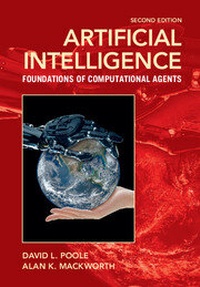
Artificial Intelligence
Foundations of Computational Agents
2nd Edition
Published on 25. September 2017
Book
Hardback
820 pages
978-1-107-19539-4 (ISBN)
Description
Artificial intelligence, including machine learning, has emerged as a transformational science and engineering discipline. Artificial Intelligence: Foundations of Computational Agents presents AI using a coherent framework to study the design of intelligent computational agents. By showing how the basic approaches fit into a multidimensional design space, readers learn the fundamentals without losing sight of the bigger picture. The new edition also features expanded coverage on machine learning material, as well as on the social and ethical consequences of AI and ML. The book balances theory and experiment, showing how to link them together, and develops the science of AI together with its engineering applications. Although structured as an undergraduate and graduate textbook, the book's straightforward, self-contained style will also appeal to an audience of professionals, researchers, and independent learners. The second edition is well-supported by strong pedagogical features and online resources to enhance student comprehension.
Reviews / Votes
'This new edition of the already classic Introduction to Artificial Intelligence by Poole and Mackworth provides a broad coverage of the symbolic and non-symbolic approaches underpinning the main current and future approaches to AI. It combines an accessible treatment of the underlying theory with practical examples that bring the theory to life. It is essential reading for anyone who wants to understand the current state of the art, and to be prepared for the future.' Robert Kowalski, Imperial College London 'Poole and Mackworth provide a crystal clear introduction to artificial intelligence. Their book paints a complete picture of the field, from the logical foundations to the latest breakthroughs in learning, representation, reasoning, and multi-agent systems. The authors view AI as the integration of a diverse set of technologies. Layer by layer, they introduce all the techniques required to build an intelligent agent. The book stands out as being both comprehensive and uncompromising, limiting the material to the most promising and intellectually gratifying topics.' Guy Van den Broeck, University of California, Los AngelesMore details
Edition
2nd Revised edition
Language
English
Place of publication
Cambridge
United Kingdom
Target group
College/higher education
Edition type
Revised edition
Illustrations
Worked examples or Exercises
Dimensions
Height: 261 mm
Width: 182 mm
Thickness: 39 mm
Weight
1820 gr
ISBN-13
978-1-107-19539-4 (9781107195394)
Copyright in bibliographic data and cover images is held by Nielsen Book Services Limited or by the publishers or by their respective licensors: all rights reserved.
Schweitzer Classification
Other editions
New editions
Book
07/2023
3rd Edition
Cambridge University Press
€72.00
Available immediately
Additional editions
E-Book
09/2017
2nd Edition
Cambridge University Press
€67.99
Available for download
Previous edition
Book
04/2010
Cambridge University Press
€81.71
Article exhausted; check for reprint
Persons
David L. Poole is a Professor of Computer Science at the University of British Columbia. He is a co-author of three artificial intelligence books including Statistical Relational Artificial Intelligence: Logic, Probability, and Computation (2016). He is a former Chair of the Association for Uncertainty in Artificial Intelligence, the winner of the Canadian AI Association (CAIAC) 2013 Lifetime Achievement Award, and a Fellow of the Association for the Advancement of Artificial Intelligence (AAAI) and CAIAC. Alan K. Mackworth is a Professor of Computer Science at the University of British Columbia. He has authored over 130 papers and co-authored two books: Computational Intelligence: A Logical Approach (1997) and Artificial Intelligence: Foundations of Computational Agents (2010). His awards include the Artificial Intelligence Journal (AIJ) Classic Paper Award and the Association of Constraint Programming (ACP) Award for Research Excellence. He has served as President of the International Joint Conference on Artificial Intelligence (IJCAI), the Association for the Advancement of Artificial Intelligence (AAAI) and the Canadian AI Association (CAIAC). He is a Fellow of AAAI, CAIAC and the Royal Society of Canada.
Content
Part I. Agents in the World: What Are Agents and How Can They Be Built?: 1. Artificial intelligence and agents; 2. Agent architectures and hierarchical control; Part II. Reasoning, Planning and Learning with Certainty: 3. Searching for solutions; 4. Reasoning with constraints; 5. Propositions and inference; 6. Planning with certainty; 7. Supervised machine learning; Part III. Reasoning, Learning and Acting with Uncertainty: 8. Reasoning with uncertainty; 9. Planning with uncertainty; 10. Learning with uncertainty; 11. Multiagent systems; 12. Learning to act; Part IV. Reasoning, Learning and Acting with Individuals and Relations: 13. Individuals and relations; 14. Ontologies and knowledge-based systems; 15. Relational planning, learning, and probabilistic reasoning; Part V. Retrospect and Prospect: 16. Retrospect and prospect; Part VI. End Matter: Appendix A. Mathematical preliminaries and notation.