

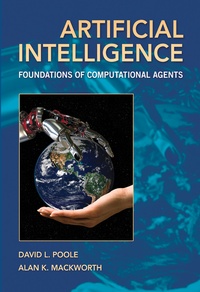
Artificial Intelligence
Foundations of Computational Agents
Published on 19. April 2010
Book
Hardback
682 pages
978-0-521-51900-7 (ISBN)
Description
Recent decades have witnessed the emergence of artificial intelligence as a serious science and engineering discipline. This textbook, aimed at junior to senior undergraduate students and first-year graduate students, presents artificial intelligence (AI) using a coherent framework to study the design of intelligent computational agents. By showing how basic approaches fit into a multidimensional design space, readers can learn the fundamentals without losing sight of the bigger picture. The book balances theory and experiment, showing how to link them intimately together, and develops the science of AI together with its engineering applications. Although structured as a textbook, the book's straightforward, self-contained style will also appeal to a wide audience of professionals, researchers, and independent learners. AI is a rapidly developing field: this book encapsulates the latest results without being exhaustive and encyclopedic. The text is supported by an online learning environment, AIspace, http://aispace.org, so that students can experiment with the main AI algorithms plus problems, animations, lecture slides, and a knowledge representation system, AIlog, for experimentation and problem solving.
Reviews / Votes
'This book, by two of the foremost researchers in Artificial Intelligence, marks the transition of the field from a miscellaneous assortment of unrelated techniques to a genuine scientific discipline. It presents the fundamental concepts of AI in a coherent structure, which shows how different techniques are related and complementary. The book is written in a clear and engaging manner, which makes it suitable both for the serious student and for the intellectually curious layperson.' Robert Kowalski, Imperial College London 'The clarity of this book is amazing! Material in each chapter is a perfect blend of accessible stuff for beginners, theory and challenges for advanced students, and reference materials for experts, organized into sections so you can split off the right bits for your students. Its like having three textbooks in one! Definitely the must-have textbook on AI for the 21st century. I know mine will be within reach for years to come.' Jesse Hoey, University of Dundee 'This book fills a real gap in the AI literature. It is accessible for advanced undergraduate students, without compromising technical rigor. It is concise, but still gives a modern presentation of all major areas of AI. It is an eminently useful textbook for introductory courses to AI. Poole and Mackworth have made a valiant effort to impose some order on the wide and heterogeneous field of Artificial Intelligence. In this order, all of AI is placed in a design space for intelligent agents defined by dimensions of complexity.' Manfred Jaeger, Aalborg University 'This text is a modern and coherent introduction to the field of Artificial Intelligence that uses rational computational agents and logic as unifying threads in this vast field. Many fully worked out examples, a good collection of paper-and-pencil exercises at various levels of difficulty, programming assignments based on the custom-designed declarative AILog language, and well-integrated online support through the AISpace applets complement the presentation. If you plan to teach a course in Artificial Intelligence at the upper-division undergraduate level or beyond, you must give serious consideration to this thoroughly enjoyable book.' Marco Valtorta, University of South Carolina 'The book covers a great variety of topics and every matter is presented with the best care for the understanding of the reader. The book is addressed to anyone who is interested in designing a smart agent: the explanations are very generous, but without being exaggerated ... reading the text, the excitement of the authors about AI becomes obvious and even contagious. Even specialists in this field will find precious information and delightful interpretations. Without a shred of doubt, this textbook will very soon become basic material for the courses of AI at universities worldwide.' Zentralblatt MATHMore details
Language
English
Place of publication
Cambridge
United Kingdom
Target group
College/higher education
Professional and scholarly
Illustrations
Worked examples or Exercises; 1 Halftones, unspecified; 186 Line drawings, unspecified
Dimensions
Height: 260 mm
Width: 184 mm
Thickness: 37 mm
Weight
1310 gr
ISBN-13
978-0-521-51900-7 (9780521519007)
Copyright in bibliographic data and cover images is held by Nielsen Book Services Limited or by the publishers or by their respective licensors: all rights reserved.
Schweitzer Classification
Other editions
New editions
Book
07/2023
3rd Edition
Cambridge University Press
€72.00
Available immediately
Book
09/2017
2nd Edition
Cambridge University Press
€74.27
Article exhausted; check for reprint
Additional editions
E-Book
05/2010
Cambridge University Press
€78.49
Available for download
E-Book
04/2010
Cambridge University Press
€65.49
Available for download
Persons
David Poole is a Professor of Computer Science at the University of British Columbia. He is known for his research on abductive and default reasoning, probabilistic inference, and relational probabilistic models, and he has recently been working on semantic science, combining ontologies, data, and rich probabilistic theories. He is a co-author of Computational Intelligence: A Logical Approach (1998), co-chair of AAAI-10 (Twenty-Fourth AAAI Conference on Artificial Intelligence), and co-editor of the Proceedings of the Tenth Conference in Uncertainty in Artificial Intelligence (1994). Poole is the former associate editor and on the advisory board of the Journal of AI Research. He is an associate editor of AI Journal and on the editorial boards of AI Magazine and AAAI Press. He is the secretary of the Association for Uncertainty in Artificial Intelligence and is a Fellow of the Association for the Advancement of Artificial Intelligence (AAAI). Alan Mackworth is a Professor of Computer Science and Canada Research Chair in Artificial Intelligence at the University of British Columbia. He is known for his research on constraint-based systems and agents, hybrid systems, and robot soccer. He is a co-author of Computational Intelligence: A Logical Approach. He was President and Trustee of International Joint Conferences on AI (IJCAI) Inc. Mackworth was Vice President and President of the Canadian Society for Computational Studies of Intelligence (CSCSI). He has served as President of the Association for the Advancement of Artificial Intelligence (AAAI). He also served as the founding Director of the UBC Laboratory for Computational Intelligence. He is a Fellow of AAAI, the Canadian Institute for Advanced Research, and the Royal Society of Canada.
Content
Part I. Agents in the World: What Are Agents and How Can They Be Built?: 1. Artificial intelligence and agents; 2. Agent architectures and hierarchical control; Part II. Representing and Reasoning: 3. States and searching; 4. Features and constraints; 5. Propositions and inference; 6. Reasoning under uncertainty; Part III. Learning and Planning: 7. Learning: overview and supervised learning; 8. Planning with certainty; 9. Planning under uncertainty; 10. Multiagent systems; 11. Beyond supervised learning; Part IV. Reasoning about Individuals and Relations: 12. Individuals and relations; 13. Ontologies and knowledge-based systems; 14. Relational planning, learning and probabilistic reasoning; Part V. The Big Picture: 15. Retrospect and prospect; Appendix A. Mathematical preliminaries and notation.