

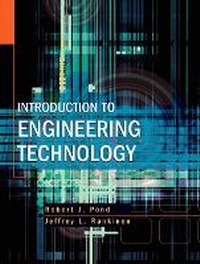
Introduction to Engineering Technology
United States Edition
7th Edition
Published on 12. June 2008
Book
Paperback/Softback
408 pages
978-0-13-515430-4 (ISBN)
Description
This book presents an overall view of the engineering world and explains how the technician and technologist fits into that world, stressing the importance of a good attitude and close attention to detail. Introduction to Engineering Technology, Seventh Edition also provides students with an opportunity to use the language and tools of the math-sciences, such as using an engineering calculator, understanding basic applied math (such as algebra and trigonometry, with emphasis on applied), and the value of good communication skills.
More details
Edition
7th edition
Language
English
Place of publication
United States
Publishing group
Pearson Education (US)
Target group
Professional and scholarly
Dimensions
Height: 193 mm
Width: 234 mm
Thickness: 22 mm
Weight
551 gr
ISBN-13
978-0-13-515430-4 (9780135154304)
Copyright in bibliographic data and cover images is held by Nielsen Book Services Limited or by the publishers or by their respective licensors: all rights reserved.
Schweitzer Classification
Other editions
New editions
Robert Pond | Jeffrey Rankinen
Introduction to Engineering Technology
Book
02/2014
8th Edition
Pearson
€163.40
Article exhausted; check different version
Previous edition
Robert J. Pond
Introduction to Engineering Technology
Book
06/2004
6th Edition
Pearson
€54.46
Article exhausted; check for reprint
Persons
Jeffrey L. Rankinen is an associate professor at the Pennsylvania College of Technology in Williamsport, Pennsylvania. He is a member of the Electronics and Computer Engineering Technology department. Jeff teaches basic electronics courses, while his specialty areas include optical communications and nanotechnology. In addition to teaching credit courses, Jeff is a Tyco Electronics AMP NETCONNECT instructor for the AMP ACT 1 and ACT 2 certification courses in premises cabling systems. He also actively consults for local industry in the area of fiber optic installation and repair. His educational credentials include a Ph.D. from the Pennsylvania State University in Materials, an M.S. from the Pennsylvania State University in Electrical Engineering, a B.S. from the Rochester Institute of Technology in Electrical Engineering and A.A.S. degrees in electronics and computer science from the Pennsylvania College of Technology.
Content
1. Engineering Technology as a Career
2. Career Choices in the Engineering Technologies
3. Survival Skills - Preparing for the Engineering Technologies
4. The Calculator
5. Measurement Systems
6. Right-Triangle Trigonometry and Geometry for Technologists
7. The Technical Library
8. The Personal Computer
9. Networking, Internet, and Industrial Automation
10. Your Future in Technology
Appendix A: Professional Organizations in Engineering
Appendix B: Algebraic Rules
Appendix C: Trigonometry
Appendix D: Glossary of Abbreviations and Acronyms
Answers to Odd-Numbered Problems
2. Career Choices in the Engineering Technologies
3. Survival Skills - Preparing for the Engineering Technologies
4. The Calculator
5. Measurement Systems
6. Right-Triangle Trigonometry and Geometry for Technologists
7. The Technical Library
8. The Personal Computer
9. Networking, Internet, and Industrial Automation
10. Your Future in Technology
Appendix A: Professional Organizations in Engineering
Appendix B: Algebraic Rules
Appendix C: Trigonometry
Appendix D: Glossary of Abbreviations and Acronyms
Answers to Odd-Numbered Problems