

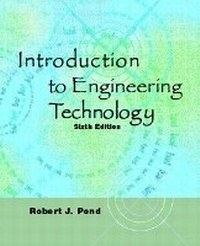
Introduction to Engineering Technology
6th Edition
Published on 17. June 2004
Book
Hardback
416 pages
978-0-13-111503-3 (ISBN)
Description
For an introductory course in engineering technology program offered in two- or four-year programs. Also suitable for use in a tech-prep program or vocational school.
Catering primarily to two-year college engineering students who may have limited academic skills, this one-of-a-kind text provides readers with a solid foundation in engineering technology, and helps to prepare and empower them for more advanced courses. Stressing the importance of possessing a good attitude and paying close attention to detail, it explores the engineering world-and the technician's and technologist's places in it-from a holistic perspective-covering the demands and requirements of a career in technology, the language, tools, the most recent technological advances and proper application essential for success in today's business and industry.
Catering primarily to two-year college engineering students who may have limited academic skills, this one-of-a-kind text provides readers with a solid foundation in engineering technology, and helps to prepare and empower them for more advanced courses. Stressing the importance of possessing a good attitude and paying close attention to detail, it explores the engineering world-and the technician's and technologist's places in it-from a holistic perspective-covering the demands and requirements of a career in technology, the language, tools, the most recent technological advances and proper application essential for success in today's business and industry.
More details
Edition
6th edition
Language
English
Place of publication
United States
Publishing group
Pearson Education (US)
Target group
Professional and scholarly
Dimensions
Width: 235 mm
Thickness: 14 mm
Weight
623 gr
ISBN-13
978-0-13-111503-3 (9780131115033)
Copyright in bibliographic data and cover images is held by Nielsen Book Services Limited or by the publishers or by their respective licensors: all rights reserved.
Schweitzer Classification
Other editions
New editions
Book
06/2008
7th Edition
Pearson
€84.17
Article exhausted; check for reprint
Previous edition
Robert J. Pond
Introduction to Engineering Technology
Book
10/2001
5th Edition
Pearson
€44.56
Article exhausted; check for reprint
Content
(NOTE:Each chapter concludes with a Problems and Selected Readings section.)
1. Engineering Technology as a Career.
History of Engineering and Technology. The Industrial Team. The Career Decision. Engineering Technology-The Right Career for You.
2. Career Choices in the Engineering Technologies.
Chemical Engineering Technician. Civil and Architectural Engineering Technician. Electrical/Electronic Engineering Technician. Computer Engineering Technician. Industrial Engineering Technician. Mechanical Engineering Technician.
3. Survival Skills-Preparing for the Engineering Technologies.
Pursuing the Technology Degree. Using the Engineering Library. Problem Solving. Professionalism.
4. The Calculator.
Purchasing the Calculator. Signed Numbers and Algebraic Logic. Powers and Roots. Using Scientific Notation. Graphing with the Calculator-"A Picture Is Worth a Thousand Words."
5. Measurement Systems.
The Fundamental Units. Conversion of Units Within the English System. Conversion of Units Within the International System. Conversion of Units Between Systems. The Use of Dimensional Analysis. Precision of the Inch and Millimeter Scales.
6. Right-Triangle Trigonometry and Geometry for Technologists.
Right-Triangle Relationships. Right-Triangle Applications. Vector Applications. Geometry Applications for the Technologist. Solid Geometry for the Technologist.
7. The Technical Laboratory.
Performing the Experiment. Reducing Errors in the Laboratory. Data Collection and Calculating Results. Presenting Data-Graphing. Reporting.
8. The Personal Computer.
Mainframe Computers Lead to the PC. The Personal Computer System. The Operating System. Application Software-A Survey. Notebooks, PDAs, and Future Trends.
9. Networking, Internet, and Industrial Automation.
Computer Networks. The Internet. Using the Internet. Process Control. Programmable Logic Controllers, or PLCs. Personal Computers (PCs)-User Friendly. Distributed Control.
10. Your Future in Technology.
The Evolving Computer-A Base for High Technology. Robotics. Optical Systems. Materials Technology. Our Environment. Meeting the High-Technology Needs of the World-A Challenge.
Appendix A: Professional Organizations in Engineering.
Appendix B: Algebraic Rules.
Appendix C: Trigonometry.
Appendix D: Glossary of Abbreviations and Acronyms.
Answers to Odd Numbered Problems.
Index.
1. Engineering Technology as a Career.
History of Engineering and Technology. The Industrial Team. The Career Decision. Engineering Technology-The Right Career for You.
2. Career Choices in the Engineering Technologies.
Chemical Engineering Technician. Civil and Architectural Engineering Technician. Electrical/Electronic Engineering Technician. Computer Engineering Technician. Industrial Engineering Technician. Mechanical Engineering Technician.
3. Survival Skills-Preparing for the Engineering Technologies.
Pursuing the Technology Degree. Using the Engineering Library. Problem Solving. Professionalism.
4. The Calculator.
Purchasing the Calculator. Signed Numbers and Algebraic Logic. Powers and Roots. Using Scientific Notation. Graphing with the Calculator-"A Picture Is Worth a Thousand Words."
5. Measurement Systems.
The Fundamental Units. Conversion of Units Within the English System. Conversion of Units Within the International System. Conversion of Units Between Systems. The Use of Dimensional Analysis. Precision of the Inch and Millimeter Scales.
6. Right-Triangle Trigonometry and Geometry for Technologists.
Right-Triangle Relationships. Right-Triangle Applications. Vector Applications. Geometry Applications for the Technologist. Solid Geometry for the Technologist.
7. The Technical Laboratory.
Performing the Experiment. Reducing Errors in the Laboratory. Data Collection and Calculating Results. Presenting Data-Graphing. Reporting.
8. The Personal Computer.
Mainframe Computers Lead to the PC. The Personal Computer System. The Operating System. Application Software-A Survey. Notebooks, PDAs, and Future Trends.
9. Networking, Internet, and Industrial Automation.
Computer Networks. The Internet. Using the Internet. Process Control. Programmable Logic Controllers, or PLCs. Personal Computers (PCs)-User Friendly. Distributed Control.
10. Your Future in Technology.
The Evolving Computer-A Base for High Technology. Robotics. Optical Systems. Materials Technology. Our Environment. Meeting the High-Technology Needs of the World-A Challenge.
Appendix A: Professional Organizations in Engineering.
Appendix B: Algebraic Rules.
Appendix C: Trigonometry.
Appendix D: Glossary of Abbreviations and Acronyms.
Answers to Odd Numbered Problems.
Index.