

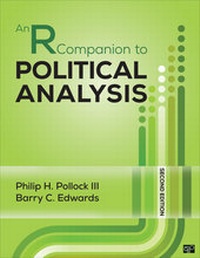
An R Companion to Political Analysis
2nd Edition
Published on 8. June 2017
Book
Paperback/Softback
248 pages
978-1-5063-6884-9 (ISBN)
Description
Teach your students to conduct political research using R, the open source programming language and software environment for statistical computing and graphics. An R Companion to Political Analysis offers the same easy-to-use and effective style as the best-selling SPSS and Stata Companions. The all-new Second Edition includes new and revised exercises and datasets showing students how to analyze research-quality data to learn descriptive statistics, data transformations, bivariate analysis (cross-tabulations and mean comparisons), controlled comparisons, statistical inference, linear correlation and regression, dummy variables and interaction effects, and logistic regression. The clear explanation and instruction is accompanied by annotated and labeled screen shots and end-of-chapter exercises to help students apply what they have learned.
"Students will love this book, as will their teachers."
- Courtney Brown, Emory University
"Students will love this book, as will their teachers."
- Courtney Brown, Emory University
Reviews / Votes
"R and its application continues to expand worldwide, replacing both its less flexible and less available alternatives and offering new opportunities. R Companion helps quickly climb the frequently steep learning curve of the 'program library of program libraries'. The book has a deserved good record as a path-breaker in teaching R with concerns towards political analysis. Highly recommended." -- Pertti Ahonen "Phillip H. Pollock has written a timely, useful, and well-written book to accompany his popular text The Essentials of Political Analysis. The use of R in the classroom is increasing each year, and the need for user-friendly books to help integrate methodological training with this powerful statistical language has reached a critical stage. Professor Pollock's book fills this gap superbly. It takes the student from the elements of installing R on their own computer or laptop through the use of R to solve both simple and complex problems in social and political analysis. Students will love this book, as will their teachers." -- Courtney BrownMore details
Edition
2nd Revised edition
Language
English
Place of publication
Washington
United States
Publishing group
SAGE Publications Inc
Target group
College/higher education
Edition type
Revised edition
Dimensions
Height: 279 mm
Width: 216 mm
Weight
636 gr
ISBN-13
978-1-5063-6884-9 (9781506368849)
Copyright in bibliographic data and cover images is held by Nielsen Book Services Limited or by the publishers or by their respective licensors: all rights reserved.
Schweitzer Classification
Other editions
Previous edition
Philip H. Pollock
An R Companion to Political Analysis
Book
01/2014
1st Edition
CQ Press
€83.14
Article exhausted; check for reprint
Persons
Philip H. Pollock III is a professor of political science at the University of Central Florida. He has taught courses in research methods at the undergraduate and graduate levels for more than thirty years. His main research interests are American public opinion, voting behavior, techniques of quantitative analysis, and the scholarship of teaching and learning. His recent research has been on the effectiveness of Internet-based instruction. Pollock's research has appeared in the American Journal of Political Science, Social Science Quarterly, and the British Journal of Political Science. Recent scholarly publications include articles in Political Research Quarterly, the Journal of Political Science Education, and PS: Political Science and Politics.
Barry C. Edwards writes textbooks and works for Fair Trial Analysis, LLC, a company that conducts research on juries and jurors for civil and criminal litigation. He received his B.A. from Stanford University, a J.D. from New York University, and a Ph.D. from the University of Georgia. He taught survey design and analysis, research methods, and prelaw courses at the University of Central Florida and continues to teach occasional courses for the University of Georgia. His political science interests include American politics, public law, and research methods. He founded the Political Science Data Group and created the PoliSciData.com website. His research has been published in American Politics Research, Congress & the Presidency, Election Law Journal, Emory Law Journal, Georgia Bar Journal, Harvard Negotiation Law Review, Journal of Politics, NYU Journal of Legislation and Public Policy, Political Research Quarterly, Presidential Studies Quarterly, Public Management Review, State Politics and Policy Quarterly, and UCLA Criminal Justice Law Review.
Barry C. Edwards writes textbooks and works for Fair Trial Analysis, LLC, a company that conducts research on juries and jurors for civil and criminal litigation. He received his B.A. from Stanford University, a J.D. from New York University, and a Ph.D. from the University of Georgia. He taught survey design and analysis, research methods, and prelaw courses at the University of Central Florida and continues to teach occasional courses for the University of Georgia. His political science interests include American politics, public law, and research methods. He founded the Political Science Data Group and created the PoliSciData.com website. His research has been published in American Politics Research, Congress & the Presidency, Election Law Journal, Emory Law Journal, Georgia Bar Journal, Harvard Negotiation Law Review, Journal of Politics, NYU Journal of Legislation and Public Policy, Political Research Quarterly, Presidential Studies Quarterly, Public Management Review, State Politics and Policy Quarterly, and UCLA Criminal Justice Law Review.
Content
List of Boxes and Figures
Preface
A Quick Reference Guide to R Companion Functions
Introduction: Getting Acquainted with R
About R
Installing R
A Quick Tour of the R Environment
Objects
Functions
Getting Help
Exercises
Chapter 1: The R Companion Package
Running Scripts
Ten Tips for Writing Good R Scripts
Managing R Output: Graphics and Text
Additional Software for Working with R
Debugging R Code
Exercises
Chapter 2: Descriptive Statistics
Interpreting Measures of Central Tendency and Variation
Describing Nominal Variables
Describing Ordinal Variables
Describing the Central Tendency of Interval Variables
Describing the Dispersion of Interval Variables
Obtaining Case-Level Information
Exercises
Chapter 3: Transforming Variables
Applying Mathematical and Logical Operators to Variables
Creating Indicator Variables
Changing Variable Classes
Adding or Modifying Variable Labels
Collapsing Variables into Simplified Categories
Centering or Standardizing a Numeric Variable
Creating an Additive Index
Exercises
Chapter 4: Making Comparisons
Cross-Tabulations and Mosaic Plots
Line Charts
Mean Comparison Analysis
Box Plots
Strip Charts
Exercises
Chapter 5: Making Controlled Comparisons
Cross-Tabulation Analysis with a Control Variable
Multiple Line Charts
The legend Function
Mean Comparison Analysis with a Control Variable
Exercises
Chapter 6: Making Inferences about Sample Means
Finding the 95 Percent Confidence Interval of the Population Mean
Testing Hypothetical Claims about the Population Mean
Making Inferences about Two Sample Means
Making Inferences about Two Sample Proportions
Exercises
Chapter 7: Chi-Square and Measures of Association
Analyzing an Ordinal-Level Relationship
Analyzing an Ordinal-Level Relationship with a Control Variable
Analyzing a Nominal-Level Relationship with a Control Variable
Exercises
Chapter 8: Correlation and Linear Regression
Correlation Analysis
Bivariate Regression with a Dummy Variable
Bivariate Regression with an Interval-Level Independent Variable
Multiple Regression Analysis
Multiple Regression with Ordinal or Categorical Variables
Weighted Regression with a Dummy Variable
Multiple Regression Analysis with Weighted Data
Weighted Regression with Ordinal or Categorical Independent Variables
Creating Tables of Regression Results
Exercises
Chapter 9: Visualizing Correlation and Regression Analysis
Visualizing Correlation
General Comments about Visualizing Regression Results
Plotting Multiple Regression Results
Interaction Effects in Multiple Regression
Visualizing Regression Results with Weighted Data
Special Issues When Plotting Observations with Limited Unique Values
Exercises
Chapter 10: Logistic Regression
Thinking about Odds, Logged Odds, and Probabilities
Estimating Logistic Regression Models
Interpreting Logistic Regression Results with Odds Ratios
Visualizing Results with Predicted Probabilities Curves
Probability Profiles for Discrete Cases
Model Fit Statistics for Logistic Regressions
An Additional Example of Multivariable Logistic Regression
Exercises
Chapter 11: Doing Your Own Political Analysis
Seven Doable Ideas
Importing Data
Writing It Up
Appendix
Table A.1 Alphabetical List of Variables in the GSS Dataset
Table A.2 Alphabetical List of Variables in the NES Dataset
Table A.3 Alphabetical List of Variables in the States Dataset
Table A.4 Alphabetical List of Variables in the World Dataset
About the Authors
Preface
A Quick Reference Guide to R Companion Functions
Introduction: Getting Acquainted with R
About R
Installing R
A Quick Tour of the R Environment
Objects
Functions
Getting Help
Exercises
Chapter 1: The R Companion Package
Running Scripts
Ten Tips for Writing Good R Scripts
Managing R Output: Graphics and Text
Additional Software for Working with R
Debugging R Code
Exercises
Chapter 2: Descriptive Statistics
Interpreting Measures of Central Tendency and Variation
Describing Nominal Variables
Describing Ordinal Variables
Describing the Central Tendency of Interval Variables
Describing the Dispersion of Interval Variables
Obtaining Case-Level Information
Exercises
Chapter 3: Transforming Variables
Applying Mathematical and Logical Operators to Variables
Creating Indicator Variables
Changing Variable Classes
Adding or Modifying Variable Labels
Collapsing Variables into Simplified Categories
Centering or Standardizing a Numeric Variable
Creating an Additive Index
Exercises
Chapter 4: Making Comparisons
Cross-Tabulations and Mosaic Plots
Line Charts
Mean Comparison Analysis
Box Plots
Strip Charts
Exercises
Chapter 5: Making Controlled Comparisons
Cross-Tabulation Analysis with a Control Variable
Multiple Line Charts
The legend Function
Mean Comparison Analysis with a Control Variable
Exercises
Chapter 6: Making Inferences about Sample Means
Finding the 95 Percent Confidence Interval of the Population Mean
Testing Hypothetical Claims about the Population Mean
Making Inferences about Two Sample Means
Making Inferences about Two Sample Proportions
Exercises
Chapter 7: Chi-Square and Measures of Association
Analyzing an Ordinal-Level Relationship
Analyzing an Ordinal-Level Relationship with a Control Variable
Analyzing a Nominal-Level Relationship with a Control Variable
Exercises
Chapter 8: Correlation and Linear Regression
Correlation Analysis
Bivariate Regression with a Dummy Variable
Bivariate Regression with an Interval-Level Independent Variable
Multiple Regression Analysis
Multiple Regression with Ordinal or Categorical Variables
Weighted Regression with a Dummy Variable
Multiple Regression Analysis with Weighted Data
Weighted Regression with Ordinal or Categorical Independent Variables
Creating Tables of Regression Results
Exercises
Chapter 9: Visualizing Correlation and Regression Analysis
Visualizing Correlation
General Comments about Visualizing Regression Results
Plotting Multiple Regression Results
Interaction Effects in Multiple Regression
Visualizing Regression Results with Weighted Data
Special Issues When Plotting Observations with Limited Unique Values
Exercises
Chapter 10: Logistic Regression
Thinking about Odds, Logged Odds, and Probabilities
Estimating Logistic Regression Models
Interpreting Logistic Regression Results with Odds Ratios
Visualizing Results with Predicted Probabilities Curves
Probability Profiles for Discrete Cases
Model Fit Statistics for Logistic Regressions
An Additional Example of Multivariable Logistic Regression
Exercises
Chapter 11: Doing Your Own Political Analysis
Seven Doable Ideas
Importing Data
Writing It Up
Appendix
Table A.1 Alphabetical List of Variables in the GSS Dataset
Table A.2 Alphabetical List of Variables in the NES Dataset
Table A.3 Alphabetical List of Variables in the States Dataset
Table A.4 Alphabetical List of Variables in the World Dataset
About the Authors