

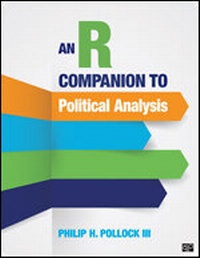
An R Companion to Political Analysis
1st Edition
Published on 21. January 2014
Book
Paperback/Softback
224 pages
978-1-4522-8731-7 (ISBN)
Description
This volume walks students through the use of R, an open source programming language and software environment for statistical computing and graphics. It features clear explanation, instruction and guidance; with plenty of annotated and labelled screenshots and a wealth of exercises and datasets so students can put their new R skills right to use.
More details
Language
English
Place of publication
Washington
United States
Publishing group
SAGE Publications Inc
Target group
College/higher education
Dimensions
Height: 279 mm
Width: 216 mm
Weight
535 gr
ISBN-13
978-1-4522-8731-7 (9781452287317)
Copyright in bibliographic data and cover images is held by Nielsen Book Services Limited or by the publishers or by their respective licensors: all rights reserved.
Schweitzer Classification
Other editions
New editions
Philip H. Pollock | Barry Clayton Edwards
An R Companion to Political Analysis
Book
06/2017
2nd Edition
CQ Press
€79.41
Article is exhausted; no reprint
Person
Philip H. Pollock III is a professor of political science at the University of Central Florida. He has taught courses in research methods at the undergraduate and graduate levels for more than thirty years. His main research interests are American public opinion, voting behavior, techniques of quantitative analysis, and the scholarship of teaching and learning. His recent research has been on the effectiveness of Internet-based instruction. Pollock's research has appeared in the American Journal of Political Science, Social Science Quarterly, and the British Journal of Political Science. Recent scholarly publications include articles in Political Research Quarterly, the Journal of Political Science Education, and PS: Political Science and Politics.
Content
1. Getting Started
2. Descriptive Statistics
3. Transforming Variables
4. Making Comparisons
5. Making Controlled Comparisons
6. Making Inferences about Sample Means
7. Chi-square and Measures of Association
8. Correlation and Linear Regression
9. Dummy Variables and Interaction Effects
10. Logistic Regression
11. Doing Your Own Political Analysis
2. Descriptive Statistics
3. Transforming Variables
4. Making Comparisons
5. Making Controlled Comparisons
6. Making Inferences about Sample Means
7. Chi-square and Measures of Association
8. Correlation and Linear Regression
9. Dummy Variables and Interaction Effects
10. Logistic Regression
11. Doing Your Own Political Analysis