

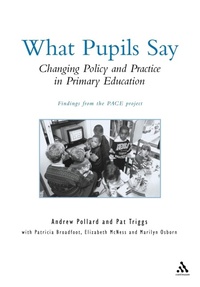
What Pupils Say
Changing Policy and Practice in Primary Education
Published on 1. January 2001
Book
Paperback/Softback
364 pages
978-0-8264-5062-3 (ISBN)
Description
The result of a research project, this work, an attempt to report on what has actually been happening in our schools, answers such questions as: what difference have education reforms made to pupils' experience in schools? and how has recent education policy impacted on children today?
Reviews / Votes
"This book is immensely important: it is engagingly written, clearly and helpfully structured, and compelling in both its detail and its broader intellectual canvas...an utterly devastating critique of contemporary approaches to educational reform" --Journal of Educational Change, 2003More details
Language
English
Place of publication
London
United Kingdom
Publishing group
Bloomsbury Publishing PLC
Target group
Professional and scholarly
College/higher education
Dimensions
Height: 244 mm
Width: 170 mm
Thickness: 20 mm
Weight
628 gr
ISBN-13
978-0-8264-5062-3 (9780826450623)
Copyright in bibliographic data and cover images is held by Nielsen Book Services Limited or by the publishers or by their respective licensors: all rights reserved.
Schweitzer Classification
Other editions
Additional editions
E-Book
01/2001
1st Edition
Continuum International Publishing Group Ltd.
€122.99
Available for download
Persons
Andrew Pollard is Professor of Education Policy and Practice and supports educational research at the IOE, UCL's Faculty of Education and Society, University College London, UK. He was Director of the UK-wide Teaching and Learning Research Programme (TLRP). Pat Triggs is Research Associate at the University of Bristol, UK.
Content
Part 1: introduction and research methods; overview of issues; research design and methodology. Part 2: changing contexts; childhood in England in the 1990s; educational changes in the 1990s. Part 3: pupil experience; curriculum; teacher-pupil relationships; learning; assessment. Part 4: conclusion.