

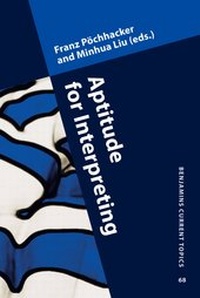
Aptitude for Interpreting
Published on 24. October 2014
Book
Hardback
183 pages
978-90-272-4256-3 (ISBN)
Description
First published as a Special Issue of Interpreting (issue 10:1, 2011) and complemented with two articles published in Interpreting issue 16:1, 2014, this volume provides a comprehensive view of the challenge of identifying and measuring aptitude for interpreting. Following a broad review of the existing literature, the array of eight empirical papers captures the multiple dimensions of aptitude, from personality traits and soft skills such as motivation, anxiety and learning styles to aspects of cognitive performance. The populations studied, with experimental as well as survey research designs, include students and professionals of sign language interpreting as well as spoken-language interpreting, and valuable synergies emerge. While pointing to the need for much further work, the papers brought together in this volume clearly represent the cutting edge of research into aptitude for interpreting, and should prove a milestone on the way toward supplying educators with reliable methods for testing applicants to interpreter training programs.
More details
Series
Language
English
Place of publication
Amsterdam
Netherlands
Target group
Professional and scholarly
Illustrations
+ index
Weight
495 gr
ISBN-13
978-90-272-4256-3 (9789027242563)
Copyright in bibliographic data and cover images is held by Nielsen Book Services Limited or by the publishers or by their respective licensors: all rights reserved.
Schweitzer Classification
Other editions
Additional editions
Franz Pöchhacker | Minhua Liu
Aptitude for Interpreting
E-Book
10/2014
1st Edition
John Benjamins Publishing Company
€105.99
Available for download
Persons
Content
1. Introduction; 2. Aptitude for interpreting; 3. Articles; 4. Aptitude testing over the years (by Russo, Mariachiara); 5. Learning styles, motivation and cognitive flexibility in interpreter training: Self-selection and aptitude (by Timarova, Sarka); 6. A story of attitudes and aptitudes?: Investigating individual difference variables within the context of interpreting (by Rosiers, Alexandra); 7. Cognitive and motivational contributors to aptitude: A study of spoken and signed language interpreting students (by Shaw, Sherry); 8. Evaluating emotional stability as a predictor of interpreter competence and aptitude for interpreting (by Bontempo, Karen); 9. Domain-general cognitive abilities and simultaneous interpreting skill (by Macnamara, Brooke N.); 10. Testing aptitude for interpreting: The predictive value of oral paraphrasing, with synonyms and coherence as assessment parameters (by Russo, Mariachiara); 11. Assessing aptitude for interpreting: The SynCloze test (by Pochhacker, Franz); 12. Putting interpreting admissions exams to the test: The MA KD Germersheim Project (by Chabasse, Catherine); 13. About the authors; 14. Index