

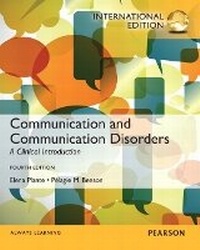
Communication and Communication Disorders
A Clinical Introduction: International Edition
4th Edition
Published on 14. September 2012
Book
Paperback/Softback
408 pages
978-0-13-292638-6 (ISBN)
Description
Featuring contributions from leading experts, Communication and Communication Disorders:A Clinical Introduction, 4e blends science, clinical applications, and introductory concepts to help readers develop a sound understanding of the field. Appropriate for both majors and non-majors, the text's consistent format and unifying organization address communication disorders involving articulation, fluency, voice and swallowing, language, and hearing. Focusing on communication disorders over the lifespan, the text balances speech-language pathology and audiology and includes separate chapters devoted to child and adult disorders. This edition includes a new chapter on pediatric audiology; expanded discussion of language acquisition; and more information on autism, ADHD, intellectual disabilities, and childhood aphasia. Case illustrations, figures, and photographs are used liberally to illustrate concepts and a capstone chapter highlights possible careers.
More details
Other editions
Previous edition
Elena M. Plante | Pelagie M. Beeson
Communication and Communication Disorders
A Clinical Introduction
Book
08/2007
3rd Edition
Pearson
€106.65
Article exhausted; check for reprint
Persons
Elena M. Plante, PhD, CCC-SLP
Elena Plante received her bachelor's and master's degrees in speech-language pathology at Loyola University in Maryland. Before completing her doctorate at the University of Arizona, she worked as a speech-language pathologist in the public schools. Since completing her doctorate and postdoctoral studies, she has been on the faculty in the Department of Speech, Language, and Hearing Sciences at the University of Arizona. Her research has focused on the biological basis of specific language impairment and she was one of the early adopters of magnetic resonance imaging as a research tool in speech-language pathology. Dr. Plante's current clinical research focuses on improving both assessment and treatment methods for those with developmental language disorder. She is a co-author of the Pediatric Test of Brain Injury, the first of its kind for children with traumatic brain injury. She has received support for her research from grants from the National Institutes of Health. Dr. Plante is a Fellow of the American Speech-Language-Hearing Association and the University of Arizona College of Science. She speaks regularly at national and international conferences on the topic of developmental language disorders.
Pelagie M. Beeson, PhD, CCC-SLP
Pelagie (Pagie) Maritz Beeson received her bachelor's and master's degrees in speech-language pathology from the University of Kansas. She began her clinical career at a community speech and language center in Fairbanks, Alaska, where she provided service to a diverse clinical population. She later completed her doctoral work at the University of Arizona, where she also served as the coordinator of the American Indian Professional Training Program in Speech-Language Pathology and Audiology. Currently, Dr. Beeson is Professor and Head of the Department of Speech, Language, and Hearing Sciences at the University of Arizona. Her research and clinical work have been devoted to neurogenic communication disorders in adults, with a particular emphasis on the nature and treatment of aphasia, alexia, and agraphia, as well as the cognitive mechanisms and neural substrates of written language. Dr. Beeson's research has been supported for many years by the National Institute on Deafness and Other Communication Disorders (NIH/NIDCD). She is board certified in Adult Neurogenic Communication Disorders by the Academy of Neurologic Communication Disorders and Sciences. Dr. Beeson is a Fellow of the American Speech-Language-Hearing Association and previously served as coordinator of the ASHA Special Interest Division 2: Neurophysiology and Neurogenic Speech and Language Disorders. She frequently speaks at national and international conferences on the topic of acquired language impairments in adults.
Elena Plante received her bachelor's and master's degrees in speech-language pathology at Loyola University in Maryland. Before completing her doctorate at the University of Arizona, she worked as a speech-language pathologist in the public schools. Since completing her doctorate and postdoctoral studies, she has been on the faculty in the Department of Speech, Language, and Hearing Sciences at the University of Arizona. Her research has focused on the biological basis of specific language impairment and she was one of the early adopters of magnetic resonance imaging as a research tool in speech-language pathology. Dr. Plante's current clinical research focuses on improving both assessment and treatment methods for those with developmental language disorder. She is a co-author of the Pediatric Test of Brain Injury, the first of its kind for children with traumatic brain injury. She has received support for her research from grants from the National Institutes of Health. Dr. Plante is a Fellow of the American Speech-Language-Hearing Association and the University of Arizona College of Science. She speaks regularly at national and international conferences on the topic of developmental language disorders.
Pelagie M. Beeson, PhD, CCC-SLP
Pelagie (Pagie) Maritz Beeson received her bachelor's and master's degrees in speech-language pathology from the University of Kansas. She began her clinical career at a community speech and language center in Fairbanks, Alaska, where she provided service to a diverse clinical population. She later completed her doctoral work at the University of Arizona, where she also served as the coordinator of the American Indian Professional Training Program in Speech-Language Pathology and Audiology. Currently, Dr. Beeson is Professor and Head of the Department of Speech, Language, and Hearing Sciences at the University of Arizona. Her research and clinical work have been devoted to neurogenic communication disorders in adults, with a particular emphasis on the nature and treatment of aphasia, alexia, and agraphia, as well as the cognitive mechanisms and neural substrates of written language. Dr. Beeson's research has been supported for many years by the National Institute on Deafness and Other Communication Disorders (NIH/NIDCD). She is board certified in Adult Neurogenic Communication Disorders by the Academy of Neurologic Communication Disorders and Sciences. Dr. Beeson is a Fellow of the American Speech-Language-Hearing Association and previously served as coordinator of the ASHA Special Interest Division 2: Neurophysiology and Neurogenic Speech and Language Disorders. She frequently speaks at national and international conferences on the topic of acquired language impairments in adults.
Content
Table of Contents
1. Introduction to the Professions of Audiology and Speech-Language Pathology
2. The Biological Foundations of Speech and Language
3. Sounds in Communication
4. Disorders of Speech Sound Production
5. Disorders of Fluency
6. Disorders of Voice and Swallowing
7. Language
8. Disorders of Language in Children
9. Disorders of Language in Adults
10. The Biological Foundation of Hearing
11. Disorders of Hearing in Children
12. Disorders of Hearing in Adults
13. Professional Issues
1. Introduction to the Professions of Audiology and Speech-Language Pathology
2. The Biological Foundations of Speech and Language
3. Sounds in Communication
4. Disorders of Speech Sound Production
5. Disorders of Fluency
6. Disorders of Voice and Swallowing
7. Language
8. Disorders of Language in Children
9. Disorders of Language in Adults
10. The Biological Foundation of Hearing
11. Disorders of Hearing in Children
12. Disorders of Hearing in Adults
13. Professional Issues