

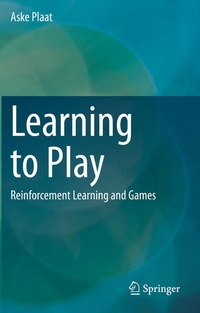
Learning to Play
Reinforcement Learning and Games
Published on 22. November 2021
Book
Paperback/Softback
XIII, 330 pages
978-3-030-59240-0 (ISBN)
Description
In this textbook the author takes as inspiration recent breakthroughs in game playing to explain how and why deep reinforcement learning works. In particular he shows why two-person games of tactics and strategy fascinate scientists, programmers, and game enthusiasts and unite them in a common goal: to create artificial intelligence (AI).
After an introduction to the core concepts, environment, and communities of intelligence and games, the book is organized into chapters on reinforcement learning, heuristic planning, adaptive sampling, function approximation, and self-play. The author takes a hands-on approach throughout, with Python code examples and exercises that help the reader understand how AI learns to play. He also supports the main text with detailed pointers to online machine learning frameworks, technical details for AlphaGo, notes on how to play and program Go and chess, and a comprehensive bibliography.
The content is class-tested and suitable for advanced undergraduate and graduate courses on artificial intelligence and games. It's also appropriate for self-study by professionals engaged with applications of machine learning and with games development. Finally it's valuable for any reader engaged with the philosophical implications of artificial and general intelligence, games represent a modern Turing test of the power and limitations of AI.
After an introduction to the core concepts, environment, and communities of intelligence and games, the book is organized into chapters on reinforcement learning, heuristic planning, adaptive sampling, function approximation, and self-play. The author takes a hands-on approach throughout, with Python code examples and exercises that help the reader understand how AI learns to play. He also supports the main text with detailed pointers to online machine learning frameworks, technical details for AlphaGo, notes on how to play and program Go and chess, and a comprehensive bibliography.
The content is class-tested and suitable for advanced undergraduate and graduate courses on artificial intelligence and games. It's also appropriate for self-study by professionals engaged with applications of machine learning and with games development. Finally it's valuable for any reader engaged with the philosophical implications of artificial and general intelligence, games represent a modern Turing test of the power and limitations of AI.
More details
Edition
2020 ed.
Language
English
Place of publication
Cham
Switzerland
Publishing group
Springer International Publishing
Illustrations
72 farbige Abbildungen, 39 s/w Abbildungen
XIII, 330 p. 111 illus., 72 illus. in color.
Dimensions
Height: 235 mm
Width: 155 mm
Thickness: 19 mm
Weight
522 gr
ISBN-13
978-3-030-59240-0 (9783030592400)
DOI
10.1007/978-3-030-59238-7
Schweitzer Classification
Other editions
Additional editions
Book
11/2020
Springer
€74.89
Shipment within 7-9 days
Person
Prof.
Aske Plaat
is Professor of Data Science at Leiden University and scientific director of the Leiden Institute of Advanced Computer Science (LIACS). He is co-founder of the Leiden Centre of Data Science (LCDR) and initiated the SAILS stimulation program. His research interests include reinforcement learning, scalable combinatorial reasoning algorithms, games and self-learning systems.
Content
Introduction.- Intelligence and Games.- Reinforcement Learning.- Heuristic Planning.- Adaptive Sampling.- Function Approximation.- Self-Play.- Conclusion.- App. A, Deep Reinforcement Learning Environments.- App. B, Running Python.- App. C, Tutorial for the Game of Go.- App. D, AlphaGo Technical Details.- References.- List of Figures.- List of Tables.- List of Algorithms.- Index.