

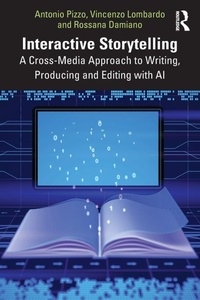
Interactive Storytelling
A Cross-Media Approach to Writing, Producing and Editing with AI
1st Edition
Published on 21. September 2023
Book
Paperback/Softback
178 pages
978-1-032-37164-1 (ISBN)
Description
Taking a cross-media approach to the ever-changing field of digital storytelling, this book offers an essential introduction to producing and editing interactive storytelling content, and to the platforms that host it.
Merging algorithmic and AI approaches with basic writing technique, the authors begin by providing a brief history of the field before moving on to practical step-by-step guides on techniques, models and software architectures. Examples and exercises are drawn from free-to-access, purpose-built software created by the authors as well as exemplary interactive storytelling work. Assuming the perspective of the storyteller and focusing on elements shared across different fields of professional communication, the book is designed to be a primer for digital communicators, irrespective of the medium they are working with. As such, the methods provided will be applicable across the spectrum of TV, film, videogames, web and mobile storytelling.
Interactive Storytelling is recommended reading for professionals as well as advanced undergraduate and postgraduate students of interactive entertainment, multimedia design and production, and digital journalism.
Merging algorithmic and AI approaches with basic writing technique, the authors begin by providing a brief history of the field before moving on to practical step-by-step guides on techniques, models and software architectures. Examples and exercises are drawn from free-to-access, purpose-built software created by the authors as well as exemplary interactive storytelling work. Assuming the perspective of the storyteller and focusing on elements shared across different fields of professional communication, the book is designed to be a primer for digital communicators, irrespective of the medium they are working with. As such, the methods provided will be applicable across the spectrum of TV, film, videogames, web and mobile storytelling.
Interactive Storytelling is recommended reading for professionals as well as advanced undergraduate and postgraduate students of interactive entertainment, multimedia design and production, and digital journalism.
More details
Language
English
Place of publication
London
United Kingdom
Publishing group
Taylor & Francis Ltd
Target group
College/higher education
Postgraduate and Undergraduate Advanced
Illustrations
25 s/w Abbildungen, 25 s/w Photographien bzw. Rasterbilder, 3 s/w Tabellen
3 Tables, black and white; 25 Halftones, black and white; 25 Illustrations, black and white
Dimensions
Height: 234 mm
Width: 156 mm
Thickness: 11 mm
Weight
307 gr
ISBN-13
978-1-032-37164-1 (9781032371641)
Copyright in bibliographic data and cover images is held by Nielsen Book Services Limited or by the publishers or by their respective licensors: all rights reserved.
Schweitzer Classification
Other editions
Additional editions
Antonio Pizzo | Vincenzo Lombardo | Rossana Damiano
Interactive Storytelling
A Cross-Media Approach to Writing, Producing and Editing with AI
E-Book
09/2023
1st Edition
Routledge
€47.49
Available for download
Antonio Pizzo | Vincenzo Lombardo | Rossana Damiano
Interactive Storytelling
A Cross-Media Approach to Writing, Producing and Editing with AI
E-Book
09/2023
1st Edition
Routledge
€47.49
Available for download
Antonio Pizzo | Vincenzo Lombardo | Rossana Damiano
Interactive Storytelling
A Cross-Media Approach to Writing, Producing and Editing with AI
Book
09/2023
1st Edition
Routledge
€206.10
Shipment within 10-20 days
Persons
Antonio Pizzo is Associate Professor of Theatre and Multimedia at the University of Turin, Italy.
Vincenzo Lombardo is Full Professor of Informatics at the University of Turin, Italy.
Rossana Damiano is Associate Professor of Computer Science at the University of Turin, Italy.
Vincenzo Lombardo is Full Professor of Informatics at the University of Turin, Italy.
Rossana Damiano is Associate Professor of Computer Science at the University of Turin, Italy.
Content
Contents
Acknowledgments
Preface
Where to start?
How this volume is organized
Chapter 1: Introduction
1.1 Preliminary definitions
1.1.1 The fascination for interactivity
1.1.2 Digital, virtual, interactive
1.1.3 Interacting, participating, collaborating
1.2 Telling stories through actions
1.2.1 Dramatic media
1.2.2 Actions and events
1.2.3 Dramatic action
1.2.4 Narrative action
1.2.5 Sequence of actions
1.2.6 Generating events
1.3 Last general issues
1.3.1 Author, authorship, control
1.3.2 Characters or stories
1.3.3 The field of investigation
1.3.4 Database, narrative and video contents
1.3.5 Delimiting the field
1.4 A general model of analysis
Chapter 2 - Dynamic Elements: the Units
2.1. What are the units
2.2 The logical relationship between the units
2.3 Organising the Multilinear Project
2.4. What separates the units
2.5. Tagging the units: metadata
2.6 Exercises
2.6.1 The flow chart of dynamic elements
2.6.2 The user actions
Chapter 3 - Dynamic elements: the Agents
3.1 Agents and audience
3.2 Intelligent agents
3.2.1 Planning as improvisation
3.2.2 Planning as directing
3.2.3 Scripting as planning
3.3 Emotions and agents
3.3.1 The (mental) reality of emotions
3.3.2 The social component of emotions
3.3.3 Emotions as a behavioural drive
3.4 Exercises
3.4.1 Describing the state of the world
3.4.2 Writing the actions
3.4.3 Writing Preconditions and Effects
3.4.4 Simulating the execution
3.4.5 Starting from the goal state
3.4.6 Reusing the plan
Chapter 4 - Display: audience, system, emotions
4.1 Participation
4.1.1 Narratology vs Ludology
4.1.2. Interaction vs Narration
4.1.3. Balancing the agency
4.1.4. Intensity of process
4.1.5. User's action
4.1.6. Intelligible actions
4.2 Writing the interaction through the units
4.2.1. Interaction by navigating the map
4.2.2. Interaction by dialogues and behaviours
4.2.3. Interaction by physical actions
4.3 Emotions in computational systems
4.3.1 Coding characters' emotions
4.3.2 The emotions of the audience
4.4. Cross media contents' communication
4.5 Exercises
Chapter 5 - Engines and systems: supporting creativity and dramatic tension
5.1 Systems and automation
5.2 System classification
5.3 Fully manual authorship
5.4 Manually authored database and automation for plot generation
5.4.1 Plot grammars
5.4.2 Constraints on plot generation
5.4.3 Planning for plot generation
5.4.4 Plot generation based on dramatic tension
5.5 Database and automation
5.6 Emergent narratives: joint automation of plot and database
5.6.1 Constraints on the plot and modifications of database elements
5.6.2 Plot and database modelled with constraints
5.6.3 Full plot automation and database simulation
5.7 General Considerations on Storytelling Systems
5.8 Exercises
5.8.1 The form to the story, or the application of a template
5.8.2 The constrained plot generation: preconditions and effects annotation
5.8.3 The dramatic tension of the story
Chapter 6. Examples to know
6.1. 1966: Eliza
6.2. 1976: Adventure
6.3. 1978: Aspen Movie Map
6.4. 1987: Afternoon a story
6.5. 1987: City in transition: New Orleans 1983-86
6.6 1911: Angels
6.7 1993: Myst
6.8 1996: Pokemon
6.9 1999. Desert rain
6.10 2001:Can you see me now?
6.11 2003: Facade
6.12 2005: FearNot!
6.13 2006: DramaTour
6.14 2012: The Walking Dead
6.15 2013: Nothing for Dinner
6.16 2018:. Black mirror Bandersnatch
61.7 2029: The Invisible Guardian
6.18 2020: Down the Rabbit Hole
Index
.
Acknowledgments
Preface
Where to start?
How this volume is organized
Chapter 1: Introduction
1.1 Preliminary definitions
1.1.1 The fascination for interactivity
1.1.2 Digital, virtual, interactive
1.1.3 Interacting, participating, collaborating
1.2 Telling stories through actions
1.2.1 Dramatic media
1.2.2 Actions and events
1.2.3 Dramatic action
1.2.4 Narrative action
1.2.5 Sequence of actions
1.2.6 Generating events
1.3 Last general issues
1.3.1 Author, authorship, control
1.3.2 Characters or stories
1.3.3 The field of investigation
1.3.4 Database, narrative and video contents
1.3.5 Delimiting the field
1.4 A general model of analysis
Chapter 2 - Dynamic Elements: the Units
2.1. What are the units
2.2 The logical relationship between the units
2.3 Organising the Multilinear Project
2.4. What separates the units
2.5. Tagging the units: metadata
2.6 Exercises
2.6.1 The flow chart of dynamic elements
2.6.2 The user actions
Chapter 3 - Dynamic elements: the Agents
3.1 Agents and audience
3.2 Intelligent agents
3.2.1 Planning as improvisation
3.2.2 Planning as directing
3.2.3 Scripting as planning
3.3 Emotions and agents
3.3.1 The (mental) reality of emotions
3.3.2 The social component of emotions
3.3.3 Emotions as a behavioural drive
3.4 Exercises
3.4.1 Describing the state of the world
3.4.2 Writing the actions
3.4.3 Writing Preconditions and Effects
3.4.4 Simulating the execution
3.4.5 Starting from the goal state
3.4.6 Reusing the plan
Chapter 4 - Display: audience, system, emotions
4.1 Participation
4.1.1 Narratology vs Ludology
4.1.2. Interaction vs Narration
4.1.3. Balancing the agency
4.1.4. Intensity of process
4.1.5. User's action
4.1.6. Intelligible actions
4.2 Writing the interaction through the units
4.2.1. Interaction by navigating the map
4.2.2. Interaction by dialogues and behaviours
4.2.3. Interaction by physical actions
4.3 Emotions in computational systems
4.3.1 Coding characters' emotions
4.3.2 The emotions of the audience
4.4. Cross media contents' communication
4.5 Exercises
Chapter 5 - Engines and systems: supporting creativity and dramatic tension
5.1 Systems and automation
5.2 System classification
5.3 Fully manual authorship
5.4 Manually authored database and automation for plot generation
5.4.1 Plot grammars
5.4.2 Constraints on plot generation
5.4.3 Planning for plot generation
5.4.4 Plot generation based on dramatic tension
5.5 Database and automation
5.6 Emergent narratives: joint automation of plot and database
5.6.1 Constraints on the plot and modifications of database elements
5.6.2 Plot and database modelled with constraints
5.6.3 Full plot automation and database simulation
5.7 General Considerations on Storytelling Systems
5.8 Exercises
5.8.1 The form to the story, or the application of a template
5.8.2 The constrained plot generation: preconditions and effects annotation
5.8.3 The dramatic tension of the story
Chapter 6. Examples to know
6.1. 1966: Eliza
6.2. 1976: Adventure
6.3. 1978: Aspen Movie Map
6.4. 1987: Afternoon a story
6.5. 1987: City in transition: New Orleans 1983-86
6.6 1911: Angels
6.7 1993: Myst
6.8 1996: Pokemon
6.9 1999. Desert rain
6.10 2001:Can you see me now?
6.11 2003: Facade
6.12 2005: FearNot!
6.13 2006: DramaTour
6.14 2012: The Walking Dead
6.15 2013: Nothing for Dinner
6.16 2018:. Black mirror Bandersnatch
61.7 2029: The Invisible Guardian
6.18 2020: Down the Rabbit Hole
Index
.