

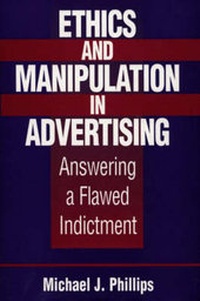
Ethics and Manipulation in Advertising
Answering a Flawed Indictment
Published on 25. June 1997
Book
Hardback
224 pages
978-1-56720-063-8 (ISBN)
Description
For more than 50 years the critics of advertising have argued that advertising is bad because it manipulates, and that it must be reined in by political controls. Not so, argues Michael Phillips. If advertising really were as successful in manipulating consumers as its critics claim, it almost certainly would be unethical and probably should be controlled-but it's not that effective. A growing body of empirical evidence now affirms that the enemies of advertising vastly overrate its power. Thus, the ethical case against manipulative advertising collapses, and with it goes much-if not all-of a statist political agenda that in Phillips's opinion is the real inspiration for the indictment. A closely reasoned, highly informative, provocative search for an understanding of advertising's efficacy and its morality, intended for professionals, academics, and informed readers alike.
The argument that political controls are needed because advertising manipulates consumers is, for Phillips, a critique with a tacit assumption: that such manipulation is bad. Phillips considers that assumption from the perspective of a business ethicist, applying four ethical frameworks: utilitarianism, Kantian ethics, autonomy, and virtue ethics. If it works as the critics say, manipulative advertising probably is unethical under most or all of these criteria. But does it really manipulate? Does it stimulate the propensity to consume and dictate the brand and product choices consumers make? Basing his conclusion on considerable empirical research, Phillips argues that advertising is not an especially strong force in these respects. For that reason, most of the ethical arguments against it break down. This means, he says, that if capitalism's critics want to tout some new and better social order, they cannot use advertising's manipulativeness as an aid in doing so. On the other hand, nothing in the book necessarily blocks piecemeal attempts to regulate manipulative ads that do work and do cause some harm.
The argument that political controls are needed because advertising manipulates consumers is, for Phillips, a critique with a tacit assumption: that such manipulation is bad. Phillips considers that assumption from the perspective of a business ethicist, applying four ethical frameworks: utilitarianism, Kantian ethics, autonomy, and virtue ethics. If it works as the critics say, manipulative advertising probably is unethical under most or all of these criteria. But does it really manipulate? Does it stimulate the propensity to consume and dictate the brand and product choices consumers make? Basing his conclusion on considerable empirical research, Phillips argues that advertising is not an especially strong force in these respects. For that reason, most of the ethical arguments against it break down. This means, he says, that if capitalism's critics want to tout some new and better social order, they cannot use advertising's manipulativeness as an aid in doing so. On the other hand, nothing in the book necessarily blocks piecemeal attempts to regulate manipulative ads that do work and do cause some harm.
More details
Language
English
Place of publication
United States
Publishing group
Bloomsbury Publishing Plc
Target group
College/higher education
Professional and scholarly
Interest Age: From 7 to 17 years
Dimensions
Height: 235 mm
Width: 156 mm
Weight
454 gr
ISBN-13
978-1-56720-063-8 (9781567200638)
Copyright in bibliographic data and cover images is held by Nielsen Book Services Limited or by the publishers or by their respective licensors: all rights reserved.
Schweitzer Classification
Person
MICHAEL J. PHILLIPS is Professor of Business Law at Indiana University's School of Business. He holds a J.D. degree from Columbia University, and LL.M. and S.J.D. degrees from George Washington University. A former editor-in-chief of the American Business Law Journal, he has authored more than 40 scholarly articles and coauthored two business law texts. He is also author of The Dilemmas of Individualism: Status, Liberty, and American Constitutional Law (Greenwood, 1983).
Content
Introduction
The Indictment of Manipulative Advertising
Utilitarian Arguments
Three Other Ethical Criticisms
Manipulative Advertising and Consumer Choice
Advertising and the Propensity to Consume
The Failure of the Critics' Vision
Bibliography
The Indictment of Manipulative Advertising
Utilitarian Arguments
Three Other Ethical Criticisms
Manipulative Advertising and Consumer Choice
Advertising and the Propensity to Consume
The Failure of the Critics' Vision
Bibliography