

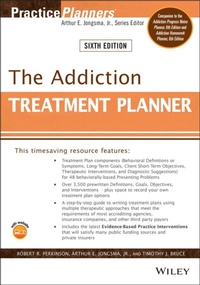
The Addiction Treatment Planner
Published on 22. June 2022
Book
Paperback/Softback
672 pages
978-1-119-70785-1 (ISBN)
Description
Clarify, simplify, and accelerate the treatment planning process so you can spend more time with clients
The Addiction Treatment Planner, Sixth Edition: provides all the elements necessary to quickly and easily develop formal treatment plans that satisfy the demands of HMOs, managed care companies, third-party payers, and state and federal agencies. This valuable resource contains treatment plan components for 48 behaviorally based presenting problems including depression, intimate relationship conflicts, chronic pain, anxiety, substance use, borderline personality, and more. You'll save hours by speeding up the completion of time-consuming paperwork, without sacrificing your freedom to develop customized treatment plans for clients.
This updated edition includes new and revised evidence-based objectives and interventions, new online resources, expanded references, an expanded list of client workbooks and self-help titles, and the latest information on assessment instruments. In addition, you'll find new chapters on some of today's most challenging issues- Opiod Use Disorder, Panic/Agoraphobia, Loneliness, and Vocational Stress. New suggested homework exercises will help you encourage your clients to bridge their therapeutic work to home.
Quickly and easily develop treatment plans that satisfy third-party requirements.
Access extensive references for treatment techniques, client workbooks and more.
Offer effective and evidence-based homework exercises to clients with any of 48 behaviorally based presenting problems.
Enjoy time-saving treatment goals, objectives and interventions- pluse space to record your own customized treatment plan.
This book's easy-to-use reference format helps locate treatment plan components by presenting behavioral problem or DSM-5 diagnosis. Inside, you'll also find a sample treatment plan that conforms to the requirements of most third-party payors and accrediting agencies including CARF, The Joint Commission (TJC), COA, and the NCQA. The Additction Treatment Planner, Sixth Edition: will liberate you to focus on what's really important in your clinical work.
The Addiction Treatment Planner, Sixth Edition: provides all the elements necessary to quickly and easily develop formal treatment plans that satisfy the demands of HMOs, managed care companies, third-party payers, and state and federal agencies. This valuable resource contains treatment plan components for 48 behaviorally based presenting problems including depression, intimate relationship conflicts, chronic pain, anxiety, substance use, borderline personality, and more. You'll save hours by speeding up the completion of time-consuming paperwork, without sacrificing your freedom to develop customized treatment plans for clients.
This updated edition includes new and revised evidence-based objectives and interventions, new online resources, expanded references, an expanded list of client workbooks and self-help titles, and the latest information on assessment instruments. In addition, you'll find new chapters on some of today's most challenging issues- Opiod Use Disorder, Panic/Agoraphobia, Loneliness, and Vocational Stress. New suggested homework exercises will help you encourage your clients to bridge their therapeutic work to home.
Quickly and easily develop treatment plans that satisfy third-party requirements.
Access extensive references for treatment techniques, client workbooks and more.
Offer effective and evidence-based homework exercises to clients with any of 48 behaviorally based presenting problems.
Enjoy time-saving treatment goals, objectives and interventions- pluse space to record your own customized treatment plan.
This book's easy-to-use reference format helps locate treatment plan components by presenting behavioral problem or DSM-5 diagnosis. Inside, you'll also find a sample treatment plan that conforms to the requirements of most third-party payors and accrediting agencies including CARF, The Joint Commission (TJC), COA, and the NCQA. The Additction Treatment Planner, Sixth Edition: will liberate you to focus on what's really important in your clinical work.
More details
Series
Edition
6th Edition
Language
English
Place of publication
New York
United States
Target group
Professional and scholarly
Dimensions
Height: 253 mm
Width: 179 mm
Thickness: 31 mm
Weight
1098 gr
ISBN-13
978-1-119-70785-1 (9781119707851)
Copyright in bibliographic data and cover images is held by Nielsen Book Services Limited or by the publishers or by their respective licensors: all rights reserved.
Schweitzer Classification
Other editions
Additional editions
Robert R. Perkinson | Arthur E. Jongsma | Timothy J. Bruce
The Addiction Treatment Planner
E-Book
03/2022
6th Edition
Polity Press
€47.99
Available for download
Robert R. Perkinson | Arthur E. Jongsma | Timothy J. Bruce
The Addiction Treatment Planner
E-Book
03/2022
6th Edition
Wiley
€47.99
Available for download
Previous edition
Robert R. Perkinson | David J. Berghuis | Timothy J. Bruce
The Addiction Treatment Planner
Includes DSM-5 Updates
Book
03/2014
5th Edition
Wiley
€85.00
Article exhausted; check for reprint
Persons
ROBERT E. PERKINSON, PhD, is Clinical Director of the Keystone Treatment Center in South Dakota and author of several books including Treating Alcoholism: Helping Your Clients Find the Road to Recovery (Wiley).
ARTHUR E. JONGSMA, Jr., PhD, is Series Editor for the bestselling PracticePlanners. He has provided professional mental health services to both inpatient and outpatient clients for approximately 50 years. He was the Founder and Director of Psychological Consultants, a group private practice in Michigan for 25 years.
TIMOTHY J. BRUCE, PhD, is Professor and Associate Chair of the Department of Psychiatry and Behavioral Medicine at the University of Illinois College of Medicine.
ARTHUR E. JONGSMA, Jr., PhD, is Series Editor for the bestselling PracticePlanners. He has provided professional mental health services to both inpatient and outpatient clients for approximately 50 years. He was the Founder and Director of Psychological Consultants, a group private practice in Michigan for 25 years.
TIMOTHY J. BRUCE, PhD, is Professor and Associate Chair of the Department of Psychiatry and Behavioral Medicine at the University of Illinois College of Medicine.
Content
Contents Listed by ASAM Assessment Dimensions
PracticePlanners (R) Series Preface
Introduction
Sample Treatment Plan
Adult-Child-of-an-Alcoholic (ACA) Traits (Dimension 3)
Anger (Dimension 3)
Antisocial Behavior (Dimension 3)
Anxiety (Dimension 3)
Attention-Deficit/Hyperactivity Disorder (ADHD) - Adolescent (Dimension 3)
Attention-Deficit/Hyperactivity Disorder (ADHD) - Adult (Dimension 3)
Bipolar Disorder (Dimension 3)
Borderline Traits (Dimension 3)
Childhood Trauma (Dimension 3)
Chronic Pain (Dimension 2)
Conduct Disorder/Delinquency (Dimension 3)
Dangerousness/Lethality (Dimension 3)
Dependent Traits (Dimension 3)
Depression - Unipolar (Dimension 3)
Eating Disorders and Obesity (Dimension 3)
Family Conflicts (Dimension 3)
Gambling (Dimension 3)
Grief/Loss Unresolved (Dimension 3)
Impulsivity (Dimension 3)
Legal Problems (Dimension 3)
Living Environment Deficiency (Dimension 6)
Medical Issues (Dimension 2)
Narcissistic Traits (Dimension 3)
Nicotine Abuse/Dependence (Dimension 1)
Obsessive-Compulsive and Related Disorders (Dimension 3)
Occupational Problems (Dimension 6)
Opioid Use Disorder (Dimension 1 )
Oppositional Defiant Behavior (Dimension 3)
Panic Disorder/Agoraphobia (Dimension 3)
Parent-Child Relational Problem (Dimension 6)
Partner Relational Conflicts (Dimension 6)
Peer Group Negativity (Dimension 6)
Posttraumatic Stress Disorder (PTSD) (Dimension 3)
Psychosis (Dimension 3)
Readiness to Change (Dimension 4 )
Relapse Proneness (Dimension 5)
Self-Care Deficits - Primary (Dimension 3)
Self-Care Deficits - Secondary (Dimension 3)
Self-Harm (Dimension 3)
Sexual Abuse (Dimension 3)
Sexual Promiscuity (Dimension 3)
Sleep Disturbance (Dimension 3)
Social Anxiety (Dimension 3)
Spiritual Confusion (Dimension 3)
Substance-Induced Disorders (Dimension 1)
Substance Intoxication/Withdrawal (Dimension 1)
Substance Use Disorders (Dimension 1)
Suicidal Ideation (Dimension 3)
Appendix A: Bibliotherapy Suggestions
Appendix B: Clinical Resources for Evidence-Based Chapters
Appendix C: Client Satisfaction Surveys: Resource Material
Appendix D: ASAM Six Assessment Dimensions: A Checklist Example
Appendix E:
Appendix F:
Alphabetical Index of Sources for Assessment Instruments and Clinical Interview Forms Cited in Interventions
PracticePlanners (R) Series Preface
Introduction
Sample Treatment Plan
Adult-Child-of-an-Alcoholic (ACA) Traits (Dimension 3)
Anger (Dimension 3)
Antisocial Behavior (Dimension 3)
Anxiety (Dimension 3)
Attention-Deficit/Hyperactivity Disorder (ADHD) - Adolescent (Dimension 3)
Attention-Deficit/Hyperactivity Disorder (ADHD) - Adult (Dimension 3)
Bipolar Disorder (Dimension 3)
Borderline Traits (Dimension 3)
Childhood Trauma (Dimension 3)
Chronic Pain (Dimension 2)
Conduct Disorder/Delinquency (Dimension 3)
Dangerousness/Lethality (Dimension 3)
Dependent Traits (Dimension 3)
Depression - Unipolar (Dimension 3)
Eating Disorders and Obesity (Dimension 3)
Family Conflicts (Dimension 3)
Gambling (Dimension 3)
Grief/Loss Unresolved (Dimension 3)
Impulsivity (Dimension 3)
Legal Problems (Dimension 3)
Living Environment Deficiency (Dimension 6)
Medical Issues (Dimension 2)
Narcissistic Traits (Dimension 3)
Nicotine Abuse/Dependence (Dimension 1)
Obsessive-Compulsive and Related Disorders (Dimension 3)
Occupational Problems (Dimension 6)
Opioid Use Disorder (Dimension 1 )
Oppositional Defiant Behavior (Dimension 3)
Panic Disorder/Agoraphobia (Dimension 3)
Parent-Child Relational Problem (Dimension 6)
Partner Relational Conflicts (Dimension 6)
Peer Group Negativity (Dimension 6)
Posttraumatic Stress Disorder (PTSD) (Dimension 3)
Psychosis (Dimension 3)
Readiness to Change (Dimension 4 )
Relapse Proneness (Dimension 5)
Self-Care Deficits - Primary (Dimension 3)
Self-Care Deficits - Secondary (Dimension 3)
Self-Harm (Dimension 3)
Sexual Abuse (Dimension 3)
Sexual Promiscuity (Dimension 3)
Sleep Disturbance (Dimension 3)
Social Anxiety (Dimension 3)
Spiritual Confusion (Dimension 3)
Substance-Induced Disorders (Dimension 1)
Substance Intoxication/Withdrawal (Dimension 1)
Substance Use Disorders (Dimension 1)
Suicidal Ideation (Dimension 3)
Appendix A: Bibliotherapy Suggestions
Appendix B: Clinical Resources for Evidence-Based Chapters
Appendix C: Client Satisfaction Surveys: Resource Material
Appendix D: ASAM Six Assessment Dimensions: A Checklist Example
Appendix E:
Appendix F:
Alphabetical Index of Sources for Assessment Instruments and Clinical Interview Forms Cited in Interventions