

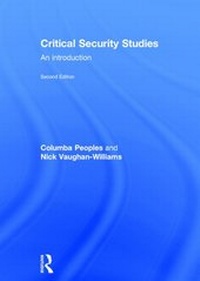
Critical Security Studies
An Introduction
2nd Edition
Published on 8. August 2014
Book
Hardback
226 pages
978-0-415-84183-2 (ISBN)
Description
Critical Security Studies introduces students to the sub-field through a detailed yet accessible survey of evolving approaches and key issues. This new edition contains two new chapters and has been fully revised and updated.
Written in an accessible and clear manner, Critical Security Studies:
offers a comprehensive and up-to-date introduction to critical security studies
locates critical security studies within the broader context of social and political theory
evaluates fundamental theoretical positions within critical security studies in application to key issues.
The book is divided into two main parts. The first part, 'Approaches', surveys the newly extended and contested theoretical terrain of critical security studies: Critical Theory, Feminism and gender theory, Postcolonialism, Poststructuralism and Securitization theory. The second part, 'Issues', then illustrates these various theoretical approaches against the backdrop of a diverse range of issues in contemporary security practices, from environmental, human and homeland security to border security, technology and warfare, and the War against Terrorism. This edition also includes new chapters on Constructivist theories (Part I) and health (Part II).
The historical and geographical scope of the book is deliberately broad and readers are introduced to a number of key illustrative case studies. Each of the chapters in Part II concretely illustrate one or more of the approaches discussed in Part I, with clear internal referencing allowing the text to act as a holistic learning tool for students.
This book is essential reading for upper-level students of Critical Security Studies, and an important resource for students of International/Global Security, Political Theory and International Relations.
Written in an accessible and clear manner, Critical Security Studies:
offers a comprehensive and up-to-date introduction to critical security studies
locates critical security studies within the broader context of social and political theory
evaluates fundamental theoretical positions within critical security studies in application to key issues.
The book is divided into two main parts. The first part, 'Approaches', surveys the newly extended and contested theoretical terrain of critical security studies: Critical Theory, Feminism and gender theory, Postcolonialism, Poststructuralism and Securitization theory. The second part, 'Issues', then illustrates these various theoretical approaches against the backdrop of a diverse range of issues in contemporary security practices, from environmental, human and homeland security to border security, technology and warfare, and the War against Terrorism. This edition also includes new chapters on Constructivist theories (Part I) and health (Part II).
The historical and geographical scope of the book is deliberately broad and readers are introduced to a number of key illustrative case studies. Each of the chapters in Part II concretely illustrate one or more of the approaches discussed in Part I, with clear internal referencing allowing the text to act as a holistic learning tool for students.
This book is essential reading for upper-level students of Critical Security Studies, and an important resource for students of International/Global Security, Political Theory and International Relations.
Reviews / Votes
'I use Critical Security Studies as a required reading for my courses in Paris and London - it is in my view the best introduction to the topic and this second edition is very welcome.' -- Didier Bigo, King's College London, UK'Combining breadth and accessibility with cutting-edge contributions, the second edition of this book provides an excellent overview of critical security studies today.' -- Michael C. Williams, University of Ottawa, Canada
'This second edition gives us a most welcome update of what remains a key introduction to critical security studies. It is great to see the most recent developments in this vibrant field of research included.' -- Jef Huysmans, Open University, UK
'In mapping the recent advances and debates in the vibrant field of critical security studies, this book will be crucially important to students and scholars alike. Critical Security Studies: An Introduction highlights a different topography of critical approaches to security, which is more complex, layered and messy than existing maps have allowed us to see. The book is thus more than an introduction to the field - it is an injunction to rethink the political-theoretical underpinnings in critical approaches and take the debates further.'-- Claudia Aradau, King's College London, UK
More details
Edition
2nd New edition
Language
English
Place of publication
London
United Kingdom
Publishing group
Taylor & Francis Ltd
Target group
College/higher education
Edition type
New edition
Illustrations
2 s/w Tabellen, 5 s/w Zeichnungen
6 Line drawings, black and white; 2 Tables, black and white
Dimensions
Height: 248 mm
Width: 174 mm
Weight
567 gr
ISBN-13
978-0-415-84183-2 (9780415841832)
Copyright in bibliographic data and cover images is held by Nielsen Book Services Limited or by the publishers or by their respective licensors: all rights reserved.
Schweitzer Classification
Other editions
New editions
Book
11/2020
3rd Edition
Routledge
€207.50
Shipment within 15-20 days
Additional editions
Book
07/2014
2nd Edition
Routledge
€74.55
Withdrawn from sale
Previous edition
Book
06/2010
Routledge
€148.80
Article exhausted; check for reprint
Persons
Columba Peoples is Senior Lecturer in International Relations in the School of Sociology, Politics and International Studies at the University of Bristol and author of Justifying Ballistic Missile Defence (2010).
Nick Vaughan-Williams is Reader in International Security in the Department of Politics and International Studies at the University of Warwick, and author of Border Politics: The Limits of Sovereign Power (2009).
Nick Vaughan-Williams is Reader in International Security in the Department of Politics and International Studies at the University of Warwick, and author of Border Politics: The Limits of Sovereign Power (2009).
Content
Introduction: Mapping Critical Security Studies, and Travelling Without Maps PART I: Approaches 1. Constructivist Theories 2. Critical Theory 3. Feminist and Gender approaches to Security 4. Postcolonial- perspectives 5. Poststructuralism and International Political Sociology 6. Securitization Theory PART II: Issues 7. Environmental Security 8. Health 9. Homeland Security and the 'War against Terrorism' 10. Human Security and Development 11. Migration and Border Security 12. Technology and Warfare in the Information Age